menu
search
Skip to main content

Chart in focus: Balancing risk and reward with hybrid capital 

•
3 min read
2027-11-09
Archived info
Archived pieces remain available on the site. Please consider the publish date while reading these older pieces.
1300495432
Noah Atlas, CFA, Fixed Income Portfolio Manager
1300495432

Key points

  • The investment landscape is becoming more challenging as equity valuations and bond yields have both risen.
  • This new landscape may create opportunities for investors who can understand and move across the capital structure — a skill that was less valuable when equity returns dominated.
  • Hybrid capital is a vast and fast-growing market that may offer opportunities for both equity-like returns and bond-like downside protection.

For the last two decades, equities benefited from a combination of capital-light business models, abundant free cash flow, and historically low interest rates. The current environment challenges each part of this equation. Business models have become more capital intense; moats of many formerly high-multiple companies are being challenged; and the scale of investment has pushed both nominal growth and real yields to levels not seen in nearly two decades.

Challenging return skew across equities and credit

The result is a more challenging investment landscape. Equity valuations are elevated, suggesting future returns may underwhelm relative to recent experience. Credit markets offer attractive absolute yields, but much of that income comes from higher Treasury rates rather than wide credit spreads, leaving limited room for error. For investors seeking attractive upside while maintaining some downside protection, equities and corporate bonds may not always provide the desired balance.

How hybrid capital can fill the gap

Positioned between debt and equity, properly structured hybrid securities can offer bond-like downside protection with equity-like upside potential. The global hybrid capital market is a vast and growing opportunity set that allows investors nuanced exposures to a wide array of companies and sectors. Because of their complex structures, hybrid securities can be priced inefficiently, offering potential returns from high-quality companies comparable to those of more efficiently priced securities of lower-quality issuers.

A large and expanding opportunity set

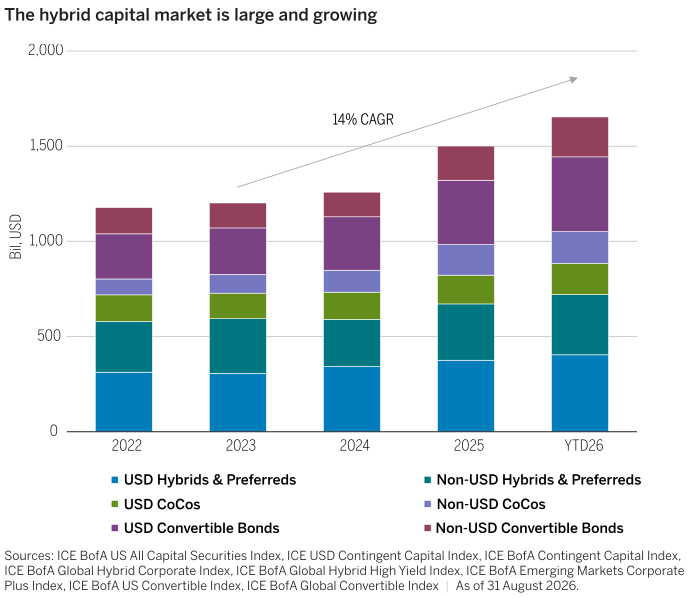
Companies are issuing public hybrid capital at a rate and scale not seen before. Substantial deals from leading companies have highlighted that deep, liquid capital pools exist for the types of flexible solutions once reserved only for private markets. At US$1.6 trillion+, the global hybrid capital market now exceeds the US high-yield market and is growing at 14% CAGR (Figure 1). With this growth, there are an increasing number of more complex and less understood securities in the market without natural buyers, creating inefficiencies and alpha opportunities for managers with expertise in capital structure relative value.

Figure 1

Chart-in-Focus-Hybrid-Fig1-v2

Structural complexity creates alpha potential

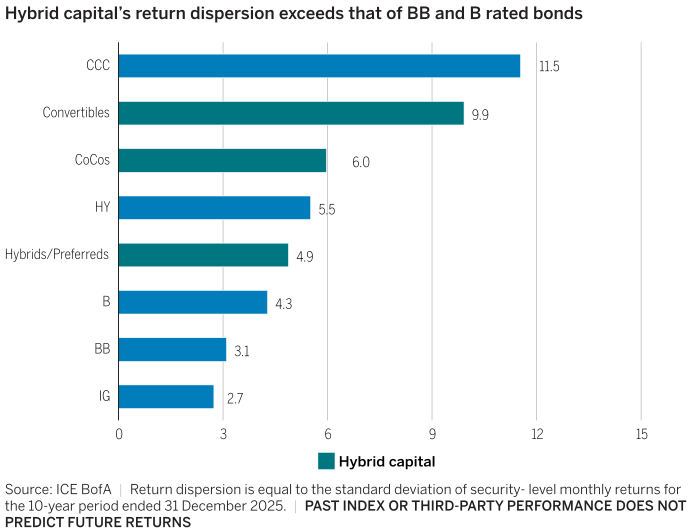
Hybrid capital is a vast and diverse opportunity set. The dispersion of returns within hybrid capital has historically exceeded that of all but the lowest- quality portion of the high- yield market (Figure 2). We believe this dispersion is a function of the complex structural features that don’t conform to traditional asset class buckets. Hybrid capital’s “misfit status” creates opportunities for investors who can understand the full capital structure, appreciate the differing return profiles that structural nuances create, and pick securities with the best asymmetry to their fundamental ideas.

Figure 2

Chart-in-Focus-Hybrid-Fig2-v2

Flattening of the efficient frontier

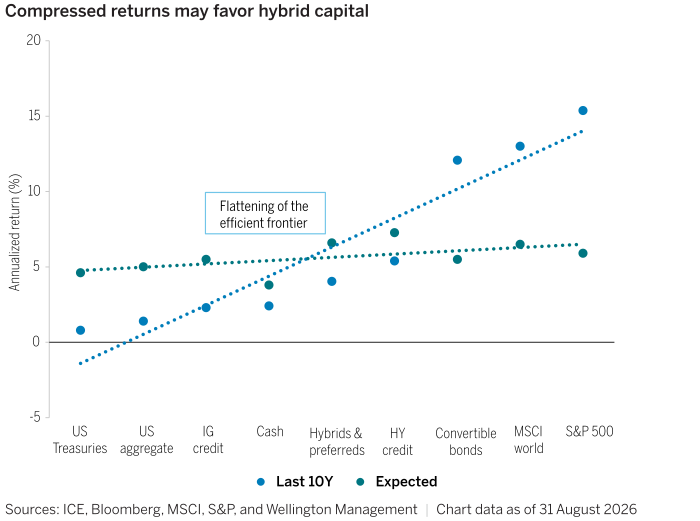
We believe that we are in a new returns paradigm that represents a dramatic shift. Given elevated equity valuations and higher yields across fixed income, we expect that future returns across asset classes will be more compressed — a “flattening” of the efficient frontier (Figure 3). In our view, this environment favors various forms of hybrid capital and the ability to move across capital structures — a skill that was less valuable when equity returns dominated.

Figure 3

Chart-in-Focus-Hybrid-Fig3

Investment implications

Given the challenging asymmetry across traditional stocks and corporate bonds, we believe that how investors take risk is paramount. Having a broad opportunity set with a focus on hybrid capital offers the potential for bond-like downside and equity-like upside. Investors can underwrite structural complexity, subordination, and equity sensitivity within a large, high-quality, liquid market. If traditional sources of return are less reliable going forward, we believe hybrid capital offers investors a way to pursue income and capital appreciation by investing differently.

The views expressed are those of the author at the time of writing. Other teams may hold different views and make different investment decisions. The value of your investment may become worth more or less than at the time of original investment. While any third-party data used is considered reliable, its accuracy is not guaranteed. For professional, institutional or accredited investors only.

Experts

Get our latest market insights straight to your inbox.

Read more from our experts