







- Equity Portfolio Manager
Skip to main content
- Funds
- Capabilities
- Insights
- About Us
Asset classes
Singapore, Individual
Changechevron_rightThe views expressed are those of the authors at the time of writing. Other teams may hold different views and make different investment decisions. The value of your investment may become worth more or less than at the time of original investment. While any third-party data used is considered reliable, its accuracy is not guaranteed.
In the third article in our series on the power of local perspective, we assess why today’s environment for European equities offers contrarian investors the potential to uncover the likely long-term winners currently being overlooked by a market focused on macro and political dynamics — an approach we think investors may find increasingly compelling as we steer through continued volatility and structural change.
Against a backdrop of ongoing economic and geopolitical uncertainty, European equity markets are likely to experience continued performance dispersion throughout 2025 and beyond, with macroeconomic and political headlines propelling further volatility. Will there be a peace deal in Ukraine? What will the impact of US tariffs be? Could a Chinese recovery stimulate export demand for Europe? How will the UK stave off the risk of a prolonged period of stagflation? These are a just some of the numerous macroeconomic and geopolitical questions that investors are currently grappling with.
In our view, the resulting market volatility obscures fundamental differences between regions, sectors and stocks and creates a fertile environment for contrarian stock pickers to seek out attractively valued investment opportunities in European equities.
Uncovering these opportunities requires a deep understanding of the impact broader trends may have on the individual companies and sectors in which they operate and, above all, a focus on accurately assessing the long-term health of companies’ balance sheets — including their associated long-run growth potential — amid a hard-to-navigate geopolitical, economic and regulatory environment. A key part of this emphasis on fundamental balance-sheet strength is identifying potential earnings tailwinds that aren’t related to the vagaries of the economic cycle and have as little dependence on the external environment as possible. We believe companies that benefit from such tailwinds are likely to outperform even if they are currently out of favour because of wider risk aversion or negative investor sentiment towards their broader sector.
The opportunities we’re currently seeing in a range of European equities highlight the potential for such an approach to uncover businesses with strong long-term tailwinds and solid balance sheets, and where the customers they rely on aren’t dependent on borrowing money to buy their products or services. For example, in the relatively defensive food ingredients and medical diagnostics sectors — where we have made a number of investments — the potential continuation of the dramatic rise in diabetes cases (Figure 1) and associated health conditions is, in our view, a significant, long-term performance tailwind.
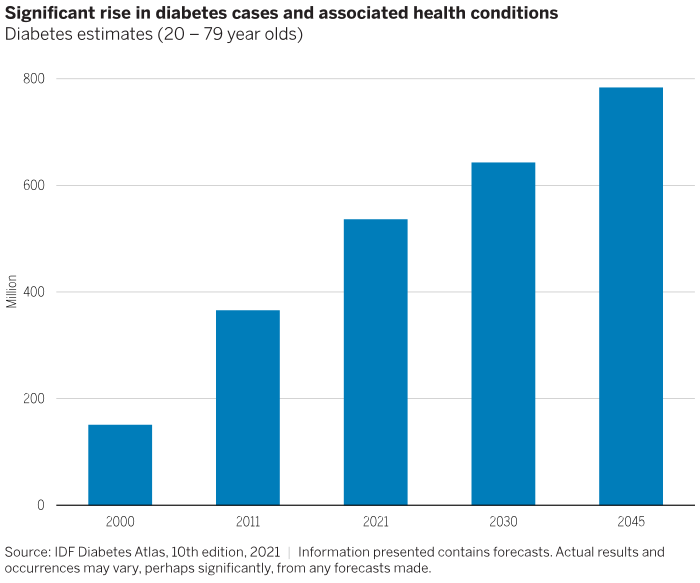
The food sector is undergoing a period of significant change, and we view a number of companies in the sector as underappreciated and undervalued — consumers stocked up on food supplies in response to the COVID pandemic and at the start of the Russia/Ukraine war but food shares subsequently became undervalued when consumer stock levels fell back. In addition to attractive valuations in the sector, we expect a number of companies — particularly in the food ingredients business — to benefit from the tailwind of consumers becoming increasingly thoughtful about making food choices that aid the transition towards a healthier lifestyle and reduce, for instance, diabetes risk.
We’ve invested in a number of these companies where regulation and evolving customer preferences are leading to reformulated products with lower saturated fat, lower sugar, lower salt and more added fibre. One such company is a global leader in both low calorie sweeteners and added fibre in food — which helps to improve texture and reduce calorie intake by making consumers feel fuller for longer. We expect increasing demand for healthier ingredients to continue to drive sustainable growth in the business.
We view proactive, on-the-ground engagement as crucial for gaining first-hand insights into a company’s sustainability credentials given their significant impact on financial performance and competitive position. This company has a strong record in this area — in the last five years, its low and no calorie sweeteners have enabled 9.0 million tons of sugar to be removed from people’s diets, which is equivalent to 36 trillion calories.
Several factors have significantly increased the incidence of myopia and other sight-related issues and led to higher demand for treatment — not least, rising cases of diabetes, the ageing population globally and increasing use of screens and mobile devices. The World Health Organisation predicts that the number of people over the age of 60 will more than double by 2050 and, according to estimates by the American Academy of Ophthalmology, the global prevalence of myopia is expected to double between 2000 and 2050.
One of the companies that we expect to benefit from these demand tailwinds is a world leader in contact lenses and surgical eye equipment. Medical technology spin offs like this company have a history of strong outperformance over time and we view it as a defensive, stable grower with high-quality leadership.
We think the business was an undermanaged asset under its previous ownership and we see significant potential for durable growth and market share gains operating as an independent company. It is investing in a number of innovative products to drive revenue growth, including a system to enable cataract surgeons to operate with improved safety features and on a higher throughput of patients, and a first-in-class drug that stimulates natural tear production to treat dry eye, which affects around 720 million patients globally.
These examples highlight the opportunities we’re currently seeing in attractively valued stocks with solid growth prospects, not just in the health care and food sectors but also in construction, defence, industrials and more. In each case, a long-term mindset is key. Uncovering quality companies that are temporarily out of favour but that have high growth potential requires the patience to hold them for a long enough period for fundamentals and sentiment to improve. For patient investors willing to look through today’s volatility, we believe the rewards of a contrarian, bottom-up investment approach will be worth the wait.
Experts
The power of Asia’s dividends
Continue readingLow tide, sharp eyes: What to pick up
Continue readingPractical portfolio considerations for a new economic age
Continue readingRapid Fire Questions with Philip Brooks on Asian equities
Continue readingChart in Focus: Is the Fed rate cut positive for risk?
Continue readingChart in Focus: What do higher long-end yields mean?
Continue readingThe long-term rewards of a contrarian approach to European equities
Continue readingURL References
Related Insights
The power of Asia’s dividends
Discover Asia’s quality dividend potential. With diverse income sources, structural tailwinds, and governance reforms at play, Asia offers a compelling mix of income, resilience, and long-term growth potential.
Low tide, sharp eyes: What to pick up
Fixed Income Managers Campe Goodman and Rob Burn share their outlook for credit in 2026 and discuss how investors can reposition for an environment where opportunities are harder to find.
Practical portfolio considerations for a new economic age
Solutions Director Andrew Sharp Paul explores practical portfolio considerations for a new economic age, focusing on quality equities, discerning bonds, and local APAC opportunities.
Rapid Fire Questions with Philip Brooks on Asian equities
In this edition of “Rapid Fire Questions,” Philip Brooks, investment director and equity strategist, answers key questions on Asian equities—exploring the structural drivers of the asset class, the traits of quality businesses, and the most compelling quality dividend opportunities today.
Chart in Focus: Is the Fed rate cut positive for risk?
In this edition of Chart in Focus, we examine how the Fed’s long-awaited interest rate cut may influence risk assets.
Chart in Focus: What do higher long-end yields mean?
Long-end yields have climbed on concerns over structural growth and fiscal expansion. In this edition of Chart in Focus, we explore how shifting yield curves are reshaping opportunities across asset classes.
The long-term rewards of a contrarian approach to European equities
Portfolio Manager Tom Horsey and Investment Director Thomas Kramer explain why viewing European equities through a contrarian lens could help investors to uncover long-term opportunities in a rapidly evolving Europe.
Chart in Focus: Fed rate cuts resume — What’s next for investors?
In this edition of Chart in Focus, we explore the Fed’s return to rate cuts after a strategic pause. We examine how this move, alongside diverging central banks paths, could shape the outlook for risk assets.
Rapid Fire Questions with Tim Manning
In this edition of “Rapid Fire Questions,” equity portfolio manager Tim Manning offers his views on rates, fiscal policy, tariffs, and AI — and shares why he remains constructive on the US equity market.
By
Chart in Focus: Where are rates headed?
In this edition of Chart in Focus, we take a look at where rates have been headed and potential implications moving forward.
Chart in Focus: Earnings upgrades fueled the recent US equity market rally
Where are earnings heading? In this edition of Chart in Focus, we address the recent uptick in earnings expectations and its potential impact on equity returns.
URL References
Related Insights
Past results are not necessarily indicative of future results and an investment can lose value. Funds returns are shown net of fees. Source: Wellington Management
© 2025 Morningstar, Inc. All Rights Reserved. The information contained herein: (1) is proprietary to Morningstar; (2) may not be copied or distributed; and (3) is not warranted to be accurate, complete or timely. Neither Morningstar nor its content providers are responsible for any damages or losses arising from any use of this information. The Overall Morningstar Rating for a fund is derived from a weighted average of the three, five, and ten year (if applicable) ratings, based on risk-adjusted return. Past performance is no guarantee of future results.
The content within this page is issued by Wellington Management Singapore Pte Ltd (UEN: 201415544E) (WMS). This advertisement or publication has not been reviewed by the Monetary Authority of Singapore. Information contained on this website is provided for information purposes and does not constitute financial advice or recommendation in any security including but not limited to, share in the funds and is prepared without regard to the specific objectives, financial situation or needs of any particular person.
Investment in the funds described on this website carries a substantial degree of risk and places an investor’s capital at risk. The price and value of investments is not guaranteed. The value of the shares of the funds and the income accruing to them, if any, and may fall or rise. An investor may not get back the original amount invested and an investor may lose all of their investment. Investment in the funds described on this website is not suitable for all investors. Investors should read the prospectus and the Product Highlights Sheet of the respective fund and seek financial advice before deciding whether to purchase shares in any fund. Past performance or any economic trends or forecast, are not necessarily indicative of future performance. Some of the funds described on this website may use or invest in financial derivative instruments for portfolio management and hedging purposes. Investments in the funds are subject to investment risks, including the possible loss of the principal amount invested. None of the funds listed on this website guarantees distributions and distributions may fluctuate and may be paid out of capital. Past distributions are not necessarily indicative of future trends, which may be lower. Please note that payment of distributions out of capital effectively amounts to a return or withdrawal of the principal amount invested or of net capital gains attributable to that principal amount. Actual distribution of income, net capital gains and/or capital will be at the manager’s absolute discretion. Payments on dividends may result in a reduction of NAV per share of the funds. The preceding paragraph is only applicable if the fund intends to pay dividends/ distributions. Performance with preliminary charge (sales charge) is calculated on a NAV to NAV basis, net of 5% preliminary charge (initial sales charge). Unless stated otherwise data is as at previous month end.
Subscriptions may only be made on the basis of the latest prospectus and Product Highlights Sheet, and they can be obtained from WMS or fund distributors upon request.
This material may not be reproduced or distributed, in whole or in part, without the express written consent of Wellington Management.
We seek to exceed the investment objectives and service expectations of our fund investors and their advisers worldwide
© Copyright 2025 Wellington Management Singapore Pte. Ltd. All rights reserved.
WELLINGTON MANAGEMENT FUNDS ® is a registered service mark of Wellington Group Holdings LLP.
Wellington Management Singapore Pte. Ltd., a private limited company incorporated in the Republic of Singapore. Address: 8 Marina Boulevard, Tower 1 #03-01 Marina Bay Financial Centre 018981. Licensed and regulated by the Monetary Authority of Singapore.