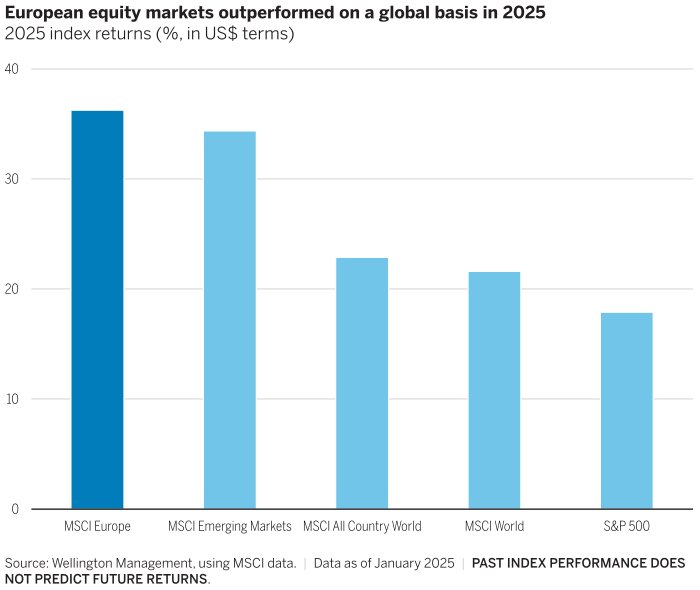
More important than the headline return, however, was the shift in market sentiment. Investors are becoming less anchored to the familiar “Europe can’t grow” narrative and more willing to underwrite a cycle that is increasingly supported by policy, investments and domestic tailwinds.
The bear case on Europe is well-rehearsed: ageing demographics, chronically low growth, a perceived tech laggard versus the US and competitive pressure from China in areas like autos and manufacturing. Those challenges haven’t disappeared, but, in our view, Europe does not need to “beat the US at Big Tech” to deliver strong equity outcomes. Even small improvements may be sufficient for things to go right for Europe in 2026. That doesn’t mean, however, that the benefits will be equally spread. In fact, we anticipate a growing dispersion between relative winners and losers as Europe’s structural transformation takes hold, creating ample potential for active investors to add value through targeted exposure.
And the opportunity to do so is exceptionally broad, given:
- the range of attractive sectors, including industrials, financials, health care, specialised technology and building products, as well as defence.
- the number of European companies that enjoy global revenues but still trade on European valuations.
- the European market still trades at a meaningful discount relative to the US and compared to its own history. At the time of writing, the MSCI Europe’s price-to-earnings ratio stands at 17.2x versus 27.8x for the MSCI USA.
From an overall portfolio standpoint, we believe European equities can increasingly act as a diversifier to the US given the differentiated return profile and valuation gap. And we think maximising that return and diversification potential means treating European equities as a standalone allocation.
























Monthly Market Review — August 2026
A monthly update on equity, fixed income, currency, and commodity markets.
By