Portugal, Intermediary

Changechevron_right
menu
search

Optimizing a small-cap allocation: Why the building blocks matter

3 min read
2027-05-31
Archived info
Archived pieces remain available on the site. Please consider the publish date while reading these older pieces.
equities
Andrew Sharp-Paul, Solutions Director, APAC
equities
Jeremy Butterworth, Investment Strategist
equities

Key takeaways

  • Quant and fundamental are distinct alpha engines in small caps. Quant offers scalable breadth and discipline, while a disciplined fundamental approach provides idiosyncratic, explainable stock selection within controlled tracking error and benchmark-aware constraints.
  • The structural reason blending can help is genuine diversification, with a cross-style correlation of just 0.358. This produces a materially smoother investment experience, with the blend's maximum drawdown less than half of either stand-alone approach.
  • The left-tail protection is where allocators feel it most. The blend's worst rolling 12-month periods are roughly half as severe as either style alone, which is precisely the improvement that makes a small-cap satellite sustainable through difficult markets.
  • The blend does not require calling regimes. It dampens drawdowns in weak environments while still participating strongly when conditions favor a single technique. The outcome improves without taking more active risk, delivering higher-quality outcomes within the same risk category.
  • Selecting the right fundamental building block matters. Strategies with deep, experienced research platforms and disciplined portfolio construction have consistently delivered higher excess returns and higher information ratios than the broad sample set. The alpha they produce is structurally different from quant, and that difference is what creates the diversification benefit.

In our view, small-cap equities offer a compelling opportunity set. Broader dispersion, greater inefficiency, and less analyst coverage than large caps all contribute to a richer alpha environment. Yet the allocator's challenge has always been implementation. Many have gravitated toward quantitative approaches as a natural starting point for a small-cap satellite allocation over the last few years. We acknowledge the well-established advantages of quantitative allocations. Quant offers systematic breadth, diversified exposure across hundreds of names, and disciplined portfolio construction with controlled tracking error.

At the same time, allocators who have sought to complement or replace quant with fundamental active management in small caps have often encountered a difficult investment experience. Concentrated, high-conviction fundamental small-cap strategies can deliver significant alpha when thesis conviction plays out, but they can also produce painful drawdowns, elevated tracking risk, and volatile return profiles that make them difficult to hold through a full cycle. For many allocators, the lived experience has been one of large swings in performance rather than the steady compounding they need from a satellite building block.

This creates a genuine tension. Fundamental research can uncover differentiated, idiosyncratic insights in small caps, arguably more so than in large caps where coverage is deeper and information advantages are harder to sustain. But the delivery mechanism matters enormously. The question is not whether fundamental alpha exists in small caps, but whether it can be harvested inside a disciplined enough framework to sit comfortably alongside quant as a complementary allocation.

We believe it can. Our research illustrates how blending a disciplined fundamental approach with quantitative strategies within a small-cap satellite allocation can create genuine diversification, not just averaging, and can materially improve the investment experience, particularly in the left tail.

What does "disciplined fundamental" mean in small caps?

Not all fundamental small-cap strategies are created equal. The distinction that matters most for portfolio construction purposes is between high-conviction concentrated approaches and disciplined fundamental strategies that operate within a defined risk budget.

A disciplined fundamental small-cap strategy shares several characteristics with quantitative approaches, including benchmark awareness, controlled tracking error, and broad diversification. However, it generates its alpha from a fundamentally different source: bottom-up, stock-specific research and conviction rather than systematic signal harvesting. The defining features include:

  • Broad diversification — which reduces single-stock risk and the volatility associated with concentrated portfolios.
  • Controlled tracking error — typically in the range of 2% to 6% p.a., keeping the strategy within a range that allocators can model and hold through the cycle.
  • Idiosyncratic risk as the primary alpha driver — where stock selection, not factor tilts or style bets, is the intentional source of active risk.
  • Benchmark aware portfolio construction — with sector and regional weights managed to stay close to the benchmark, minimizing unintended macro or factor exposures.

The advantage this brings is not more active risk. It is different active risk: explainable, bottom-up decisions grounded in deep industry expertise that can behave differently from systematic alpha when that style is under stress.

The case for blending: Evidence from global small caps

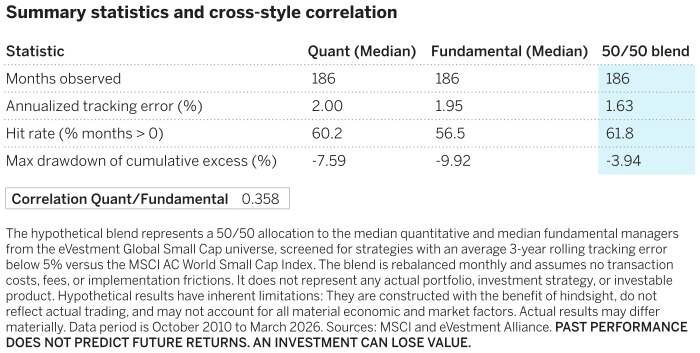
Figure 1 illustrates what happens when you combine both quant and fundamental into a single allocation with 50% invested in each.

Cross-style correlation: 0.358

The blend's tracking error of 1.63% is lower than either stand-alone approach (quant at 2.00%, fundamental at 1.95%), a direct result of the low 0.358 correlation between the two excess return streams. This is genuine diversification, not dilution. The hit rate improves to 61.8%, and critically, the maximum drawdown of cumulative excess returns falls to just -3.94%, which is less than half of fundamental's -9.92% and meaningfully better than quant's -7.59%.

Figure 1

summery statistics and cross style correlation

Where the benefit shows up most: The left tail

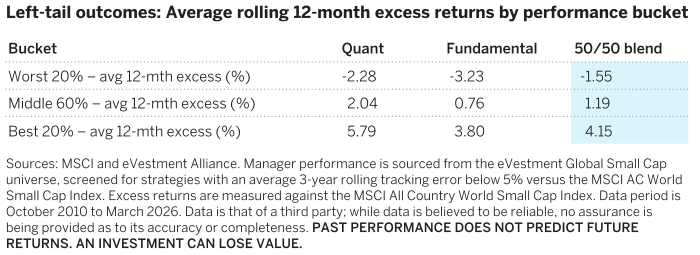
Figure 2 addresses different return environments. In this hypothetical example, the diversification benefit is most powerful precisely where investor experience is most at risk: in the left tail.

Left-tail analysis: Worst, middle, and best 20% of rolling 12-month windows

Looking at the last 15+ years of rolling 12-month windows, we ranked each series independently into worst 20%, middle 60%, and best 20% buckets. The median quant manager's worst 20% of rolling 12-month windows averaged -2.28% excess and the median fundamental's averaged -3.23%, but the blend's worst 20% averaged just -1.55% — roughly half the simple average of the two stand-alones. This is exactly the kind of outcome improvement that makes a small-cap satellite allocation sustainable through a full cycle.

Figure 2

left tail outcomes : average rolling 12 months excess returns by performance buckets

Cross-style alpha windows and left-tail behavior

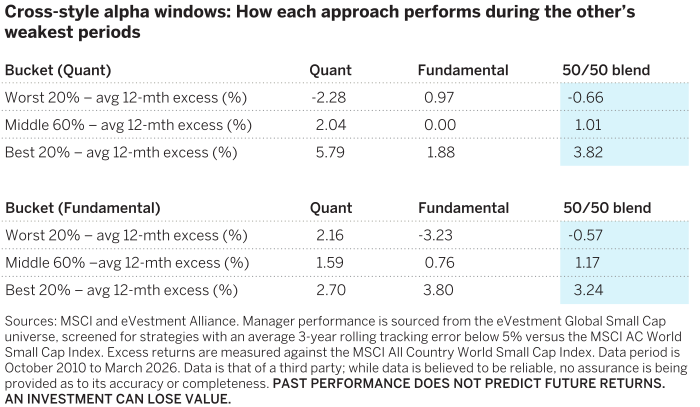
Applying a different lens, we analyze excess returns through style-specific alpha windows, defined as periods when each approach has performed at its strongest and weakest. This allows us to move beyond average outcomes and examine how quantitative and fundamental strategies behave when the other is under pressure.

The results highlight a clear and economically meaningful asymmetry. When the median quantitative manager has experienced its weakest 20% of rolling 12-month excess return periods, the median fundamental manager has delivered positive excess returns of 0.97% on average. Conversely, when the fundamental manager has been in its weakest periods, the median quantitative manager has generated excess returns of 2.16%.

This pattern is characteristic of effective diversification, with the two alpha engines rarely experiencing periods of weakness at the same time.

Figure 3

cross style alpha windows: how each approach performs during the others

Conclusion

The case for blending quantitative and fundamental approaches in small-cap investing rests on a simple but powerful observation:

The two alpha engines behave differently, and that difference can be most valuable precisely when the risk of sharp drawdowns and uneven returns is highest. With a low cross-style correlation, we believe that a blended quant and fundamental approach can potentially materially reduce drawdowns, smooth rolling-return outcomes, and improve the consistency and efficiency of active risk without increasing overall portfolio risk.

In our view, for allocators looking to build a more resilient small cap satellite, selecting a disciplined fundamental building block with genuine research depth and benchmark-aware portfolio construction is the practical next step.

The views expressed are those of the authors at the time of writing. Other teams may hold different views and make different investment decisions. The value of your investment may become worth more or less than at the time of original investment. While any third-party data used is considered reliable, its accuracy is not guaranteed. For professional, institutional or accredited investors only.

Experts

Get our latest market insights straight to your inbox.

Read more from our experts