Portugal, Intermediary

Changechevron_right
menu
search

Corporate governance: still a key driver for Japanese equities

6 min read
2027-08-15
Archived info
Archived pieces remain available on the site. Please consider the publish date while reading these older pieces.
694817808
Nicolas Wylenzek, CFA, Macro Strategist, Investment Research
694817808
Calista Lee, ESG Analyst
694817808

Key points

  • We believe that Japan’s corporate governance reform remains a central feature of the country’s journey towards recovery and reflation. In our view, it also supports the investment case for Japanese equities.
  • Reform momentum is real, but the next phase is likely to place greater emphasis on how effectively companies deploy capital, not only through shareholder returns, but also through capex, R&D and human capital.
  • Pressure is likely to be strongest on firms operating in strategically important sectors such as energy security, artificial intelligence and defence.
  • If implemented effectively, stronger corporate investment could reinforce the macro foundations of the reflation trade by supporting productivity.
  • For equity investors, the implication may be a gradual shift in the composition of returns — from payout-driven returns towards earnings growth.
  • Companies with genuinely improving governance are likely to remain an important source of outperformance but we see a greater need for selectivity, underscoring the importance of in-depth research and high-quality stewardship.

Corporate governance reform remains critical to Japan’s transformation

Ongoing corporate governance reform is addressing structural inefficiencies that have historically suppressed Japanese equity returns and valuations. While cyclical factors such as rising inflation, wage growth and a shift in monetary policy have attracted investor attention over the last few years, governance reform targets the deeper structural features of corporate Japan.

For decades, many Japanese companies accumulated large cash buffers, maintained extensive cross-shareholdings and placed limited emphasis on shareholder returns. This resulted in structurally low return on equity, with many companies trading below book value.

Reforms initiated under the Abe government and since reinforced by the Japan Stock Exchange have encouraged companies to focus more explicitly on capital efficiency and shareholder value.

Reform momentum is real

At an aggregate level, the reforms have achieved meaningful progress. Payout ratios are rising; margins are improving; and, on a shareholder yield basis (dividends plus buybacks), Japanese equities now appear broadly comparable to European equities and more attractive than US equities.

There also seems to be strong alignment among policymakers to continue advancing governance reform, with several signs that momentum is accelerating:

  • Faster unwinding of cross-shareholdings: Barely a week passes without another Japanese company unwinding its cross-shareholdings. Financial institutions have taken the lead, but consumer and industrial companies face increasing pressure to follow suit. Each position that is unwound releases capital and removes a hurdle to better governance and increased re-rating potential.
  • Growing appetite for M&A: Japan’s long-standing M&A taboo appears to be structurally weakening. The Tokyo Stock Exchange reforms and the new M&A guidelines introduced in 2024 have challenged the routine rejection of acquisition approaches, contributing to a pickup in both domestic takeovers and cross-border transactions. Private equity investors and activists are increasingly targeting underperforming companies where operational improvements and balance-sheet discipline can unlock value.
  • Activism increasingly driving corporate change: Outside the US, Japan has emerged as a major hunting ground for activist investors with a record number now targeting Japan. While activism historically struggled to gain traction in Japan, corporate management has become increasingly willing to engage with activist investors.

But not everything is working as intended

Policymakers, regulators and academics appear increasingly focused on whether companies are striking the right balance between returning excess capital to shareholders and investing in capex, R&D and human capital — particularly wage growth.

If Japan is to complete its transition out of deflation, domestic demand must strengthen. In a country facing demographic decline and limited fiscal headroom, higher corporate investment and faster wage growth are among the most important channels through which domestic demand can increase.

Further policy adjustments are helpful

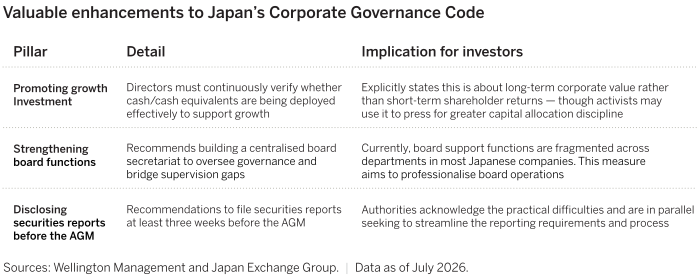
Japan’s Financial Services Agency and the Tokyo Stock Exchange have just announced further enhancements to Japan’s Corporate Governance Code. Figure 1 lists the key enhancements that are now in force under the revised Corporate Governance Code. These revisions not only bolster the quality of governance but also encourage boards to focus more explicitly on longer-term value creation.

Figure 1

Investment-Angles

Public and peer pressure could be key

In practice, Japan relies heavily on soft pressure mechanisms rather than regulation to encourage behavioural change. In effect, governance reform operates through reputation and market signalling.

Policymakers are likely to use these soft-pressure mechanisms to nudge companies to demonstrate how their capital allocation supports sustainable corporate value.

Strategic sectors most susceptible to pressure

Political pressure to improve capital productivity will likely be strongest in sectors considered strategically important. Shortly after taking office in October 2025, Prime Minister Sanae Takaichi identified 17 strategic investment areas intended to guide large-scale public-private investment towards sectors seen as critical for growth, economic security and technological leadership. Three priority areas stand out:

  • Energy security: The government is restarting nuclear reactors and increasing renewable energy capacity to reduce dependence on energy imports.
  • AI and semiconductors: Japan is seeking to strengthen supply chain resilience and reduce exposure to China-centric technology ecosystems. One example is the more than US$20 billion Japan Advanced Semiconductor Manufacturing (JASM) initiative to help revitalise domestic semiconductor manufacturing.
  • Defence: Prime Minister Takaichi has outlined plans to strengthen Japan’s defence industry by raising military spending to around 2% of GDP, easing restrictions on arms exports, expanding domestic weapons production and investing in dual-use technologies such as AI and advanced systems.

Companies seen as critical to success in these areas are likely to face the strongest political pressure to strike a better balance between shareholder returns and investment.

A gradual shift is likely

Beyond those sectors, we expect a more incremental adjustment that shifts the balance from shareholder distributions towards investment in growth.

Rising dividends and buybacks have been an important driver of the recent re-rating in Japanese equities. If political pressure gradually encourages companies to allocate more cash towards investment in growth and productivity, the pace of shareholder returns could moderate.

This could diminish investor support for companies whose investment cases depend primarily on excess cash returns. However, where capital is deployed productively, stronger corporate investment could reinforce the macro foundations of the reflation trade by supporting productivity growth, domestic demand and wages.

For investors, the implication may be a gradual shift in the composition of returns — from payout-driven returns towards earnings growth over time.

Selectivity is vital

Companies that can deploy capital productively should benefit, which underscores the growing importance of management quality. Returning capital via dividends or buybacks is straightforward; allocating capital effectively is considerably more challenging, particularly in an environment of rapid technological and geopolitical change.

Investors now need to judge whether companies are willing to make the necessary tough strategic decisions such as shrinking, selling, consolidating or exiting businesses.

An attractive investment theme for active investors

From an equity selection perspective, companies that are genuinely improving their governance — enhancing disclosure, reducing cross-shareholdings and addressing excess cash balances — are an important source of potential outperformance.

This holds whether freed-up capital is ultimately returned to shareholders or reinvested in growth. In our view, the key is to identify companies that combine improving governance with strong operational quality and management excellence. These companies should be able to pivot successfully to a more reinvestment-orientated governance model while retaining sufficient financial flexibility to initiate or continue shareholder distributions.

For investors, successfully identifying these companies is likely to require greater emphasis on in-depth research and high-quality stewardship.

The views expressed are those of the authors at the time of writing. Other teams may hold different views and make different investment decisions. The value of your investment may become worth more or less than at the time of original investment. While any third-party data used is considered reliable, its accuracy is not guaranteed. For professional, institutional or accredited investors only.

Experts

Get our latest market insights straight to your inbox.

Read more from our experts