Norway, Institutional

Changechevron_right
menu
search

Why public-equity volatility overstates “company risk” — and what that means for sizing private-market allocations

Reframing private-equity risk: a fundamentals-based perspective

18 min read
2027-04-30
Archived info
Archived pieces remain available on the site. Please consider the publish date while reading these older pieces.
Multiple authors
1445182462

Key points:

  • Private-market volatility arguments collapse into overly simplistic binary approaches: Take reported private returns at face value (or ignore them entirely) or unsmooth them to match public volatility. But the real question for allocators is upstream: What are you benchmarking against?
  • We think estimating public-company fundamental volatility (intrinsic value) and using it as a benchmark for public-equity price volatility and reported private-equity volatility can provide a number of benefits.
  • Our findings indicate fundamental volatility tends to sit well below public-market price volatility but still exceeds reported private volatility. For risk management, the takeaway is practical: Some upward adjustment to private volatility may be warranted to get a balanced view of ex-ante risks relative to historical results.
  • For strategic asset allocation (SAA), the key implication is that mechanically forcing private returns to match public-price volatility for modeling is a flawed approach due to the inherent horizon mismatch between public volatility and private risks, the latter of which is more anchored to long-term fundamental execution.

For asset allocators, volatility assumptions are critical to decisions about risk budgets and position sizing. When it comes to sizing private equity allocations, a debate has emerged in recent years about how best to measure that volatility. But we think the argument too often boils down to an unnecessary binary of sorts, focusing on extreme options and overlooking the realities of private company dynamics.

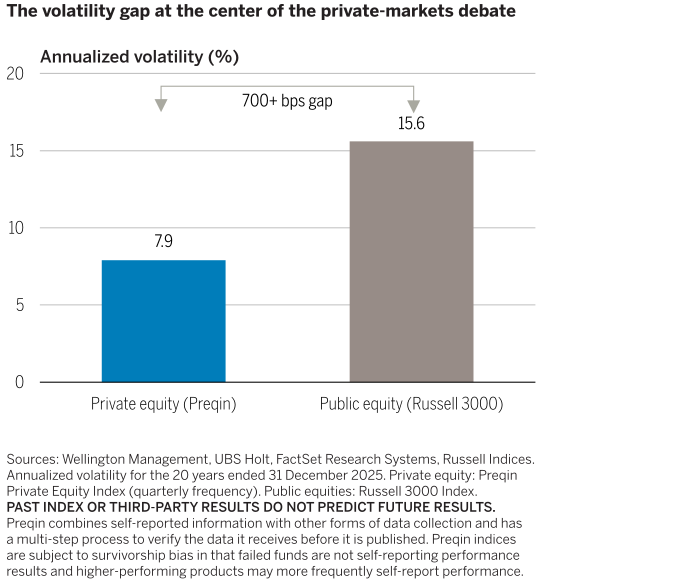
The starting point for the debate is the common view that periodic, appraisal-based private equity valuations suppress measured volatility, so industry series should not be used directly in portfolio construction or risk management. This “volatility laundering” critique is fueled by the gap between reported private-equity manager volatility and public-market volatility — a gap of 700+ bps over the last 20 years (Figure 1). In need of a volatility substitute, allocators often turn to public-equity volatility as a yardstick for “company risk” and try to unsmooth private returns to match it.

Figure 1

Table showing median manager’s average quarterly excess return by market environment

As we discuss in this paper, this debate needs to be reframed, distinguishing between underlying company fundamentals, public-market prices, and private appraisal-based marks. We agree with many in the industry that anchoring to reported private volatility alone risks understating company risk as well as liquidity and drawdown risk. On the other hand, anchoring mechanically to public-market volatility can result in overstating company risk by importing short-horizon repricing that may not track underlying business fundamentals (e.g., repricing driven by macro shocks). We believe that an SAA framework is meant to capture long-term risk and portfolio outcomes, and that fully unsmoothing private-equity performance violates this premise by artificially adding short-term public-market dynamics that, by definition, do not exist in private markets.

We think the solution is a third option: fundamental volatility, derived from a fundamentals-based estimate of public-company value (intrinsic value), which should be more representative of actual company performance and long-term value. In the following pages, we share the research behind this approach and discuss the portfolio implications. Importantly, we are not trying to produce a single “correct” private-market volatility metric or a new strategic asset allocation input for volatility-based optimizations. Our aim is narrower: to separate business-value volatility from market-price volatility so private-equity risk can be framed more coherently in a role-based, total portfolio approach to asset allocation and risk management.

To read more, please download the full paper below.

The views expressed are those of the authors at the time of writing. Other teams may hold different views and make different investment decisions. The value of your investment may become worth more or less than at the time of original investment. While any third-party data used is considered reliable, its accuracy is not guaranteed. For professional, institutional or accredited investors only.

Experts

Get our latest market insights straight to your inbox.

Read more from our experts