



- Vice Chair, Wellington Management
Norway, Institutional
ChangeThe views expressed are those of the author at the time of writing. Other teams may hold different views and make different investment decisions. The value of your investment may become worth more or less than at the time of original investment. While any third-party data used is considered reliable, its accuracy is not guaranteed. For professional, institutional or accredited investors only.
An interesting shift is occurring in areas of the market traditionally considered “climate-focused investments.” As government policy increasingly focuses on tariffs, AI dominance, industrial onshoring, and domestic energy security, products and services previously ring-fenced as climate-related are being seen more as opportunities to reduce costs, save time, and develop resilience, with long-term economic benefits. Although the Trump administration’s rhetoric is anti-“green” and avoids an explicit climate policy, many of the government’s interests and priorities implicitly support climate-related investments.
The intersection of certain macroeconomic factors and the commercial interests of companies in strategic sectors — from AI hyperscalers to semiconductor companies to auto manufacturers to electric and water utilities — provides investors with insights on where to focus.
Figures 1 and 2 help illustrate the macroeconomic dynamics that have presented challenges to US climate policy to date. A decade ago, oil and gas exports accounted for less than 2% of total US exports. Following advancements in hydraulic fracturing (fracking) and horizontal drilling since then, oil and gas now account for around 10% of exports (Figure 1). At the same time, as Figure 2 shows, the US has been increasingly importing equipment needed to support the energy transition, including solar panels, wind turbines, battery systems, heat pumps, and many others.
Figure 1
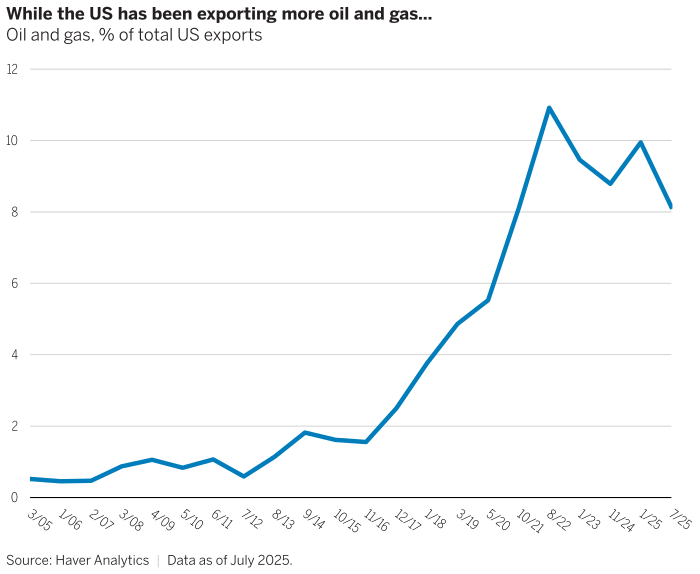
Figure 2
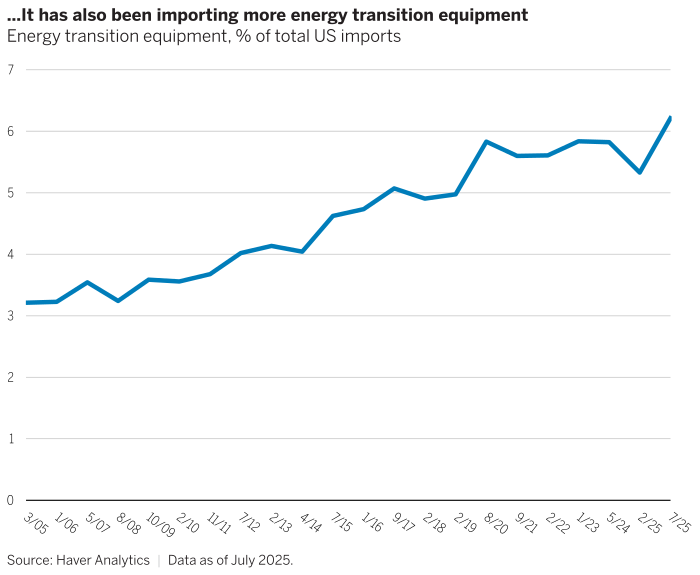
Taken together, this data suggests an economic disincentive for the US to transition away from fossil fuels and toward renewable energy. That said, both the Trump and Biden administrations have established policies that should, over time, bring more balance to the US energy sector. The Biden administration sought to reduce US reliance on foreign suppliers of energy transition equipment, most notably with its signature legislation, the Inflation Reduction Act of 2022 (IRA), aimed at stimulating domestic production. However, Biden did not take much action to curtail rising fossil-fuel exports. As a result, the imbalance shown above continued.
More recently, the Trump administration’s stated policy of increasing fossil-fuel drilling to keep top-line export figures elevated would, theoretically, widen the gap further. However, at current prices, producers are already operating at capacity and are unlikely to do much more. As ConocoPhillips’ CEO, Ryan Lance, said on a recent investor call, “I am already ‘drill-baby-drilling.’ I can’t ‘drill-baby-drill’ more.” In addition, while the administration’s proposed tariffs are not focused on climate mitigation, they will likely result in increased domestic production of energy transition equipment, which should help reduce imports over time. Although the two administrations differ in their policy approach, both have aimed to address this economic disconnect, leaving room for investors to tap opportunities if they know where to look.
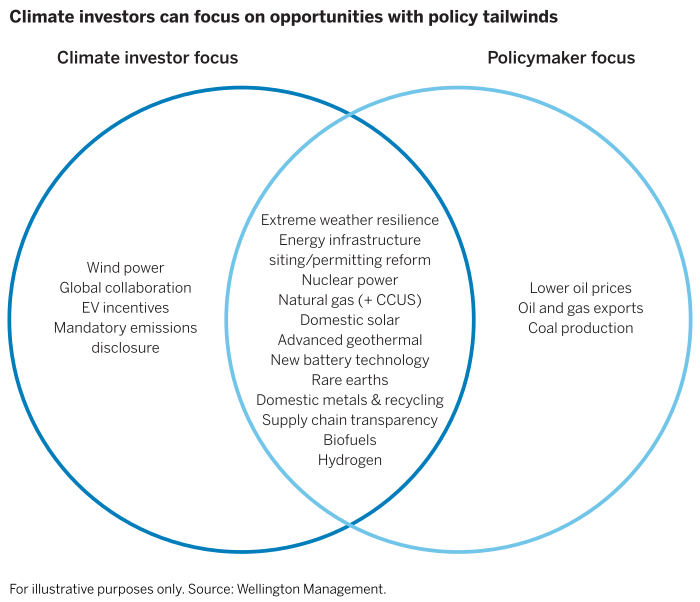
Our research indicates significant overlap between traditional “climate investments” and the policy objectives of the Trump administration (Figure 3). We believe that assets in the center of the Venn diagram are poised to benefit from ongoing policy tailwinds. Coupled with increasing consumer demand, these investments have the potential to generate attractive investment returns for years to come.
Figure 3
Policy focus: Protecting life and property from extreme weather and natural disasters
Climate investors’ focus: Climate adaptation and climate-risk mitigation
Common ground: Solutions that build extreme weather resilience
There will likely be a multiplier effect from dollars spent on these solutions today that result in greater savings in the future, as the price tag from natural disasters (hurricanes, floods, droughts, wildfires, etc.) grows. Global temperatures are rising, and with each upward tick, climate change worsens, increasing the need to adapt. Companies that provide solutions will likely see rising demand.
Policy focus: Energy infrastructure siting and permitting reform; protecting the grid from extreme weather and rising energy demand from AI
Climate investors’ focus: Increasing the proportion of clean energy across the power grid
Common ground: Technologies that harden the grid, lower costs, and expand distribution capacity
While connectivity has been a bottleneck to hardening the existing electrical grid, grid upgrades can help achieve this while facilitating expanded integration of renewable power sources. Advanced materials and technologies are beginning to enable utilities to increase their line capacity relative to traditional conductors, partially offsetting the costly and time-consuming challenges of siting and permitting.
Policy focus: Preparing for rising energy demand stemming from AI buildout, including hyperscalers
Climate investors’ focus: Clean energy generation and storage
Common ground: Nuclear power, natural gas and carbon capture, domestic solar, advanced geothermal, clean hydrogen
Nuclear: There has been bipartisan support for nuclear power, which aligns with the US goal of AI dominance (and increased power demand as a result). President Biden’s goal was 300 gigawatts of nuclear capacity by 2030; President Trump has increased it to 400 gigawatts. Current US energy secretary Christopher Wright is supportive, though research from the MIT Center for Sustainability Science and Strategy indicates that these goals may be unachievable. New small modular reactors, which can produce up to 300 MW each, are unlikely to be online until 2029 or 2030. Our natural resources analyst sees upside potential for uranium, driven in part by supply constraints.
Natural gas and carbon capture units (CCUs): Given rising demand for power and the lack of new resources in the short term, natural gas is likely to play a significant role in the energy mix. Direct air capture and storage have enjoyed policy backing since the bipartisan Infrastructure Investment and Jobs Act of 2021. President Trump’s “One Big Beautiful Bill'” (OBBB) enhances support for carbon capture system credits. Methane capture seems to be an area of intersection as well.
Domestic solar: The Trump administration’s changes to solar tax credits are less severe than previously anticipated; they should be manageable for the utility-scale solar industry. Our solar analyst expects steady volume growth and prioritization of domestic solar content through 2030. With policy uncertainty behind us, fundamentals — which are not fully reflected in current prices or consensus estimates — should become a greater focus for investors.
Advanced geothermal: This is a marginal contributor to energy supply today, but it is a clean, firm power supply that is of interest to hyperscalers. While cost is a key hurdle, geothermal is eligible for credits under current policies, and energy secretary Wright remains supportive. Lateral drilling and fracking technologies are in scope for credits. The US Geological Survey estimates that 10% of US electricity demand could be met by advanced geothermal supplies.
Hydrogen
After being initially removed from the IRA during the bill’s negotiations, Congress included a clean hydrogen credit at the last minute. With at least one energy major supportive of this credit, the Trump administration may continue to support hydrogen development.
Policy focus: Innovation leadership on large-scale power storage
Climate investors’ focus: Reduced intermittency and loss for renewables
Common ground: New battery technologies
The Trump administration has earmarked a significant budget for new battery technology at the National Labs in the US Department of Energy. This aligns with a Trump administration desire for the US to be known as an innovation leader. (The lithium-ion battery was created by National Lab scientists, who were awarded the Nobel Prize in Chemistry in 2019.) AI can potentially further materials optimization and better battery composition.
Policy focus: Reducing reliance on Chinese natural resource imports
Climate investors’ focus: Energy transition
Common ground: Domestic rare earth and metals extraction and processing
Rare earths: The US government wants to increase domestic production to reduce reliance on China. (This has been a principal leverage point for China in tariff negotiations.) President Trump recently issued back-to-back executive orders aimed at increasing domestic production of rare earth elements and researching the national security risks of overreliance on imported processed critical minerals. The US Department of Defense has made direct investments in rare earth companies. Finally, most of the largest technology firms have longstanding rare earth recycling initiatives and ambitious recycling goals. Recycling rare earth materials uses far less energy than primary production, creating an indirect climate benefit.
Domestic metals
Like rare earths, the US government considers critical minerals as essential for AI and national security. US supply of metals is “greener” than some other global sources. The US lacks geology to increase its supply of copper and aluminum organically, so it may seek to improve collection and recycling of existing material. In July 2025, the Trump administration set a 2027 policy restricting exports of high-quality scrap copper.
Policy focus: Tariffs
Climate investors’ focus: Climate risk in corporate supply chains
Common ground: Supply chain transparency
Climate investors seek to analyze companies’ exposure to and potential financial impact of climate physical and transition risks in corporate supply chains. With the near ubiquity of tariffs, companies will need to better understand their global web of suppliers to make sourcing decisions and optimize costs. Companies need to share this strategy with investors as well. Climate investors may want to identify companies with disclosures on greenhouse gas emissions and the physical risks facing the property, plants, and equipment of vendors along their supply chain. Private companies offering solutions that support supply chain management and transparency are of interest.
Policy focus: Supporting US farmers
Climate investors’ focus: Emissions reductions
Common ground: Biofuels
The Trump administration supports agriculture-based biofuel policies as a means of helping US farmers. While margins are negative for many crops, soybean oil is a notable exception. The administration has increased the Renewable Volume Obligation (annual renewable-blend requirement for gas and diesel refiners and importers). We believe federal policy, along with a constructive outlook on California’s Low Carbon Fuel Standard credits, is bullish for certain commodities and has implications for agriculture-related stocks.
For asset owners seeking to earn investment returns and direct capital toward solutions that address climate change, the current macro and market environment presents a wide range of investment opportunities. Although certain economic dynamics have created challenges for the US energy transition so far, government policies aimed at AI innovation and dominance, industrial onshoring, and domestic energy security are beginning to accelerate the shift toward a more diversified energy mix. This shift is creating areas of the market that align with the goals of climate investors and US policymakers, who are seeking to spur economic growth.
Companies in strategic sectors, including hyperscalers, semiconductors, auto manufacturing, and electric and water utilities, are investing heavily in technology and solutions that have positive direct and indirect climate impacts. From extreme weather resilience and energy infrastructure upgrades to bipartisan support for nuclear power and innovation in battery technology, the path forward involves a multifaceted approach. By leveraging these opportunities, asset owners can support a sustainable and resilient energy future while investing in areas with potentially long runways for growth.