Netherlands, Institutional

Changechevron_right
menu
search

The role of secondaries in venture and growth private equity

5 min read
2027-04-30
Archived info
Archived pieces remain available on the site. Please consider the publish date while reading these older pieces.
Multiple authors
mountain tree river

Key points

  • Secondary investment may help solve for liquidity needs in the VC and growth space.
  • VC/growth funds are more open to using secondary investments today than they have been in the past, so the opportunity set is expanding.
  • We believe reputation and ability to access company-level information help to differentiate secondary buyers with the greatest potential for success.

Within private equity, the venture capital (VC) and growth ecosystem has experienced a prolonged liquidity drought following the 2021 market peak.1 This has significantly reduced exit activity (via initial public offerings or mergers and acquisitions of private companies), leaving many private equity investors searching for liquidity.

In the face of this challenge, demand for alternative liquidity solutions across limited partners (LPs), general partners (GPs), founders, and employees has increased. One such alternative liquidity solution is the use of private equity secondary transactions, or the transfer of a private equity commitment from one investor to another.

The past, present, and future of venture and growth secondaries

Historically, use of secondary transactions in the VC and growth market lagged compared to the buyout space. More recently, this has changed and their use in the VC and growth spaces has increased substantially.2 Several factors help explain this shift:

Market size
In the past, the buyout market was significantly larger than the VC/growth market, making it easier for a secondary ecosystem to come into play.

What has changed?
The number of VC and growth-stage funds has grown in the past fifteen years3 and the secondary market has become more accepted over time. Secondaries are a better fit in the VC space now than they were a few years ago.

Information availability
VC funds have historically been less transparent than buyout counterparts with underlying private company information ― for example, on financials, operational data and management insights. They’ve also been restrictive on who can invest in the funds. This has made it difficult for secondary buyers to underwrite transactions in this space.

What has changed?
Restrictions have eased over time and as secondary buyers have become more active in the space, some have been able to access information more effectively. As private companies matured and stayed private for longer, certain holdings became more common (and concentrated) across portfolios, improving investors’ ability to form bottom-up views on portfolios.

Liquidity
For several years, VCs and the investors in VC funds saw liquidity and distributions from IPOs.

What has changed?
More recently, IPO activity has slowed, contributing to the liquidity concerns we outlined above. Because a key function of secondaries is to provide relative liquidity, they may be a better fit in the VC/growth space than they were in the days of more active IPOs.

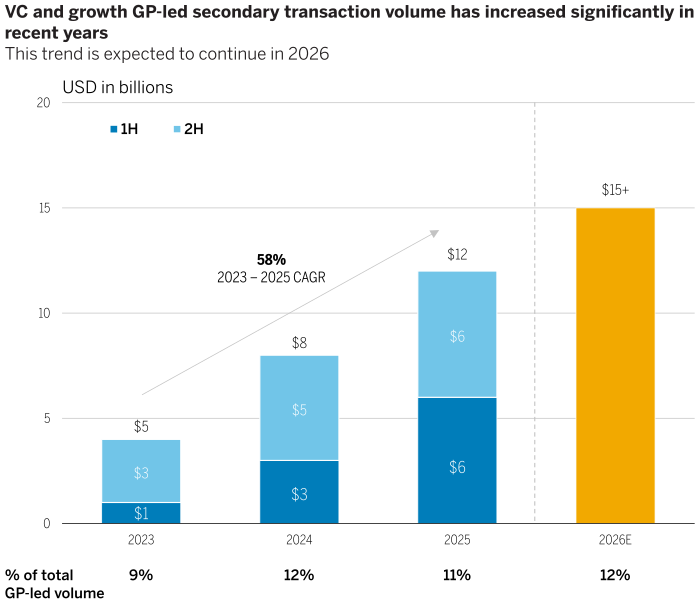
LPs led the first wave of VC/growth secondary transactions, driven by investors seeking liquidity. But now, as liquidity needs have grown more broadly, holding periods have extended, and capital availability has increased, GPs have become more open to secondaries, too. In fact, GP-led VC/growth secondary transaction volume reached about US$12 billion in 2025, an increase of more than 40% year over year.4

Figure 1

Yied differential

Source: UBS, 2025 Secondary Market Report, 2026. Past results are not necessarily indicative of future results and actual results may vary from forward looking estimates.

We believe the opportunity set for VC/growth secondaries is significant. Because it’s still early days for secondary investment in this space, there’s a limited supply of dedicated capital focused on secondaries. And the relatively small size of the secondary buyer universe in VC/growth drives structurally lower pricing compared to buyout, infrastructure, or private credit secondaries.

In parallel, use of direct secondaries has grown meaningfully in recent years. These are private equity transactions in which an investor purchases existing direct ownership stakes in individual companies from investors, employees, or founders, rather than buying into a fund. This growth reflects the broader trend of companies remaining private for longer.

Because companies are often staying private for several years longer than they used to, equity-holding employees at private companies face extended periods without liquidity. Companies used to discourage employee share sales, but now, with their trend of staying private for longer, many actively support or sponsor secondary liquidity programs. These can range from individual-employee-driven transactions to large-scale, company-led tender offer funds (a type of registered closed-end fund). These liquidity solutions could also benefit early-stage investors who may have similar liquidity concerns due to extended holding periods.

How VC and growth secondaries may fit in portfolios

The primary benefit of VC and growth secondary investments is the same as it is in other markets: the liquidity potential for LPs. Another potential benefit is that allocators can reposition their portfolios to focus on the managers they view most strongly by selling non-priority managers via secondary sales. This is particularly helpful in today’s market of ample capital but limited exit opportunities.

For investors and GPs, VC and growth secondaries can also provide a complementary way to access innovation-oriented private equity exposure. Compared with primary venture commitments, secondary investments may offer entry into companies that are further along in their development, with more observable operating performance, clearer market positioning, and, in some cases, a shorter path to liquidity. This can reduce some of the early-stage company risk associated with primary venture investing while still providing exposure to growth businesses that remain private for longer.

Entry pricing may also reflect discounts relative to NAV, particularly in periods of constrained liquidity. As a result, VC and growth secondaries may serve several portfolio roles, including diversifying venture exposure across vintages, gaining access to more mature private innovation companies, and complementing primary commitments with a potentially more selective, information-rich entry point.

What differentiates secondary buyers in VC and growth

As the VC and growth secondary market is rapidly evolving, we believe it is critical to evaluate the potential drivers of success in this growing space. In our view, access and underwriting capability are closely linked in the private equity secondary market. Because ownership is often fragmented and private company disclosure is limited, the ability to evaluate opportunities depends not only on seeing transactions, but also on gaining sufficient access to company and portfolio information to underwrite them effectively. This makes networks, relationships, and reputation important sources of competitive advantage, particularly when companies and GPs are selective about who enters the shareholder base.

But access alone is not enough. We believe success in this segment also requires deep company-level underwriting capabilities, including the ability to assess business fundamentals, competitive positioning, financing needs, and likely exit paths. In our view, the strongest secondary buyers are those who combine trusted access with the direct investing skill set needed to evaluate venture and growth companies on their own merits. Equally important, companies and GPs often prefer secondary investors who can serve as constructive, long-term partners, bringing credibility, stability in the shareholder base, and the ability to support companies as they continue to scale.

1PitchBook Data, Inc., “NVCA Venture Monitor,” data from January 1, 2015 through September 30, 2025. | 2PitchBook Data, Inc., “US VC and Buyout Secondary deal count,” data from January 1, 2010 through December 31, 2025. | 3PitchBook Data, Inc., “US Venture Capital fund formations,” data from January 1, 2010 through December 31, 2025. | 42025 Secondary Market Report, UBS, 2026.

The views expressed are those of the authors at the time of writing. Other teams may hold different views and make different investment decisions. The value of your investment may become worth more or less than at the time of original investment. While any third-party data used is considered reliable, its accuracy is not guaranteed. For professional, institutional or accredited investors only.

Experts

alex-behm-9186-316
Head of Secondaries, Venture Growth Evergreen, Private Investments

Get our latest market insights straight to your inbox.

Read more from our experts