Netherlands, Institutional

Changechevron_right
menu
search

Secondary investment: Flexibility in private equity

7 min read
2027-03-31
Archived info
Archived pieces remain available on the site. Please consider the publish date while reading these older pieces.
Multiple authors
2248782380

Key takeaways:

  • For limited partners, secondaries can serve as a source of liquidity.
  • For general partners, secondary investment can provide the capital needed to fuel growth.
  • Investing in secondaries has several potential benefits, including diversification and access to the full spectrum of private-markets value.

During the past decade, private equity secondary transactions, or the transfer of a private equity commitment from one investor to another, have become more popular, to the potential benefit of investors and fund managers alike.

We view this as a boon to the private-market ecosystem for two reasons:

  • Firms investing in secondaries can help provide liquidity to private-market fund investors, or limited partners (LPs).
  • They can also provide capital to private-market fund managers, or general partners (GPs), seeking to maximize asset value.

In this piece, we explore these two critical functions and unpack the potential benefits of secondaries investment, which can be useful across asset classes, but may be particularly valuable in the venture and growth space.

Secondaries as a growing liquidity solution

Secondaries can be a useful infusion of liquidity in private markets, an otherwise relatively illiquid area of the market. In fact, while private funds have several potential advantages over their public counterparts (including higher return potential with lower volatility1), for many, the primary drawback is their illiquidity.

Closed-end private funds, which account for the majority of the private fund universe, don’t have a liquidity mechanism. Unlike in public markets, in this space, there’s no organized exchange where one investor can transfer an interest in a fund to another investor.

LPs typically enter private fund commitments with the intent to stay invested for an extended period of time. This is usually a condition of committing to the fund. However, there are several reasons an LP might want to exit earlier — portfolio rebalancing, regulatory changes, liquidity pressures. This can create a problem because if an LP would like to exit their interest, they must find a replacement LP to assume their commitment.

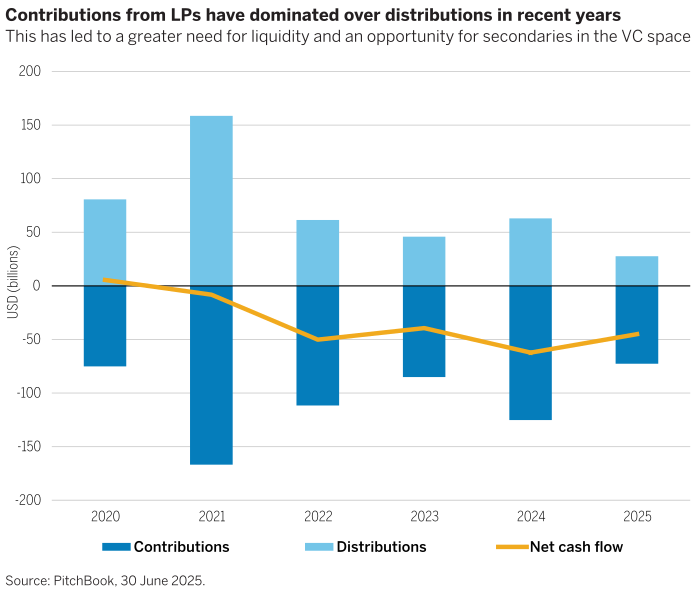
Secondary investors may represent a solution. In the absence of an open market exchange typically found with publicly traded securities, these secondary investors can negotiate and transact with the LP seeking liquidity by purchasing the commitment to the private fund in exchange for cash. What’s more, within the VC space, in recent years, there’s been a dearth of exits. This has led to contributions from LPs meaningfully outweighing distributions to LPs. Secondaries could provide the liquidity this space lacks (Figure 1).

Figure 1

Yied differential

Transacting in the secondary market is a legitimate, programmatic tool institutions can use to manage their investment portfolios effectively. What’s more, it’s gaining popularity. LPs have been particularly interested in generating liquidity from their venture and growth interests, which have been slow to return capital since the hot IPO market in 2021. Closed-end private equity (PE) and venture funds have broadly had poor recent track records generating liquidity, which both creates buying opportunities for secondaries and highlights how differentiated the funds are that have continued to generate DPI in today’s environment. And over the past decade, the volume of secondary transactions in LP interests across all private asset classes rose from US$33 billion per year in 2015 to more than US$120 billion per year in 2025.2

Secondaries as a capital provider

Secondaries can be useful not only for LPs, but also GPs. The traditional private fund structure can limit a GP’s ability to support or reinvest in its existing portfolio companies. For example, GPs often see additional growth potential in companies they’ve held for some time, but the GP may not have additional capital to invest, or the LPs in the fund may instead prioritize liquidity over further value upside.

As a potential solution, secondary investors can partner with GPs to create a new fund, typically called a continuation vehicle (CV). The CV acquires the asset(s) from the legacy fund, the secondaries investor capitalizes the assets the GP couldn’t, and the GP retains its role. This allows GPs to continue backing those portfolio companies they believed in without going into debt or diluting their ownership. At the same time, the original LPs have an opportunity to receive liquidity.

This is particularly notable given the trend toward companies staying private longer. Because businesses are delaying IPOs, GPs often need additional private capital and additional time to support their companies, and secondary investments can potentially provide it.

This structure allows the legacy fund’s LPs an option to receive liquidity and gives the GP additional time and capital to maximize the value of its assets. This type of transaction has proven so compelling that the annual transaction volume in the GP-led market increased from US$9 billion in 2015, to US$106 billion in 2025.3

Why invest in secondaries?

It’s worth noting that these two uses of secondaries (providing liquidity to LPs and capital to GPs in the form of CVs) represent two of the more common situations for this type of investment. There are many more approaches secondaries participants use in pursuit of LP and GP objectives. Broadly speaking, secondary investment is a flexible tool with several applications.

So, there are a few potential advantages of investing in secondaries:

  • Diversification and limited blind pool risk – a single secondary transaction typically includes multiple underlying assets and may provide exposure to dozens of companies. Additionally, all or nearly all assets within a private-market fund have typically already been identified and invested in at the time of the secondary transactions.4 This may reduce blind pool risk and increase transparency.
  • Potential for faster return of capital – historically, a GP has typically held the assets acquired through a secondaries transaction for multiple years. The assets are further along in their value-creation life cycle and the fund may be closer to exiting them. This shorter expected duration allows secondary investors' capital to be returned more quickly than other private-market strategies.
  • Potential J-curve mitigation – secondary transactions typically occur at a price below a GP’s stated net asset values,5 reflecting a liquidity discount. This often allows transaction value appreciation to occur quickly, followed by potential subsequent gain as the assets continue to mature. As a result, J-curves are often mitigated and potentially even inverted.
  • Access to the full spectrum of private-markets value creation – companies are staying private longer and, in some circumstances, accumulating more value in the process. With secondary structures like CVS, investors may be able to maintain exposure to companies throughout their life cycles. This opens them up to the possibility of capturing more of that value creation prior to an exit.

It's worth nothing that while secondary investments can offer attractive opportunities, there are risks, including potential conflicts of interests where investors are reliant on GPs to act in their best interest, particularly on execution and exit timing, and investors may have limited transparency into underlying companies. Individual risk tolerance and investment objectives should inform if and how secondaries investment fits in a portfolio.

This said, the bottom line is: Use of secondaries in private equity has grown and we believe this will continue, as LP liquidity demands and GP capital needs align, creating a potentially meaningful investment opportunity for secondary market participants.

1MSCI, “Tracking Private Equity: Closing the Performance Gap,” 30 September 2025. | 2Evercore Private Capital Advisory, “2025 Secondary Market Highlights,” January 2026. | 3Ibid. | 4Jeffries, Global Secondary Market Review, January 2026. | 5Ibid.

The views expressed are those of the authors at the time of writing. Other teams may hold different views and make different investment decisions. The value of your investment may become worth more or less than at the time of original investment. While any third-party data used is considered reliable, its accuracy is not guaranteed. For professional, institutional or accredited investors only. 

Experts

alex-behm-9186-316
Head of Secondaries, Venture Growth Evergreen, Private Investments

Get our latest market insights straight to your inbox.

Read more from our experts