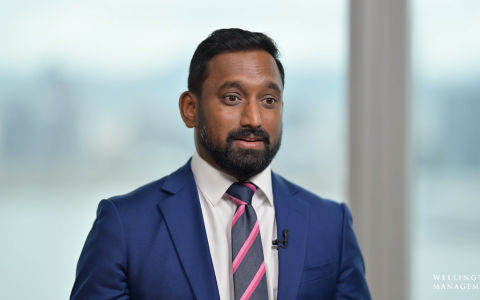



- Equity Portfolio Manager
Latin America, Intermediary
Change
Not all dividend stocks are created equal. Equity Portfolio Manager Naveen Venkataramani explains how the team identifies quality dividend companies across Asia, the high-conviction opportunities that stand out today, and the key risks on the horizon.
Q: What are the key attributes you look for in quality dividend companies?
Our definition of quality has three pillars: competitive moat, management quality and governance. And governance here is defined broadly, not just how a company treats its shareholders, but how it treats all stakeholders. On top of this, we apply a valuation discipline and look for a sustainable dividend backed by strong cash flows, healthy balance sheets and a willingness to return capital.
Companies with these characteristics generally fall into three buckets. We call them Dividend Compounders, which are enduring quality franchises; Dividend Surprisers—that is, emerging quality companies where the market underestimates future earnings and dividends; and Dividend Leaders, which are mature, cash-generative companies with high and sustainable yields even if they have slower growth rates.
Just as importantly, we steer clear of companies offering optically high dividend yields that we think are not sustainable. Typically, because earnings visibility is poor or governance and capital allocation are weak. We also avoid the most speculative names in every cycle, including, in this case, parts of the AI hardware complex where capital intensity is rising rapidly, customer concentration is high and dividend policies are not the focus.
Q: What are your highest-conviction ideas right now?
The team conducts over 1,000 company meetings each year, and our recent research trips have reinforced our conviction in four themes that we believe are particularly compelling.
First, the financial sector. Chinese state-owned banks and insurers, Korean financials and ASEAN banks are all benefiting from a mix of structural reforms and improving shareholder returns, while pan-Asian insurers are benefiting from aging demographics and structural retirement income demand.
Second, we also see opportunities in select AI-linked technology companies, owned for their quality and cash flow, not AI hype. Taiwanese semiconductor and hardware suppliers, Korean memory companies, Chinese internet platforms, and AI data-center enablers. These are all companies where AI provides growth optionality on top of an already attractive base business.
Third, Chinese industrials and "anti-involution" winners. This includes heavy-duty truck exporters, express logistics operators and mining companies, all are examples of companies that emerged from the COVID period leaner, more cash-generative and more focused on shareholder returns.
Fourth, Value-Up beneficiaries in Korea and China. This includes telecom companies, banks, insurers and consumer companies. While tech and industrial companies have re-rated meaningfully, opportunities remain in less appreciated areas.
Q: What are the key risks to watch over the next 6–12 months?
AI concentration and a sharp rotation, to me, is the biggest risk. A meaningful share of benchmark returns this year has been driven by a handful of AI-related names. Historically, periods of extreme narrow leadership have been followed either by sharp rotations or meaningful drawdowns. A sharp correction in AI stocks is a risk for broader markets and could be triggered by earnings disappointment, capex digestion or a simple positioning unwind. We do believe that we are well positioned.
Geopolitics and energy prices are the second major risk. The Middle East conflict and its impact on energy prices is a key risk for Asia, which is a net energy importer.
Third, tariffs, US-China tensions and a stronger US dollar. We could see pressure on less competitive Asian exporters and currencies. Our preference in this environment is for companies with strong domestic franchises, strong pricing power or exporters with a competitive edge that can offset these forex headwinds.
The views expressed are those of the speaker at the time of filming. Other teams may hold different views and make different investment decisions. The value of your investment may become worth more or less than at the time of original investment. While any third-party data used is considered reliable, its accuracy is not guaranteed. For professional, institutional, or accredited investors only.