




- Investment Director, Fixed Income
Italy, Institutional
ChangeThe views expressed are those of the author at the time of writing. Other teams may hold different views and make different investment decisions. The value of your investment may become worth more or less than at the time of original investment. While any third-party data used is considered reliable, its accuracy is not guaranteed. For professional, institutional, or accredited investors only.
We have officially begun a Fed cutting cycle, and asset owners are now faced with the age-old question — how low can we go?
While the answer remains uncertain, what is certain is that yields on floating-rate assets (such as direct lending) are about a quarter point lower than they were before the Fed met in September, and signs point even lower over the coming Fed meetings. As rates could continue to fall while the Fed navigates this cycle, asset owners must consider how this affects the yield on their credit portfolio and how to allocate marginal dollars.
Here, we explore the impact of Fed cuts on Collateralized Loan Obligation (CLO) equity, compare the effect on floating-rate exposures like direct lending, and highlight the associated risks.
Today’s asset owners are confronted with the challenge of maintaining income in a world where interest rates are falling from recent elevated levels. In our view, CLO equity presents an intriguing solution for asset owners looking to potentially preserve and even improve income to offset declines in the broader market.
Unlike many fixed-rate and floating-rate credit instruments, the quarterly income distributions of CLO equity are not overly sensitive to fluctuations in short-term interest rates. This is because CLO equity’s income primarily comes from excess spreads and is less impacted by prevailing short-term Fed rates. The equity tranche is "short" the Secured Overnight Financing Rate (SOFR) because it pays SOFR on the CLO liabilities and is "long" SOFR because it earns SOFR on the bank loan assets. There is a small degree of slippage but, overall, the offsetting mechanism effectively neutralizes the impact of changes in SOFR as a result of Fed rates.1
We believe this makes CLO equity an attractive option for those seeking to reduce the rate sensitivity of their income portfolio.
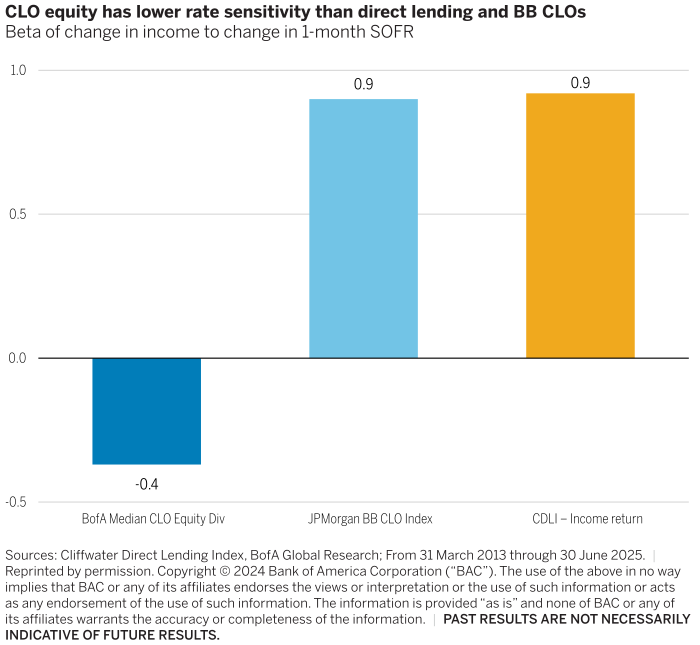
Notably, the above dynamic differs significantly from direct lending, the largest private credit allocation for many asset owners, and BB CLOs, another frequent alternative to CLO equity. When comparing these three potential allocations, it's essential to consider both the income profile and rate sensitivity of each asset class. The median CLO equity tranche has historically had a relatively consistent income profile over the past 10 years, even during periods of macro rate volatility. On average, CLO equity has delivered an income of around 16% per year over the past decade.2 Direct lending and BB CLOs have also had relatively high yields historically at around 10%.2
Critically, however, direct lending and BB CLOs float off SOFR so their income profile has a strong positive relationship with changes to the rate, with a historical beta of +0.91 and +0.90, respectively.2 This means their yields tend to decline in tandem with Fed cuts, making them more sensitive to rate changes compared to CLO equity, which has a modestly negative beta of -0.37 (Figure 1).2 So, while the consensus view in the market appears to be that CLO equity could be negatively affected by the cutting cycle, we take a more nuanced view. We believe the impact from a change in base rates is likely to be neutral at worst given the inversion of the 1-month/3-month SOFR curve offsetting the lower base rates.
Importantly, an asset owner’s view on the credit cycle is another key part of this discussion.
Income is not the only consideration for asset owners as they also need to have a view on how a slowing economy could affect credit performance. After all, the Fed is cutting rates because it believes that US economic activity is slowing. With this in mind, we consider four impacts of today’s environment on CLO collateral pool fundamentals (Figure 2):
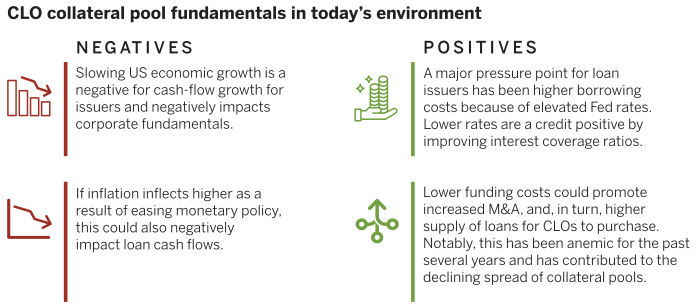
The above risks and opportunities are fairly balanced today and only time will tell if one of these factors emerges as more dominant over the coming quarters.
CLO equity has the potential to help asset owners maintain income while hedging some of the significant rate sensitivity that exists in their other credit assets. However, it is crucial to consider the potential risks associated with Fed rate cuts, including the impact on credit quality in the underlying collateral pool. By carefully evaluating these factors, asset owners can make informed decisions about allocating capital between CLO equity, direct lending, and BB CLOs in the current rate environment. We believe the Fed action has made CLO equity income relatively more attractive than other credit assets but are cognizant of the risks to the economy present in our allocation decisions.
1There is nuance to this statement. The CLO debt tranches are generally about 90% of the notional value of the deal and the equity tranche is about 10%. So SOFR is only about 90% neutralized. Additionally, CLO liabilities are fully 3mo SOFT, while the bank loan collateral is a shifting mix between 1mo SOFR and 3mo SOFR. All said, the impact of changes in Fed cuts on equity income will at the margin be impacted by the absolute level of rates, and the shape of the 1mo and 3mo curve. These are generally going to be offsetting factors in a rate cut cycle because the SOFR rate will fall on the 10% of SOFR exposure in the portfolio, and at the same time income will improve because the 1mo/3mo curve is typically inverted during a cutting cycle. | 2Sources: Cliffwater Direct Lending Index, BofA Global Research; From 31 March 2013 through 30 June 2025. | Reprinted by permission. Copyright © 2024 Bank of America Corporation (“BAC”). The use of the above in no way implies that BAC or any of its affiliates endorses the views or interpretation or the use of such information or acts as any endorsement of the use of such information. The information is provided "as is" and none of BAC or any of its affiliates warrants the accuracy or completeness of the information. | PAST RESULTS ARE NOT NECESSARILY INDICATIVE OF FUTURE RESULTS.