Italy, Institutional

Changechevron_right
menu
search

The role of commercial real estate debt in an insurance portfolio

5 min read
2028-06-30
Archived info
Archived pieces remain available on the site. Please consider the publish date while reading these older pieces.
Multiple authors
commercial construction

Key takeaways

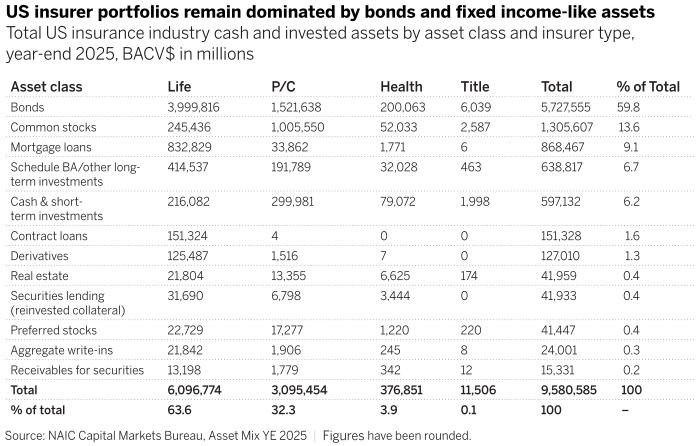
  • Insurance portfolios average 66.1% in fixed income but just 2.8% in real estate. Transitional CRE debt can diversify that concentration through asset-based, rather than issuer-based, exposure.
  • Floating-rate CRE loans with interest-rate floors can provide contractual income across rate environments, potentially helping insurers reduce earnings volatility.
  • CRE debt positions typically classify as commercial mortgage loans (Schedule B) or real estate (Schedule BA), offering a relatively capital-efficient path to private market income.
  • We believe transitional CRE debt has both structural (properties are always in some stage of transition) and cyclical drivers (reset valuations, tighter underwriting, and traditional lenders reallocating and rebalancing).

INSURANCE PORTFOLIOS REMAIN HEAVILY CONCENTRATED IN FIXED INCOME AND CORPORATE CREDIT, leading many allocators to search for durable sources of income and diversification that do not simply add more issuer-based risk. We believe transitional commercial real estate (CRE) debt, a segment that remains underutilized in most insurance portfolios, can address both needs.

To level set, transitional CRE lenders provide first-lien, senior secured loans to institutional owners of well-located properties1 for the purpose of upgrading, leasing, or reprogramming an asset to its highest use. In the current environment, we believe lenders can expect low-to-mid-teens levered yields,2 supported by tighter post-2022 underwriting standards, a US$2 trillion-plus maturity wall driving borrower demand, and reset valuations that could favor new capital deployment.

For more on these market dynamics, see our earlier research:

In this paper, we examine how transitional CRE debt can fit within an insurance portfolio, from its role alongside existing fixed income and real estate allocations to the practical questions of regulatory classification and capital treatment.

Why CRE debt fits the insurer toolkit

For insurers, we believe the starting point is putting a CRE debt allocation into context, particularly given the concentration noted above (Figure 1). Although many insurers, particularly life companies, hold traditional commercial mortgages, that exposure has not translated into broader use of private CRE debt strategies.

Figure 1

Line chart illustrating how stock-bond correlations have been closely tied to inflation expectations in recent years.

In our view, this gap means transitional CRE debt allocations have the potential to improve insurers’ portfolio construction across three key dimensions.

  • Income and earnings stability: Transitional CRE lending aims to generate returns primarily through contractual interest and fees, supporting predictable cash distributions once a portfolio is substantially invested. For insurers seeking to reduce earnings volatility, this profile has the potential to complement longer-duration fixed income holdings. CRE debt loans are typically floating rate and often structured with interest-rate floors, offering the potential to preserve income if base rates fall, while still benefiting if they rise.
  • Diversification beyond corporate credit: Unlike most private credit allocations, which provide exposure to companies or pools of borrowers, CRE debt is fundamentally asset-based lending. These strategies can underwrite specific properties, markets, and business plans rather than adding to insurers’ existing corporate credit concentration. Performance in the asset class is also driven largely by idiosyncratic property-level factors, enabling diversification across geographies, property types, and borrower profiles that is difficult to replicate in other credit markets.
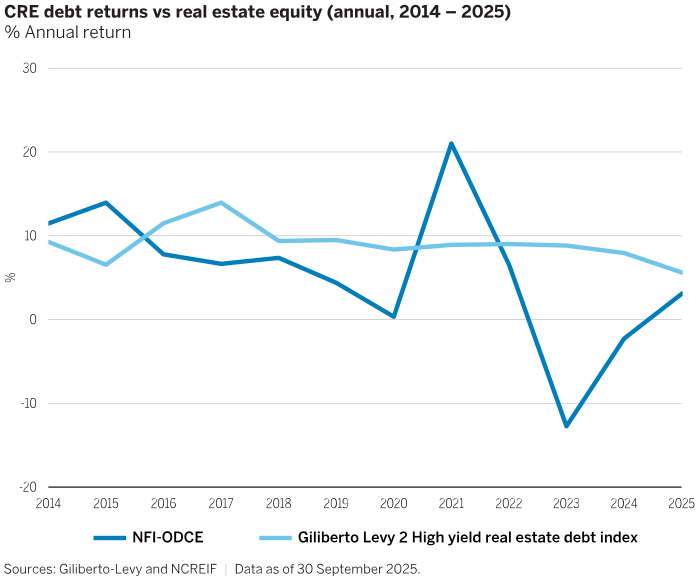
  • Consistency relative to real estate equity: As Figure 2 below illustrates, CRE debt has historically delivered returns in a narrower (i.e., less volatile) band than real estate equity. That relative consistency reflects the asset class’s contractual income profile, lower reliance on asset appreciation, and the fact that returns are not dependent on cap rate compression.

Figure 2

Line chart illustrating how stock-bond correlations have been closely tied to inflation expectations in recent years.

Taken together, transitional CRE debt can serve multiple strategic roles in an insurance portfolio: a complement to corporate credit, a diversifier within private credit, and a way to access real asset value creation with the potential for stronger downside protection than equity.

Diving deeper on classification and capital considerations

For allocators who find transitional CRE debt’s investment case compelling, the next practical question is how an allocation fits within an insurer's regulatory and reporting framework.

Private CRE debt insurance allocations typically sit at the intersection of private credit and real estate. Because these transactions are privately originated, the asset class falls within the broader private credit universe alongside corporate private credit, asset-based finance, and residential real estate debt, among others.

At the same time, for US insurers, private CRE debt is generally categorized as real estate in regulatory reporting rather than grouped with corporate or asset-based private credit. In practice, individual CRE debt positions, such as those held in separately managed accounts, are typically classified as commercial mortgage loans on Schedule B, while LP interests are generally reported on Schedule BA as other long-term assets — real estate. As a result, insurers often discuss CRE debt as part of their private credit allocation from an investment standpoint, while treating it as part of their real estate exposure for regulatory and reporting purposes.

In our view, this distinction matters for portfolio construction. For insurers with meaningful existing CRE holdings, private CRE debt may offer a way to diversify real estate exposure across regions, property types, and asset conditions, including transitional assets. Importantly, they can do so while still potentially benefiting from key private credit attributes, such as: potential yield pickup and illiquidity premium, structural seniority, covenant protection, and the ability to negotiate and actively manage through stress situations.

Capital treatment remains an important consideration, but we believe it is best evaluated in the context of the specific implementation vehicle and local regulatory regime. Across jurisdictions, capital treatment broadly rhymes, even if the exact weighting differs based on regulatory objectives. That said, due to CRE debt’s contractual income, structural seniority, collateral backing, and more defensive attachment points, we believe the underlying risk profile can compare favorably with many other private asset classes. On that basis, we think CRE debt can offer a relatively capital-efficient way to access private market income compared with more equity-like exposures. Actual treatment will depend on the applicable regime, the implementation vehicle, the extent of look-through, and how leverage is recognized.

CRE debt risks to consider

CRE debt allocations carry potential risks that insurers should size and manage carefully. These assets are influenced by execution of the underlying asset business plan, including leasing progress, capital programs, and timing, and outcomes can vary across managers based on sourcing, structuring, underwriting, and asset management capabilities. As a private market allocation, it is also less liquid than public market alternatives, and appraisal-based valuations may adjust more gradually than traded markets. Regulatory and internal guidelines may further shape implementation through concentration and exposure limits.

Bottom line

Insurers accessing the CRE debt asset class have the potential to benefit from contractual cash flow, floating-rate structures, collateral backing, and a broad opportunity set. Moreover, the asset class continues to experience traditional lenders reallocating and rebalancing their exposures, post-2022 valuations potentially creating more attractive entry points, and CRE debt seeing a multiyear, multi-trillion-dollar maturity wall.

We believe transitional CRE debt can provide insurance portfolios with a differentiated mix of current income, downside protection, and diversification, as well as potentially greater capital efficiency than real estate equity. In our view, this is particularly true given that these assets are often underrepresented in most insurers’ asset allocations.

1 Well-located refers to properties located in a top 25 market for the applicable property type based on population size and other sector-specific factors. | 2 Wellington estimates based on commercial real estate debt market transactions. Estimates as of 31 May 2026. Risk and levered return information is illustrative and for informational purposes only and results for actual investments in each sector may vary from these ranges.

The views expressed are those of the authors at the time of writing. Other teams may hold different views and make different investment decisions. The value of your investment may become worth more or less than at the time of original investment. While any third-party data used is considered reliable, its accuracy is not guaranteed. For professional, institutional or accredited investors only.

Experts

Get our latest market insights straight to your inbox.

Read more from our experts