Iceland, Institutional
Change


We focus on being effective stewards of sustainability within our operations.
WellSustain
Our corporate sustainability function, WellSustain, focuses on several operational sustainability frameworks, including supply chain oversight, enterprise risk and firm resilience, and the impact of our carbon-neutrality approach. We believe this work strengthens our ability to service our clients effectively while operating responsibly where we do business.
Renewable energy use
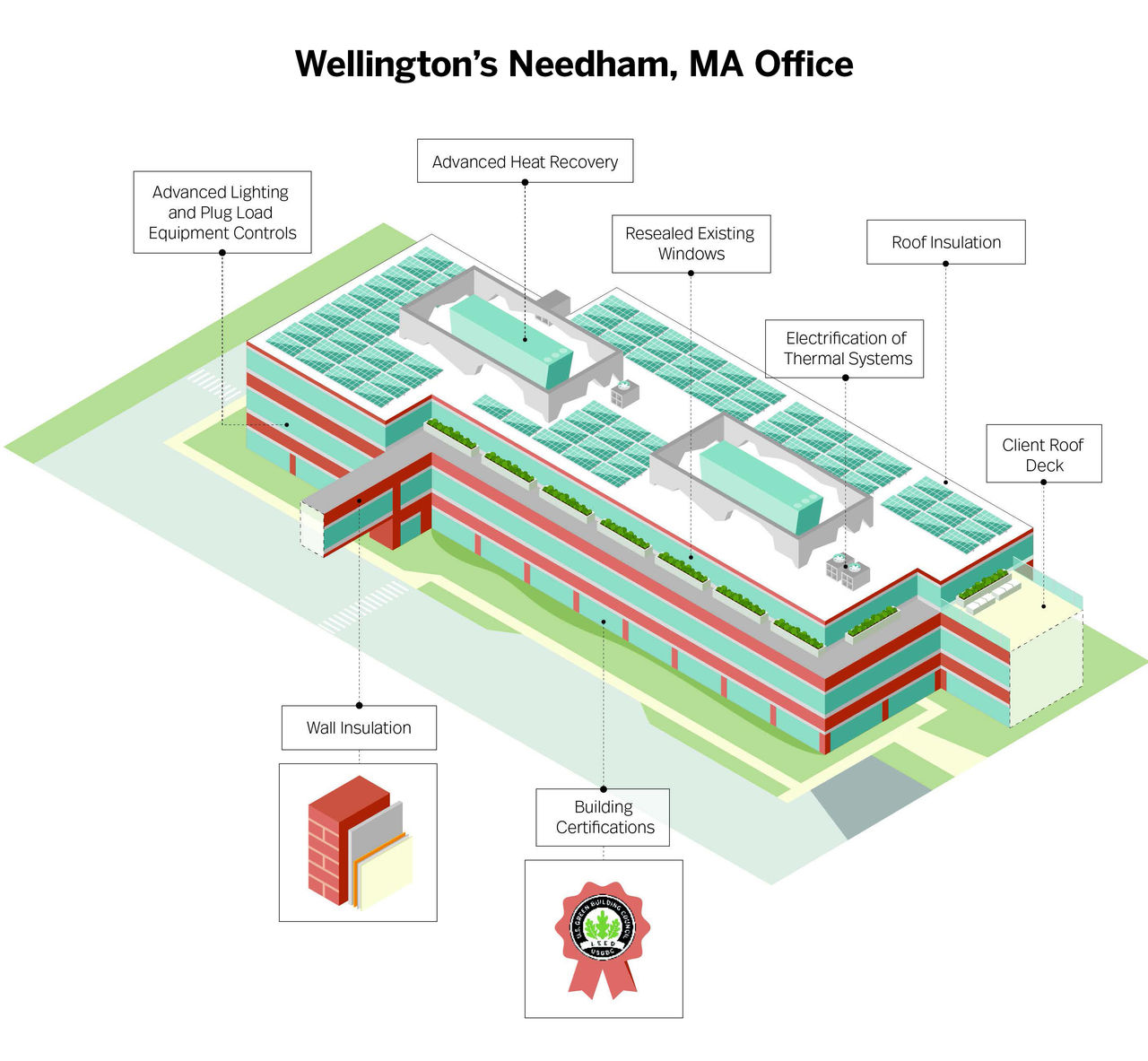
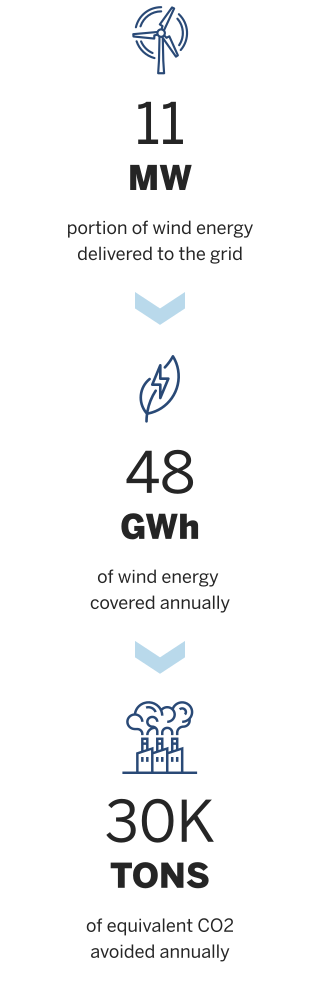
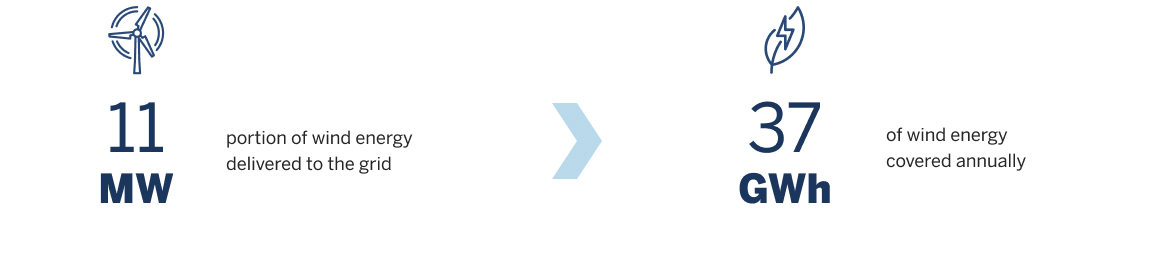
In 2021, Enel Green Power North America and Wellington entered into a 10-year virtual power purchase agreement (VPPA) for an 11 MW portion of Enel Green Power’s Rockhaven wind project. In 2025, this portion delivered approximately 37 GWh to the grid, and an equivalent volume of renewable energy certificates (RECs) to Wellington, which translated to the avoidance of approximately 14.7K tonnes of CO2. Under the agreement, the contracted clean energy is expected to equal or exceed electricity demand for all Wellington US corporate offices and the personal electricity usage of US employees, consistent with our hybrid work approach. To learn more, please see our VPPA FAQ.


- Carbon neutral operations
Impact of carbon credit purchases
This is a dynamic widget from our vendor, CNaught, reflecting credits we purchase. If you click into the widget it will take you to the Wellington | CNaught site that provides more details.
Sustainable business travel
Wellington Management’s approach to sustainable business travel focuses on reducing environmental impact while supporting essential business needs by providing employees with guidance and tools to make informed travel decisions. We encourage employees to assess the necessity of travel and select lower-emission options where feasible, supported by a preference for rail over air on high-frequency routes and by working with travel partners that demonstrate commitments to decarbonization, including investments in fuel efficiency, sustainable aviation fuel, and renewable energy. This approach is designed to balance operational requirements, client expectations, and long-term sustainability objectives, while continuously identifying opportunities to improve efficiency and reduce emissions across our global travel program.

Managing our supply chain responsibly
We take seriously our obligations to prevent modern slavery and human trafficking and are committed to taking appropriate steps to ensure that the requirements of Australia’s and the UK’s respective Modern Slavery Acts are met within our business supply chain. Links to our Modern Slavery statements can be found on our website.
Mitigating modern slavery risk in our supply chain
We have a centralized sourcing function for Wellington’s vendor contract processes. The contract managers collaborate with our Third-Party Risk Management (TPRM) Team, which initiates due diligence for new suppliers and conducts periodic reviews for certain existing suppliers. To identify and mitigate modern slavery and human trafficking risk, we have taken a risk-based approach to our evaluation. Where applicable, we may incorporate modern slavery-related provisions into our contractual agreements. We may also ask a supplier to provide information about its necessary actions to prevent or remediate modern slavery in its business or its supply chain. We identify and review third-party service providers for potential modern slavery risks during onboarding, based on risk factors such as the party’s industry and country of operation. Should we find any supplier using modern slavery in any part of its supply chain and/or its business, we will initiate remediation discussions and potentially terminate the contract. The nature of our business, along with the high standards we have for ourselves and our suppliers, has helped ensure that the risk of slavery and human trafficking in our supply chain is low. Regardless, Wellington takes a risk-based, case-by-case approach to supplier evaluations. Each evaluation takes into account the supplier’s geographic location(s) and the sector(s) in which it operates, with particularly careful consideration when a supplier operates in a region and/or industry that has been determined to be more susceptible to slavery and human trafficking.
Supplier access & resilience
At Wellington, we are unwavering in our belief in the power of differences and inclusivity. We are building a supply base that promotes fair access, competition, and resilience among providers of goods and services to our firm. We manage and assess a variety of vendor and supplier relationships solely based on merit, performance, risk management, and value, consistent with our fiduciary duty to clients. In support of best execution and operational resilience, we partner with a broad range of brokerage firms and local small businesses and seek to reduce unnecessary barriers to supplier participation across our procurement and trading activities. We continue to raise internal awareness of opportunities to expand our supplier ecosystem while maintaining objective, non‑discriminatory vendor selection and oversight processes. We will continue to manage and assess our vendor and supplier relationships in the best interests of our clients.
Mitigating other forms of supply chain risk
Finally, we are committed to minimizing the environmental impact of our operations and fostering a culture of sustainability. We aim to measure, report, and continuously improve our environmental performance globally. We favor suppliers who demonstrate responsible resource use, waste reduction, and environmentally conscious practices appropriate to their size and impact. Suppliers must comply with all applicable environmental laws and are encouraged to adopt internal policies and systems that support environmental risk management and transparency. We value constructive engagement and expect suppliers to monitor and disclose material environmental risks, in alignment with evolving global standards such as IFRS S2. Please refer to Wellington’s Supplier Code of Conduct for details about our supply chain risk-management approach.”