



- Technology Sector Lead, Growth Lending
Iceland, Institutional
ChangeThe views expressed are those of the authors at the time of writing. Other teams may hold different views and make different investment decisions. The value of your investment may become worth more or less than at the time of original investment. While any third-party data used is considered reliable, its accuracy is not guaranteed. For professional, institutional, or accredited investors only.
The US venture ecosystem has undergone a fundamental transformation. Companies are staying private longer, valuations have increased significantly, and capital deployment has concentrated in sectors like AI. Meanwhile, a slower IPO market, tighter fundraising conditions, and overall liquidity pressures (as LPs have experienced three consecutive years of negative net cash flows1) have constrained founders and investors alike.
Growth lending, also known as venture debt, has increasingly emerged as a complementary source of capital in this market. High-growth companies see its potential to help them extend their runway, expand product offerings, or finance acquisitions. For asset owners, growth lending represents a segment of private credit that offers exposure to the innovation economy with a differentiated risk-return profile. Critically, it combines this with senior-secured positioning, steady income, and measured upside potential through warrants or success fees.
In a capital-constrained venture environment, we believe growth lending has become a critical, institutionalized financing channel. In this piece, we dive into this asset class in six sections:
1. Market context: Funding gap, institutionalization, and more
4. Structural features of growth lending
The environment described above has reshaped financing behavior across the market. The growth-lending asset class has evolved to help fill the venture funding gap and later-stage private companies increasingly see the potential for its flexible, less-dilutive debt financing.
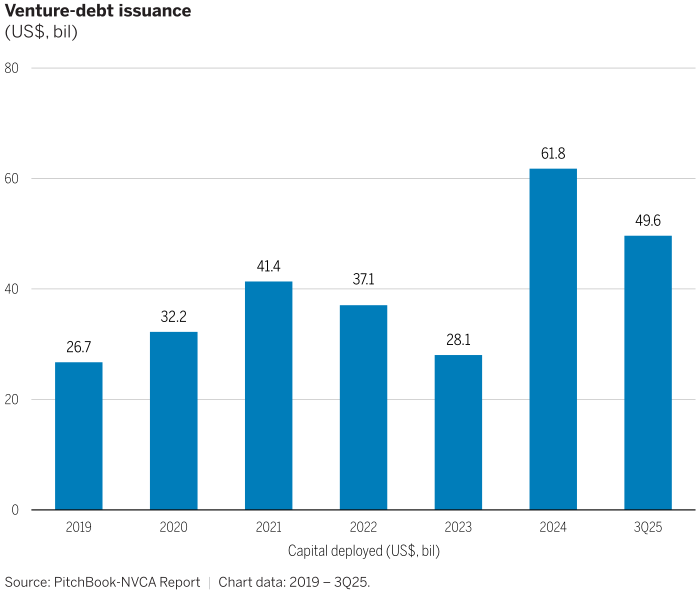
Perhaps unsurprisingly, growth lending has experienced faster growth than venture equity and has matured from a niche strategy to a central pillar of the venture financing landscape. In fact, over the past decade, venture debt has expanded at an estimated 15% compound annual growth rate (CAGR), compared with roughly 9% for total venture-equity investment.2 The asset class reached US$50 billion in issuance in the first three quarters of 2025, following 2024’s record of US$62 billion (Figure 1).
Figure 1
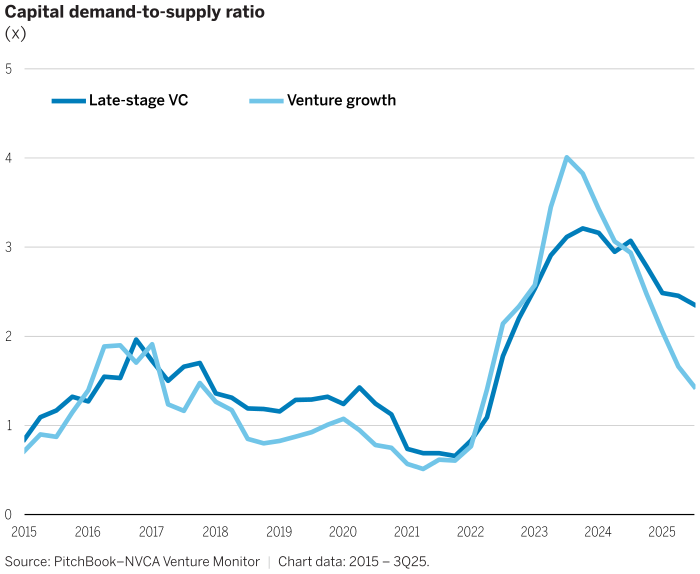
Capital demand also now outpaces supply substantially, with a ratio of 2.4x for late-stage growth companies as of mid-2025 (Figure 2). At the same time, venture capital fundraising remains at its lowest level in seven years.3
Figure 2
Growth lending provides senior-secured loans to venture-backed, high-growth companies that have reached meaningful scale but are not yet consistently profitable. These borrowers typically share four key characteristics:
Unlike traditional lending, growth lending is underwritten primarily based on a company’s enterprise value and growth trajectory rather than historical cash-flow coverage. Credit analysis in this space integrates quantitative metrics such as annual recurring revenue (ARR) growth, retention rates, and gross margins, as well as qualitative factors like market leadership, business model scalability, and investor support.
The institutionalization of growth lending
Once considered a niche strategy dominated by specialist banks, venture debt has matured into a fully institutionalized asset class. Today, nonbank lenders, private-credit funds, and business development companies (BDCs) lead the market, supported by experienced teams, scalable investment platforms, and robust underwriting processes.
Technology companies account for nearly 90% of venture-debt deal value, led by borrowers in AI, SaaS, and digital infrastructure.4 The average late-stage loan size has more than tripled since 2024, reflecting both the growing scale of borrowers and lender confidence in the asset class.5 As venture lending has matured, deal structures increasingly mirror those in institutional private credit, emphasizing recurring revenue, efficient unit economics, and strong sponsor alignment.
We believe a common misconception is that lending to venture-backed companies entails excessive credit risk. In reality, structural safeguards, conservative leverage, and institutional sponsorship create a risk profile that has historically compared favorably with other forms of private credit.
Growth lenders operate at the top of a company’s capital structure, typically lending at loan-to-value ratios below 25%, compared with 40% – 60% in traditional middle-market loans. A company’s equity value would therefore need to decline by roughly 75% before principal risk would become material. Borrowers are also usually supported by experienced venture or growth-equity sponsors who have both the capital and the incentive to sustain enterprise value, providing a material equity cushion beneath the lender.
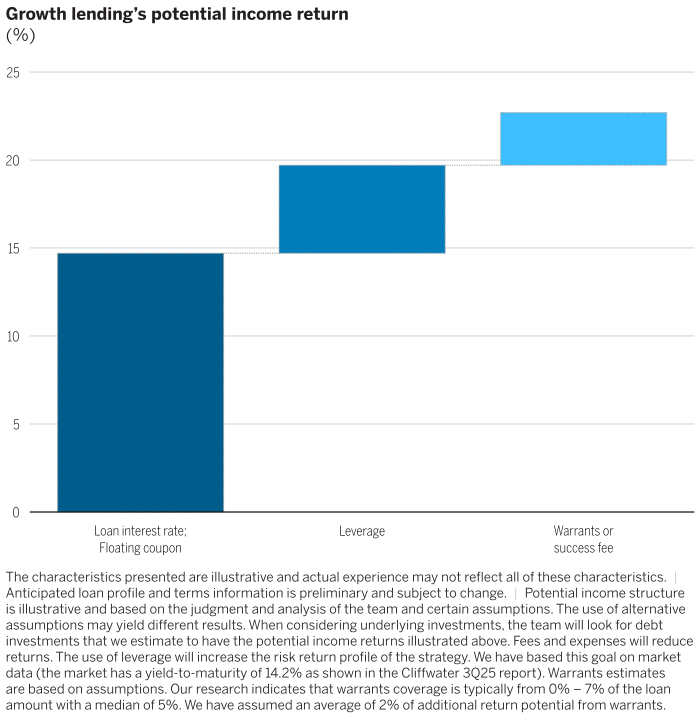
Moreover, strong loan returns do not depend on strong equity returns. Because growth loans occupy a senior-secured position and represent only a fraction of a company’s enterprise value, lenders are repaid before equity investors realize gains or losses. Interest payments also provide predictable, periodic income, and warrants and fees offer additional upside potential. Finally, even when equity returns are muted, the contractual nature of debt, combined with recurring interest payments and sponsor support, offers growth lenders the potential to generate attractive, stable returns. As of mid-2025, the average unlevered yield to maturity for loans to venture-backed companies was approximately 14% – 15%, with total return potential exceeding 20% when warrant gains are realized.6
Importantly, today’s environment enables growth lenders to be highly selective, focusing on fundamentally sound borrowers and structuring credit for downside protection. Growth loans also incorporate well-defined covenants and performance triggers that allow lenders to act proactively before distress occurs. In practice, realized losses in the venture-debt market have averaged less than 1% annually since 2005.7
As noted above, growth-lending structures are designed to combine attractive income potential with meaningful downside protection. Loans are typically issued at floating interest rates, most often 400 to 500 basis points above the prime rate and generally include rate floors to protect against declines in benchmark rates. In addition to interest income, lenders earn a mix of origination, end-of-term, and prepayment fees that can total between 1% – 7% of the loan amount. Loan maturities typically range from three to five years, although most are repaid within two to three years.
A distinctive feature of growth lending is the inclusion of warrants or success fees, usually representing 3% – 5% of the loan amount. This allows lenders to participate in a company’s upside when a liquidity event or acquisition occurs. This equity-linked element creates the potential for an asymmetric return profile that enhances total returns in favorable outcomes without materially increasing downside risk. In general, fund-level leverage is also modest, at historically around 1x, underscoring the asset class’s focus on credit quality and structure rather than financial engineering.8
Risk management is fundamental to the asset class. Unlike many middle-market loans that have become covenant lite, growth-lending facilities usually include meaningful financial covenants, such as minimum liquidity, cash-burn, or revenue/growth thresholds. These are typically paired with restrictions on leverage, acquisitions, and dividends. Lenders also conduct active portfolio monitoring, tracking operational metrics such as ARR trends, customer concentration, and cash runway. This combination of formal covenants and hands-on engagement allows lenders to identify issues early and work closely with management teams to preserve enterprise value.
Most loans are senior secured and backed by an all-asset lien, ensuring first-priority recovery in downside scenarios. Together, these features create a structure that has historically delivered consistent income and modest equity-linked upside while maintaining strong credit protections that have historically resulted in low loss rates and resilient performance across market cycles.
Figure 3
For institutional investors, we believe growth lending offers a compelling entry point into the private-markets landscape. It combines current-income characteristics and credit protections typical of private credit with access to innovation-driven companies more commonly associated with venture equity.
Returns have historically been anchored by mid-teens unlevered yields and enhanced by warrant participation that can add modest equity upside.9 Floating-rate coupons can also provide a natural hedge against inflation and rising interest rates, while short loan durations contribute to faster capital turnover. Historically, the asset class has seen low default and loss rates, which further reinforce the space’s potential risk-adjusted appeal.10
Because returns are driven primarily by borrower performance rather than market valuations or IPO timing, growth lending has historically exhibited low correlation with both public equities and traditional venture funds.11 For asset owners seeking yield, diversification, and exposure to high-growth sectors through a credit-based approach, growth lending can provide a differentiated source of alpha within private markets.
Growth lending presents unique challenges, as it involves lending to innovative companies that are often burning cash and are reliant on future fundraising or on reaching profitability. Success in this asset class depends on a lender’s ability to evaluate company-specific factors, such as business model resilience, growth trajectory, and sector dynamics, rather than relying solely on historical financials. The unpredictable nature of the venture ecosystem and the idiosyncratic performance of individual firms can lead to outcomes that diverge sharply from initial expectations.
Mitigating these risks requires a disciplined, company-by-company approach. In our view, each growth-lending opportunity should be assessed on its own merits, and lenders must have deep sector expertise and robust credit frameworks to determine true enterprise value and durability. Ultimately, we believe downside risk is best addressed through careful loan structuring, the implementation of meaningful covenants, and by maintaining close alignment with sponsors and management teams from the outset.
Bottom line on growth lending
In our view, the US growth-lending market has reached structural maturity. As venture-backed companies continue to scale privately and asset owners seek yield with greater risk discipline, the asset class has continued to prove itself to be both resilient and essential.
We believe several dynamics are expected to shape its continued growth:
With record issuance, improved underwriting standards, and a broadening investor base, we believe growth lending has transitioned from a tactical financing tool to a strategic cornerstone of modern private markets. For institutional investors, it represents the intersection of innovation and income and offers the potential to capture the growth of the innovation economy through secured credit.
1Source: PitchBook–NVCA Venture Monitor (Q3 2025). | 2Ibid. | 3Source: Pitchbook-NVCA Report (3Q25). | 4Source: Pitchbook-NVCA Report (3Q25). | 5Ibid. | 6Source: Cliffwater Direct Lending Index Report (3Q25). | 7Ibid. | 8Historic GAAP leverage ratios from public BDCs that have an investment style focused on venture lending as stated on their SEC filings. Leverage of 1x implies a 1:1 debt-to-equity ratio. | 9Source: Cliffwater Direct Lending Index Report (3Q25). | 10Ibid. | 11Source: Venture Lending Index correlation to Venture Capital 0.55, Private Equity 0.49 and Public Equities 0.24. Data from 2Q05 – 2Q25, Growth Lending is represented by Cliffwater Direct Lending Index – Venture Lending, Venture Capital represented by Cambridge Associates Venture Capital Horizon Index, Private Equity represented by Cambridge Associates Private Equity Horizon Index, Public Equities represented by the Standard & Poor's 500 Composite Stock Price Index.
Experts