





- Fixed Income Portfolio Manager, Credit Analyst
Iceland, Institutional
ChangeThe views expressed are those of the authors at the time of writing. Other teams may hold different views and make different investment decisions. The value of your investment may become worth more or less than at the time of original investment. While any third-party data used is considered reliable, its accuracy is not guaranteed. For professional, institutional or accredited investors only.
There’s no denying high-yield-bond, or junk bond spreads are rich, or narrow, relative to history. High-yield spreads are roughly 280 basis points (bps) today, with BB and B rated spreads of 175 bps and 275 bps, respectively. Both quality buckets are trading close to historical tights. This means there’s limited pricing differentiation across these bonds. Typically, when the market is trading tight, it’s best to be a little bit more defensive because investors aren’t being compensated for additional credit risk.
Despite rich spreads, we believe segments of the high-yield market are relatively attractive today. CCC rated bonds may be worth exploring because if the market continues to grind along its current trajectory, we could see further compression among ratings categories. We’ve seen this happen in the past and believe that even though broad high-yield spreads are tight, CCC rated bonds have room to tighten more compared to BB or B rated bonds, which trade tighter relative to history (Figure 1).
Figure 1
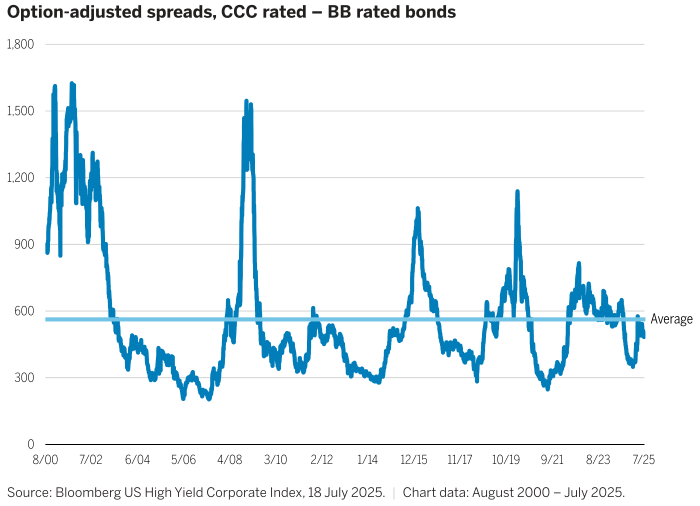
If the US ends up in a favorable tariff deal with China and/or the US Federal Reserve (Fed) cuts interest rates in September, CCC rated bonds may be pushed tighter, leading to potential outperformance compared to high-yield bonds in other ratings categories. On the flip side, if these events don’t come to pass, or market spreads widen, we anticipate BB and B rated bonds would widen just as much as their CCC rated peers, because they would simply be returning to their average levels from their current position, near all-time levels of tightness. Overall, we believe the upside/downside skew for CCC rated bonds is more favorable relative to BB or B rated bonds.
So, no matter which direction markets take, there’s a case to be made that bonds in the lower-quality high-yield space are attractive. What’s more, given CCCs are yielding close to 11%, we believe they look compelling from a fundamental perspective. At current CCC yields, we’re being compensated for more than just higher default risk. By using historical recoveries and default probabilities for each ratings category, we can infer what implied risk premium the market is assigning to each ratings bucket.
As a group, CCC rated bonds represent 13% of the high-yield index. However, generalizing about this group is difficult; the constituents are vastly different. Several industries are represented in this space, including:
Some CCC rated bonds trade on a relatively tight basis, while others trade much wider and are likely to default. Thus, the dispersion of returns within the group is significant. This is why many managers avoid this cohort entirely, but it’s also why we believe there are opportunities.
It’s not possible to invest specifically in a CCC index and there are many more higher-quality high-yield funds than low-quality ones, but we believe this space is ripe with opportunities. Among CCC rated bonds, there may be credits with misrated spreads, meaning they could be more attractive than they first appear. Skilled active managers with thorough research capabilities may be well positioned to identify the CCC rated companies with stronger annual return potential and relatively lower default risk to diversify fixed income allocations. We believe these types of managers may have an upper hand in generating higher total returns and alpha in client portfolios.
Experts