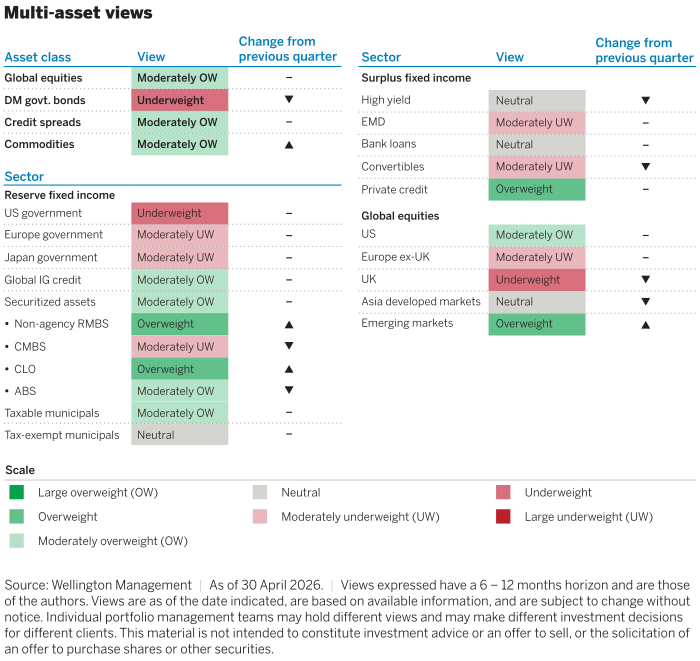
As we’ve seen in prior shocks, markets tend to front-load a repricing of valuations before meaningful earnings downgrades come through. Through the end of March, the decline in the 12-month forward PE on global equities was similar in magnitude to the adjustment following Liberation Day. While there may be earnings downgrades to come, the price adjustment is close to the average for conflicts historically, but not at the extremes of major energy shocks such as the Ukraine war in 2022 and the Iraq war in 1990. On the sentiment and positioning side, a fair amount of adjustment has occurred, but not a full capitulation.
Again, we are balancing out these competing elements to arrive at our slight equity overweight. Given volatility related to the conflict, we would need to see a further downside adjustment or upside catalysts relating to a resolution of the conflict before we would take a stronger overweight view.
On a regional basis, we have an overweight view on EM against the UK. Overall, AI-demand visibility remains strong through 2027, and as noted, emerging markets in Asia are critical to the AI supply chain. China’s resilience during the conflict has also stood out. The country’s energy stockpiles and diversified energy sources have helped, and there are policy levers available to help smooth any negative effects — even as recent activity data has surprised on the upside.
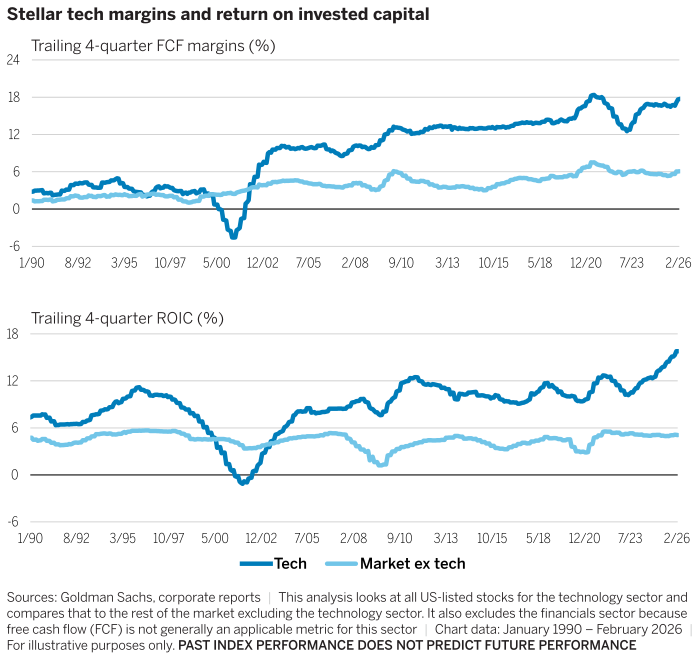
We have moved to a small overweight view on the US against Eurozone equities. This largely reflects a gap between relative earnings fundamentals and relative price performance, with this gap favoring the US in our view. Relative sentiment captured in investment surveys is also more positive on Europe than on the US and may be due for a reversal. Meanwhile, US mega-cap tech companies have seen a big adjustment in relative valuations, making them attractive again from a PE perspective. Both the UK and Europe ex-UK suffer from a weak earnings outlook, though the UK’s relatively high exposure to the energy sector provides some offset.
Commodities
Prior to the war, we maintained a modest underweight view on oil, but the hostilities and the surge in oil prices led to a considerable widening of possible outcomes for the asset class with the skew toward the higher end. That heightened uncertainty, combined with exceedingly high costs associated with rolling positions at the front end of the curve, rendered the risk/reward profile of our underweight view untenable, and we shifted to a neutral view.
Meanwhile, we used the recent sell-off in gold to introduce a slight overweight view. While there has been some clearing out of long positioning in gold since the war began, leaving it to behave like a risk asset, we believe the fundamental case for the precious metal, including strong long-term demand potential and diversification away from the US dollar, remains intact.
The biggest risk to our long-term bull thesis for gold is the possibility that central banks will become net sellers due to capital needs from the war. This keeps us from moving to a larger overweight view, despite the potential we see for significant excess returns relative to cash. Importantly, we’d push back against the idea that gold is an inflation hedge, as correlations here are weak or nonexistent. The primary long-term relationships are negative correlations to the US dollar and real yields. We don’t see significant upside emerging in either, but a fundamental reengagement with a bull case in the dollar is an additional risk.
Regulatory developments
In the US, as part of the ongoing CLO C-1 factor modeling project, the NAIC’s Risk-Based Capital Investment Risk and Evaluation Working Group conducted a conference call on April 10 for the American Academy of Actuaries to present their analysis on the residual. Their analysis showed that while the losses vary depending on the accounting methodology used (the allowable earned yield (AEY) method or a practical expedient method), they have not found support to change the RBC factor for like insurers from the current 45%. As of this writing, their analysis was scheduled to be exposed for public comment and further discussed on May 6.
For the debt tranches, final factors are still expected to be available later this quarter, absent any significant change requests from the regulators. We believe the end state of this study will result in very modest capital charges for senior-most tranches and increases in capital charges for thinner mezzanine tranches. This reflects cliff risk for those tranches during correlated default and loss periods.
In Europe, the European Commission published Commission Delegated Regulation (EU) 2026/269 in the Official Journal on 18 February 2026, amending Delegated Regulation (EU) 2015/35. While the substance of these changes had already been developed and agreed as part of the Solvency II Review in 2024 – 2025, this publication marks the point at which the updates become final and legally binding. The regulation includes revisions across a wide range of areas, including adjustments to spread risk calibrations for securitizations (both STS and non-STS), a reduction in the correlation between spread risk and interest-rate risk within the SCR market-risk module, updates to the interest-rate risk model, and changes to the volatility adjustment, among other modifications. Most of these changes are expected to apply from January 2027, following the agreed implementation timeline.