



- Impact Measurement & Management Practice Associate
Finland, Institutional
ChangeThe views expressed are those of the authors at the time of writing. Other teams may hold different views and make different investment decisions. The value of your investment may become worth more or less than at the time of original investment. While any third-party data used is considered reliable, its accuracy is not guaranteed. For professional, institutional, or accredited investors only.
As the world grapples with escalating environmental and social challenges, companies face great pressure to provide solutions. Governments cannot solve the world’s biggest problems alone, and with more than 80% of the United Nations Sustainable Development Goals (SDGs) off track from their 2030 targets, companies and other issuers may be key to narrowing the gap between ambition and outcome.
Many in the impact investing community, including our teams, have embraced the complexity of the SDGs with a rising focus on multi-theme investments. With fixed income in particular, the scale and scope of credit instruments, including green, social, and sustainability bonds, provide opportunities to invest in issues that deliver positive impact across themes and goals. Here, we explain why we classify a growing number of investments in our portfolio as multi-theme, and how we measure and track the multifaceted impact they have.
Driving the rise of the multi-theme impact focus is the increasing realization of the inherently interconnected nature of the SDGs. Progress in one goal often catalyzes improvements in others. For instance, expanding access to affordable and clean energy (SDG 7) not only helps reduce poverty (SDG 1), but also enhances public health (SDG 3), improves educational outcomes (SDG 4), and promotes gender equality (SDG 5) by alleviating the burden of fuel collection that largely falls to women and girls.
Certain large issuers, such as development banks, often directly advance specific SDGs while indirectly contributing to others through broader initiatives. Impact investors are acutely aware that falling short on one goal can limit progress on others, which is why multi-theme approaches are so critical. Investments can (and should) reflect the complexity of sustainable development while helping to ensure that capital is directed in ways that support inclusive, resilient progress across a spectrum of challenges. Identifying a potential multi-theme impact investment is one thing; setting and tracking progress across multiple key performance indicators (KPIs) is another.
Classifying an investment as multi-theme reflects careful, evidence-based analysis. Measuring the full scope of a multi-theme issuer’s impact is, by definition, more complex. When selecting KPIs, our Impact Measurement & Management (IMM) Practice weighs data accuracy, relevance to the theory of change, and regular disclosure to track progress consistently over multiple years.
For multi-theme issuers, this approach can lead to a preferred KPI of “capital committed,” which typically captures the breadth of an issuer’s initiatives. Because this metric alone does not convey the outcomes achieved once projects are implemented, we believe that data analysis and qualitative reviews of annual reports and case studies from each multi-theme issuer are essential. In our view, this combination has demonstrated impact from both scale — through consistent and credible numbers — and depth, by uncovering the real-world outcomes of the projects supported. Taken together, we believe these perspectives offer a more holistic understanding — and better tracking — of the impact of our multi-theme holdings.
An investment in AfDB, a large, supranational organization with extensive reach, illustrates both the nuances and the rigorous analysis involved in multi-theme classification.
Initially, we classified AfDB under our strategy’s sustainable agriculture & nutrition theme, reflecting its significant agricultural lending program. At the time, this seemed like the most appropriate alignment for our portfolio. However, the impact KPI we selected to measure the bank’s lending progress showed fluctuations over time. This prompted our IMM Practice to engage with the bank to understand the reasons behind these shifts. Through this engagement, it became clear that loan volatility did not stem from weak agricultural outcomes, but rather from changes in how the bank allocated its loan portfolio.
While agriculture remains a core focus for the bank, it is only one part of a broader strategy to holistically advance development through its “High 5” priorities: Light up & power Africa, Feed Africa, Industrialize Africa, Integrate Africa, and Improve the quality of life for the people of Africa. We decided that limiting the issuer’s classification to a single impact theme would have failed to capture the full breadth of the bank’s contribution across health, education, financial inclusion, and alternative energy, for example.
To more accurately reflect AfDB’s diverse activities and interconnected impact on sustainable development, we updated its classification in our portfolio to multi-theme. In accordance with that change, we also updated our core KPI from one focused on agricultural loans to funding allocated across the High 5 priority areas. As part of our annual KPI collection process, we will continue to review and validate this alignment to ensure it remains a fair representation of the bank’s work and our investment objectives.
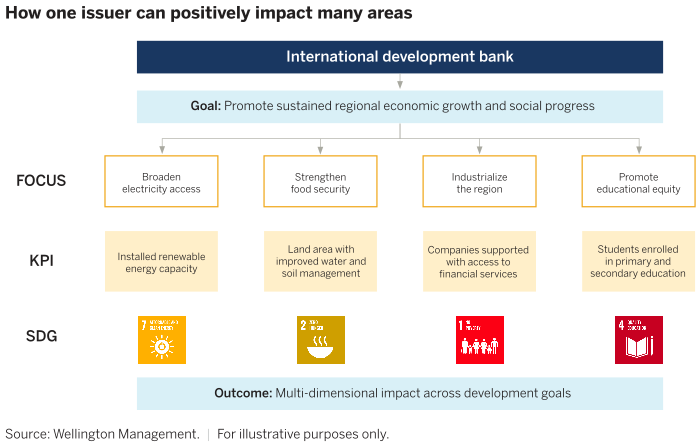
Figure 1 illustrates a strategy commonly adopted by international development banks, including AfDB. Each area aligns with specific SDGs, yet progress in all areas is vital to advancing sustainable development and sustained economic growth.
Figure 1
In an increasingly interconnected world, where sustainability challenges span sectors and borders, multi-theme impact classification has and will likely continue to play a pivotal role in capturing the full scope of an issuer’s contribution to sustainable development. Far from being a compromise, the multi-theme designation reflects a rigorous, evidence-based approach that acknowledges the crosscurrents of impact. By combining quantitative metrics with qualitative insights, including through annual evaluations and regular issuer engagements, our impact investment team aims to ensure that each multi-theme classification remains accurate, meaningful, and aligned with the evolving realities of global sustainability efforts.
Experts