Finland, Institutional
Change




This is an excerpt from our Investment Outlook, in which specialists from across our investment platform share insights on the economic and market forces that we expect to influence portfolios.
Key points:
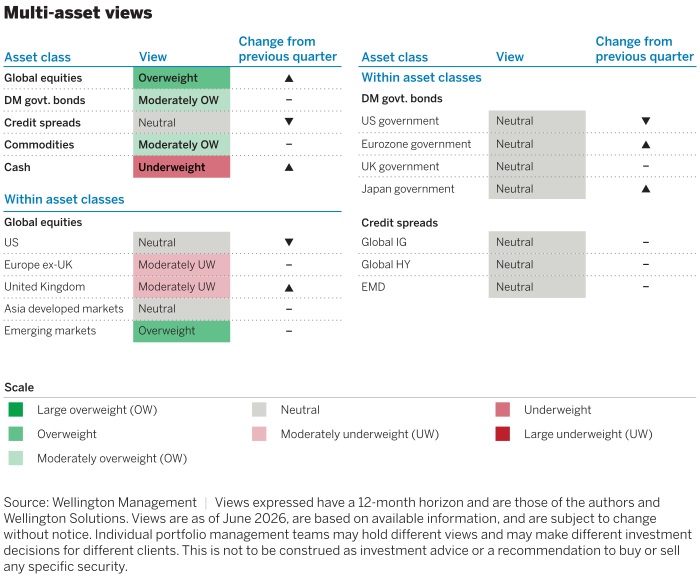
- We have raised our view on global equities to overweight. Despite geopolitical headwinds, companies continue to generate strong earnings and the global economy remains resilient, with some regional variation. Equity valuations have also adjusted to more reasonable levels over the past few quarters. We expect earnings growth to remain buoyant, though driven largely by demand through the AI supply chain. The market advance is still narrow, although earnings growth is picking up in parts of the market.
- Among equity markets, we favor emerging markets (EM) over Europe. We think EM Asia should benefit from the AI theme, given its critical position in the supply chain, but can also benefit from an improvement in prospects for India and China. Earnings per share (EPS) expectations for Europe remain unrealistically high and stagflationary effects are likely to be more acute there.
- Markets have priced tighter policy across the globe. Fears ranging from inflation to stagflation are likely to dominate over the near term and central banks have moved to a hawkish stance. However, higher real yields present an opportunity to favor government bonds. We have turned neutral on credit given significant tightening in spreads.
- We have a moderately overweight view on commodities, expressed in oil, where the market is already pricing in the resumption of a surplus, even as significant uncertainties remain around exports from the Middle East and demand growth.
- Downside risks include high levels of leverage among retail investors and market concentration in the US and EM. The market’s ability to digest net issuance from blockbuster IPOs or a big shift in expectations for AI capex leading to a bust could be concerns. So could a sharp rise in interest rates and the US dollar. Upside risks include renewed hopes for central bank rate cuts enabled by an end to the Middle East conflict and a restoration of oil supply. More broadening in markets beyond technology would be a positive sign for equities.
Overview
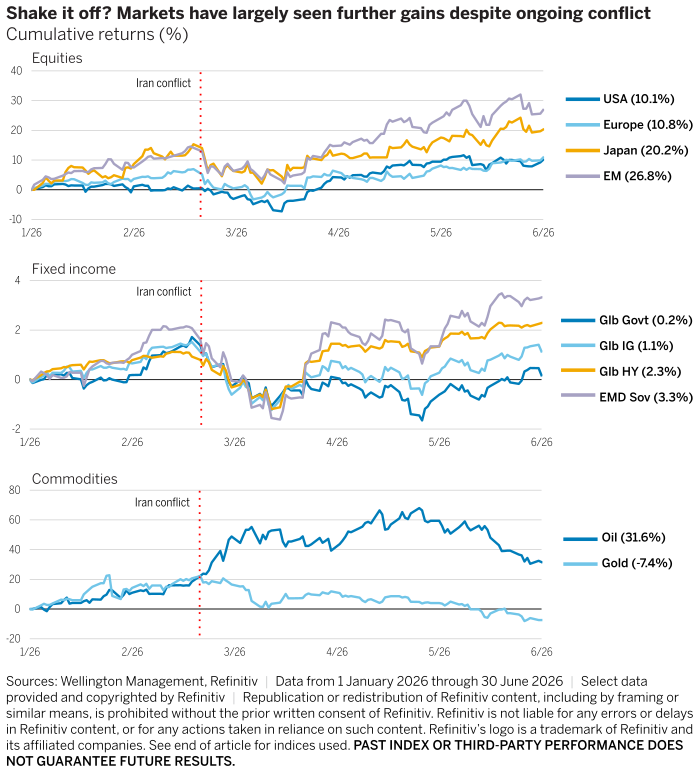
The macro and market backdrop has surprised us on the upside despite the tug of war with geopolitical risk (Figure 1). There has been an incremental pickup in maritime traffic through the Strait of Hormuz, but energy supplies remain heavily disrupted and inflation risks are higher than before the war, with stagflationary pressures elevated in some regions, including Europe.
What explains the economic and market resilience? The AI-driven earnings boom has enabled the market to absorb the geopolitical disruption. In a testament to their adaptability, companies have beaten expectations in the face of extreme uncertainty, and the upshot of strong expectations is that equities have cheapened significantly. Continued robust AI demand combined with supply constraints (in compute, memory, and power) is extending the AI spending cycle into 2027 – 2028 and creating attractive opportunities as AI bottlenecks drive pricing power.
On the policy front, most central banks have moved quickly to establish credibility on inflation, signaling a degree of willingness to look past any signs of faltering growth in favor of a hawkish stance to address inflation. The European Central Bank was a notable first mover, hiking rates in June, and other central banks may be poised for similar inflation-minded moves.
With respect to oil prices, one reason we did not see worst-case scenarios come to pass is that countries drew extensively on their reserves; stockpiling by China and other countries also helped alleviate the pressure. However, a slow normalization of traffic in the Strait of Hormuz will raise upside risks for oil prices given lower inventory levels.
Our expectation of strong earnings growth amid more moderate valuations has led us to increase our equity view to overweight and to express a preference for EM over Europe. We have turned neutral on credit amid a significant tightening in spreads while keeping our moderately overweight view on global duration. Breakeven inflation rates have compressed significantly but we think real yields — particularly in the front end of the yield curve — are too high in many regions.
Figure 1
Equities
Despite the effects of the Middle East conflict, conditions for equities have remained supportive, driven by strong earnings revisions and a resilient manufacturing cycle. The durability of the global earnings and macro cycle is a sign of the profound impact of the technological shift we’re witnessing and the capex wave it’s fueling.
In nearly every market except Japan, virtually all the year-to-date gains in equities have been driven by EPS growth. Given that returns have been tied to earnings, valuations have de-rated and we don’t expect them to be a headwind.
Looking ahead, we think the market's performance will come down to earnings expectations, which we estimate will be in the low- to mid-double digits for global equities over the coming 12 months, with some room for modest valuation expansion. In our view, high expectations for EPS growth over the short- and mid-term are justified. Beyond earnings, balance sheets are strong, with relatively low debt to equity and high operating cash flows to debt.
There are incipient signs of equity market broadening. This includes a growing awareness of the layers beneath the big AI names, including the companies supporting the AI-driven build-out of infrastructure, chips, energy, and other parts of the economy. The recent outperformance of US small caps relative to large caps and the underperformance of hyperscalers relative to areas such as industrials and financials are also indications of some rotation coming through. Amid this rotation, volatility has picked up, and any technical correction driven by these dynamics would, in our view, present a tactical opportunity to add exposure, given solid fundamentals.
We have moved to a neutral view on US equities. Earnings growth remains robust and valuations appear reasonable. The spate of IPOs will likely drive positive to neutral net issuance this year. While we expect the market to absorb this new issuance, we think the growth in net issuance and larger deal sizes could make equity supply something of a headwind for the market over the coming 12 months. We do not see evidence of stretched positioning in aggregate across a range of investor groups, but there are signs of exuberance in some areas, such as leveraged ETFs.
In Europe ex-UK and the UK, we think earnings expectations remain too high and stagflationary concerns are more relevant. France and Germany have been hurt by competition from China, and risks related to political instability in France ahead of the 2027 presidential election could weigh on sentiment. We would stress, however, that we are not negative on Europe and there is potential for positive surprises, such as progress on financial markets reform in the European Union (EU) or quicker-than-expected deployment of fiscal stimulus in Germany.
Relative to Europe, we have a higher-conviction view on EM equities. Emerging markets in Asia are critical to the AI supply chain. In addition, China’s resilience during the Middle East conflict has stood out.
We are neutral on Japan. The market continues to benefit from buybacks, high/improving return on equity (ROE), and corporate reforms, but we are concerned about the potential for blowback from rate and currency volatility at a time when valuations are more stretched, based on some metrics, than they have been for some time.
Fixed income
While yields moved modestly lower after the US and Iran began discussing a peace deal, they remain elevated given continued inflation risks and hawkish central bank positioning. Global growth has remained largely resilient throughout the crisis, particularly in the US, offering some central banks breathing room to focus on inflation via rate hikes. However, it’s possible that markets may be overestimating future policy tightening. A lasting resolution to the conflict would likely ease energy-driven inflation pressures. In addition, evolving policy frameworks that emphasize any evidence of limited secondary inflation effects or real-economy softening could test central bank willingness to follow through on hawkish rhetoric.
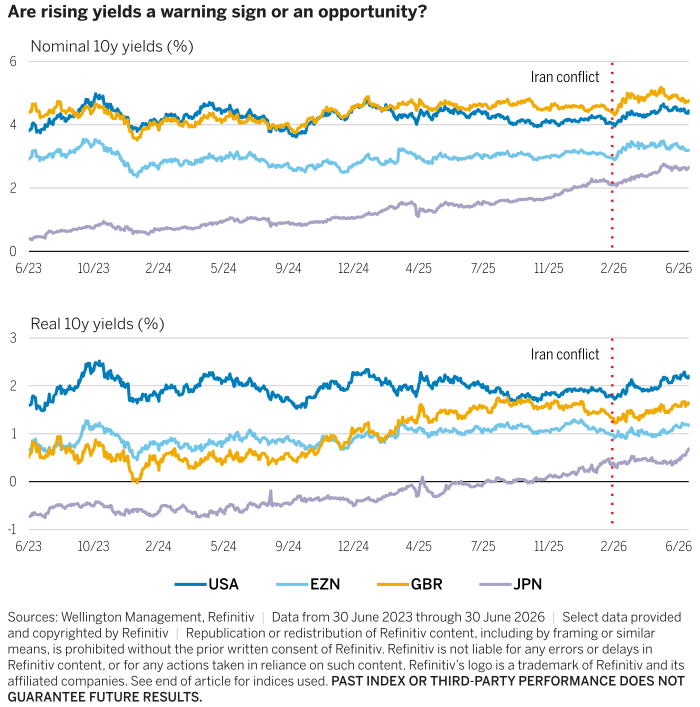
Against this backdrop, government bonds look more compelling as both nominal and real yields have reset higher (Figure 2). Entry yields are a key driver of long-term total returns, and we think today’s elevated levels offer improved carry and return potential. They could also help restore government bonds’ role as a downside diversifier to equities in a steady inflation/weaker growth scenario.
Figure 2
We have moved from a moderate underweight view on Japanese government bonds (JGBs) to a neutral view. Inflation risks have risen, partly because the Bank of Japan remains behind the curve in tightening rates. However, this has been priced in to a great extent, making a separate position in the 10-year JGB — where paying carry is the most expensive among regions — less attractive.
Globally, differentials in how fiscal risks are priced can lead to interesting relative value opportunities. We are watching France in particular, where domestic political uncertainty is growing against a backdrop of fiscal slippage versus EU targets. In other countries, additional defense spending could reinforce the fiscal-activism narrative, weakening confidence in long-term demand even as this spending fuels more supply.
In credit, we have moved to a neutral stance. While we think all-in yields are attractive, spreads have once again tightened significantly and offer limited compensation for downside risks. We have removed our overweight view on credit as a result, although we continue to prefer European credit due to stronger fundamentals. Increased issuance, including AI-related capex and financing activity, could weigh on technicals, though it may also create greater dispersion across sectors and issuers, supporting more selective opportunities. Overall, the risk/reward profile appears balanced, warranting a neutral view.
Commodities
We have moved to a small overweight view on oil given the sharp decline in prices. The market is transitioning from a short-term deficit to a medium-term surplus. However, the market is already pricing much of that future surplus today despite lingering uncertainties about the resumption of exports from the Middle East, demand growth, and the supply response (e.g., the development of new pipelines to bypass the Strait of Hormuz).
On the cyclical demand side, many countries, including the US, will need to replenish their reserves given the large drawdowns during the conflict. However, structural demand also carries uncertainties, particularly from China given its focus on renewables.
On the supply side, the urge by OPEC member nations to flout OPEC agreements or even consider exiting the organization as the UAE did in May could be limited by breakeven oil prices, which are much higher than the cost of production in many Middle Eastern countries.
The near term setup for oil is therefore finely balanced, and we think our modest overweight view is warranted based on fundamental upside. While there could be an additional relief rally, the outlook appears asymmetric from here, particularly as prospects for an enduring resolution to the Middle East conflict and a fuller resumption of flows in the Strait of Hormuz remain in flux.
On gold, we have moved from our small overweight view to a neutral view. Our conviction has fallen materially, as the thesis has weakened from a two engine demand story (central bank and ETF demand) to a single propeller (central bank demand). To reiterate a point we made previously, we don’t view gold as an inflation hedge, as correlations are weak or nonexistent. The primary long-term relationships are negative correlations to the US dollar and real yields. We don’t see significant upside emerging in either, but a fundamental reengagement with a bull case in the dollar is a risk.
Investment implications
Look for opportunities to diversify — Returns may diverge across regions and sectors based on energy vulnerabilities, creating the opportunity for active positioning to add value over passive beta.
Don’t give up on the AI boom as a driver of the macro and earnings cycles — We still see a positive trajectory for US and EM earnings — the US because the AI innovation theme is intact and EM because EM Asia is a lifeline for AI infrastructure. The theme can evolve and efficiencies in model usage will likely drive higher AI adoption.
Consider capturing the spike in government bond yields — Central bank expectations have gone from easing to tightening with the rise in oil prices. We think the move puts global yields at attractive valuations, with the repricing overdone in our view, particularly given the potential for high oil prices to derail growth. Look for opportunities created by regional divergences in yields.
Opportunities may be limited in credit, which should be well-supported but has tightened — Spreads have narrowed significantly and we find little value at current levels. We think European credit has better fundamentals than the US in terms of debt service and leverage, and it is more insulated from US private credit issues. EM debt has tightened to pre-war levels — it may be worth adding there opportunistically.
Indices used in Figure 1: Equities: MSCI USA Index, MSCI Europe Index, MSCI Japan Index, MSCI Emerging Markets Index; Fixed income: ICE BofA Global Government Index, ICE BofA Corporate Index (Investment Grade), ICE BofA Global High Yield Index, JPMorgan Emerging Markets Sovereign Index (EMBI Global Core); Commodities: Dow Jones Commodity Index – Crude Oil, Dow Jones Commodity Index – Gold.
Indices used in Figure 2: Nominal: US generic 10-year Treasury yield, Eurozone 10-year yield (Wellington composite of Germany [bund], France [OAT], and Italy [BTP]), UK generic 10-year government bond (gilt) yield, Japan generic 10-year government bond (JGB) yield; Real: US 10-year inflation-linked Treasury (TIPS) real yield (constant maturity), Eurozone 10-year real yield (Wellington composite of inflation-linked bonds from Germany, France, and Italy), UK 10-year inflation-linked gilt real yield, Japan 10-year inflation linked government bond real yield.
The views expressed are those of the authors at the time of writing. Other teams may hold different views and make different investment decisions. The value of your investment may become worth more or less than at the time of original investment. While any third-party data used is considered reliable, its accuracy is not guaranteed. For professional, institutional or accredited investors only.