menu
search
Skip to main content

INVESTMENT ANGLES

AI capex and the new credit cycle

6 min read
2027-10-05
Archived info
Archived pieces remain available on the site. Please consider the publish date while reading these older pieces.
Multiple authors
semiconductor

Key points

  • AI is now present across nearly all segments of the credit market, with data center-related debt issuance in particular rising exponentially.
  • The implications of this structural trend differ across the credit market spectrum, but the common theme is one of increasing dispersion across sectors and issuers and the need for careful analysis of capital allocation, financing, and execution risk.
  • The AI build-out is unlikely to follow a smooth path given the potential for supply bottlenecks, execution challenges, and market financing fatigue, which increase the risk of uneven outcomes.
  • In high-yield markets, we are likely to see a greater discrepancy between winners and losers, with AI winners often found in non-tech areas.
  • In private credit and securitized credit, we expect the quality of underwriting and structuring to matter more as the capex cycle progresses.
  • Overall, AI is likely to create significant new opportunities for investors provided they are able to meet the increased need for rigorous and nuanced analysis as the cycle evolves and shapes credit market outcomes.

What the AI infrastructure boom may mean for credit investors

AI not only drives equity markets, it’s also increasingly important for credit markets. The massive infrastructure spending that AI requires may still be in its early stages, but its implications for credit are already becoming clear: growing capital intensity, expanding credit supply, and rising dispersion across sectors and issuers.

For investors, we think the challenge will be to distinguish companies that can translate AI-related investment into sustainable returns from those that cannot. Careful analysis of capital allocation, financing, and execution risk is likely to be critical as AI investments become a more significant driver of market outcomes.

Implications across the credit market spectrum

While spending on AI infrastructure broadly supports credit demand, the investment implications differ meaningfully across sectors:

  • Investment-grade investors are focused on the balance between growth and rising capital intensity;
  • High-yield investors are seeing increasing dispersion between issuers that benefit from AI and those that are disrupted by it;
  • Private credit investors are evaluating opportunities to finance critical infrastructure; and
  • Securitized investors are focused on transaction structure and repayment assumptions.

As a result, the opportunity set is becoming more differentiated across credit markets and the primary theme is dispersion rather than uniform risk.

Companies directly tied to the AI build-out — such as hyperscalers, semiconductor firms, and infrastructure providers — are generally benefiting from stronger growth and, in some cases, improving fundamentals.

However, the picture is more nuanced for companies investing heavily simply to remain competitive. Where the path to monetization is uncertain, elevated capex can pressure cash flows and leverage metrics. This divergence is likely to increase dispersion within investment-grade markets, reinforcing the importance of issuer-level analysis and disciplined capital allocation.

Financing needs and market constraints

The scale of AI investment implies substantial ongoing financing needs. Large technology firms are already important credit issuers, and continued capital deployment is likely to sustain elevated supply. While many issuers have strong balance sheets, the demand for financing across the ecosystem is significant.

Notably, this capex cycle appears, at least for now, to be less sensitive to modest changes in interest rates than previous cycles. Projects are often evaluated using high hurdle rates and long-term strategic assumptions. As a result, constraints on investment are more likely to emerge through market-based channels — such as investor demand, spread movements, or equity market valuations — rather than central bank policy alone.

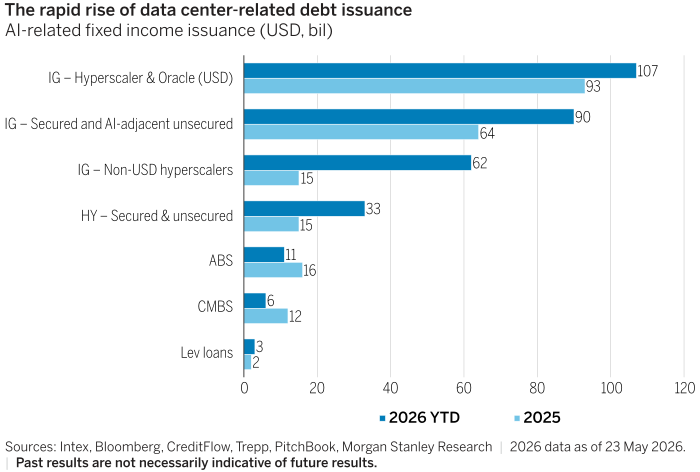
Figure 1 depicts the steep rise in dedicated data center-related debt issuance across different market segments, but it still excludes the significantly larger amount of debt raised by hyperscalers, which has grown to more than US$100 billion. Together, these trends highlight the outsized scale of financing required to support the AI build-out.

Figure 1

Bar chart illustrating the rapid rise of AI-related credit issuance across different market segments since 2025.

Execution risks and supply chain constraints

As investment accelerates, execution risks are becoming more visible. Building data centers requires complex supply chains, including semiconductors, power equipment, and specialized labor. Bottlenecks in any area can delay projects or increase costs.

For credit investors, these constraints introduce the risk of uneven outcomes. Even companies with strong demand may face operating challenges that affect earnings and cash flow. Execution capability is therefore likely to become a more significant driver of credit performance.

High yield: AI creates growth — and credit casualties

In high-yield markets, the AI build-out reinforces the theme of resilient spreads alongside rising dispersion. Despite macro uncertainty, spreads have so far remained relatively tight, suggesting continued demand for income and a relatively supportive backdrop.

At the same time, opportunities are becoming more differentiated. Dispersion is increasing across issuers, particularly in lower-rated segments, reflecting both sector-specific dynamics and the uneven impact of AI investment. For some companies, AI-related investment may support growth, while for others it raises capital intensity or disruption risks.

The result is a market with diverging issuer-level outcomes. While spreads may remain range-bound in the absence of a downturn, greater dispersion underscores the importance of selective positioning and bottom-up credit analysis. Moreover, AI exposure in high yield often lies outside traditional technology companies. Beneficiaries increasingly include independent power producers, utilities, telecom infrastructure providers, and industrial suppliers that support the AI build-out.

Private credit: Toll collectors of the AI economy

The AI build-out also has implications for private credit markets, where financing demand may extend beyond public markets. As companies invest in infrastructure, private capital may play a growing role in funding projects that are large, complex, or less suited to traditional bond issuance.

The expanding role of private credit raises questions around underwriting standards and risk selection. As capital flows into the asset class, investors will need to differentiate between transactions supported by durable cash flows and those more exposed to execution risk or optimistic growth assumptions.

As in other areas of credit, AI investment may create attractive opportunities for private lenders, but it demands both rigorous discipline in underwriting and structuring given an environment of increasing capital intensity. As financing demand continues to grow, the ability to structure transactions thoughtfully may become an increasingly important differentiator. Careful structuring and appropriate lender protections may ultimately help mitigate downside risk while allowing lenders to participate in attractive long-term financing opportunities.

Securitized credit: Collateral matters

AI investment is creating opportunities in securitized markets but also highlights the importance of structure and collateral quality. In areas tied to data center and infrastructure financing, investors are increasingly evaluating whether projected cash flows and anticipated takeout financing assumptions will materialize as expected.

A key concern is that some transactions are being structured around optimistic repayment timelines or refinancing assumptions. If projects experience delays, construction challenges, or slower-than-expected cash-flow generation, investors may face significant extension risk. In these cases, headline yields can mask structural vulnerabilities if financing terms rely heavily on favorable future market conditions.

As a result, securitized investors are placing greater emphasis on transaction structure, downside mitigation, and the durability of underlying cash flows rather than simply seeking exposure to AI-related growth. The opportunity remains attractive, but differentiation between well-designed and aggressively structured transactions is becoming progressively more important.

Structural shift in credit markets

The AI capex cycle is still in its early stages, but its implications for credit markets are becoming clearer. It represents a structural shift toward higher capital intensity, a growing source of credit supply, and a key driver of dispersion across sectors and issuers. For investors, it creates significant new opportunities, but careful analysis of capital allocation, financing, and execution risk will be critical as the cycle evolves and increasingly shapes credit market outcomes.

The views expressed are those of the authors at the time of writing. Other teams may hold different views and make different investment decisions. The value of your investment may become worth more or less than at the time of original investment. While any third-party data used is considered reliable, its accuracy is not guaranteed. For professional, institutional, or accredited investors only.

Experts

Get our latest market insights straight to your inbox.

Read more from our experts