Formats
2026 Midyear Investment Outlook

2026 Midyear Investment Outlook
The views expressed are those of the authors at the time of writing. Other teams may hold different views and make different investment decisions. The value of your investment may become worth more or less than at the time of original investment. While any third-party data used is considered reliable, its accuracy is not guaranteed. For professional, institutional or accredited investors only.
Earlier this year, Moody’s downgraded the United States’ sovereign credit rating. The agency’s peers, Fitch and Standard & Poor’s, had already done so in 2023 and 2011, respectively. This final blow to the US’s sterling credit rating has coincided with broader concerns about institutional credibility including questions about Federal Reserve (Fed) independence and a weakened US dollar.
Despite these concerns, we remain optimistic the US can remain the favored destination of capital. We explain why in three charts.
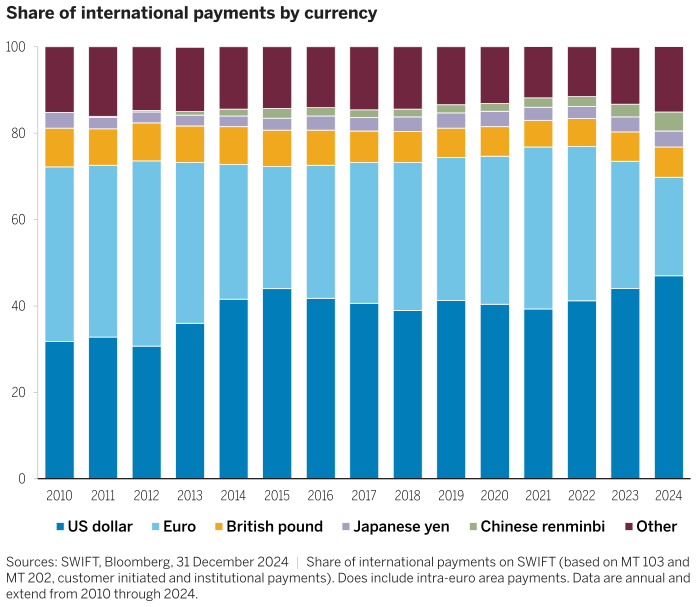
The US dollar has turned in relatively weak performance year to date, thanks in large part to policy uncertainty and currency hedging. While a sustained decline could signal fading US exceptionalism and put the dollar’s status as a safe-haven currency at risk, we don’t believe this is imminent.
The USD is still the preferred invoicing currency for as much as 40% of international payments — the highest proportion of all major global currencies (Figure 1). This is true even in instances when the US isn’t the final destination of said trade.
Figure 1
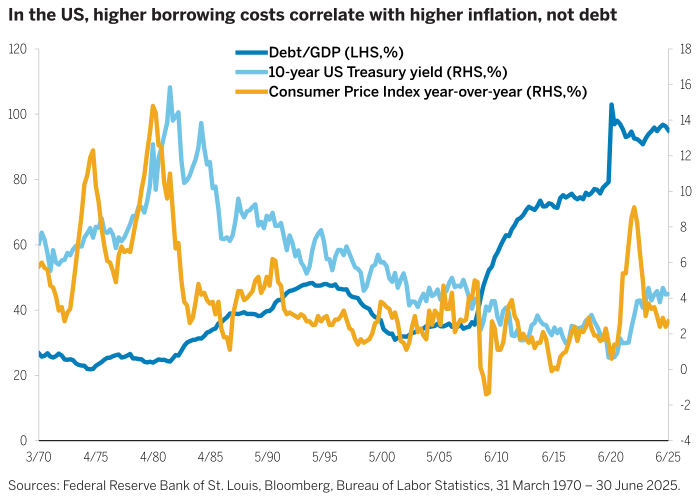
Much ink has been spilled over the rising level of US debt, and it’s easy to see why. Total national debt, which stands at an all-time high of US$37 trillion,1 has been expanding significantly since the global financial crisis in 2008.
However, though federal debt has been rising relative to the size of the economy, it hasn’t resulted in higher borrowing costs. In fact, over time, as the stock of debt relative to the size of the economy has increased, the 10-year Treasury yield has remained flat or declined. Figure 2 demonstrates that borrowing costs are actually more sensitive to inflation than debt levels.
Figure 2
This is notable because, for many countries, higher borrowing means a higher cost of debt. Thus far, there is little to suggest that this is the case for the US, partly because of the USD’s status as a reserve currency, and partly because of the depth and liquidity of the US Treasury market, both of which reinforce the functional utility of the greenback.
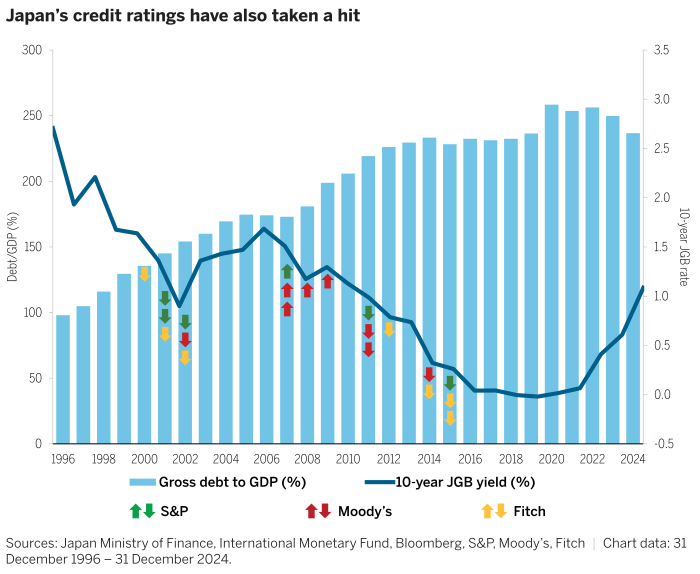
We think it’s important to remember that the dynamics shrouding the US credit market aren’t necessarily unique. Japan, for example, has been able to sustain low borrowing costs despite a debt-GDP ratio in excess of 250% — among the highest in the world.
Japan has also experienced downgrades from credit ratings agencies. Japanese sovereign bond downgrades have come despite the fact that the country has a high savings rate and the lion’s share of its debt is held domestically (leaving Japanese government bonds [JGBs] less exposed to the vagaries of global capital flows). Even as the store of debt has increased in Japan, JGB yields have continued to move lower over time (and we acknowledge the active involvement of the Bank of Japan).
Figure 3
These charts illustrate why the concerns surrounding US credit quality are no reason to make knee-jerk allocations away from US capital markets. From a fixed income perspective, investors who remain wary of the United States’ creditworthiness may wish to diversify abroad to help navigate uncertainty and volatility or consider allocating to a broader array of developed country fixed income markets as well as emerging markets local currency debt. However, we’d caution that neither of these asset classes is necessarily a strong replacement for a US Treasury (or other developed market sovereign) allocation, but rather, a complement.
To incorporate diversifying strategies like these, or to help assuage concerns about the current state of US credit, prudent investors may do well to lean into an active approach, which is likely to be nimble and adaptable in the face of what’s next for markets.
1US Department of the Treasury, 30 September 2025.
Experts

As an investment communications manager in Fixed Income Product Management, Adam leverages product-specific knowledge to generate investment content, communicate investment strategy, and provide timely updates for clients, consultants, and prospects globally. His coverage extends across investment-grade credit, high-yield corporates, bank loans, and broad market fixed income products.
Prior to joining the firm in 2012, Adam was a research analyst at LPL Financial as well as an associate portfolio manager at Standish Mellon Asset Management.
Adam earned his BA in history from Colby College and received his MBA from the Boston College Carroll School of Management.