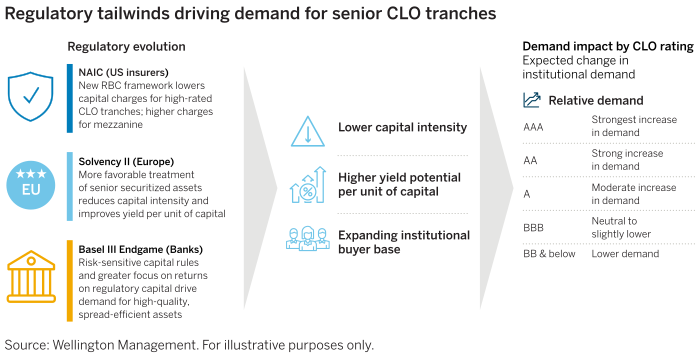
For insurance investors, we view the change primarily as a relative value shift rather than a catalyst for broad selling or significant balance sheet stress. Most life insurers are already concentrated in higher-quality CLO tranches, and the new rules should reinforce that positioning by favoring AAA through A rated debt and larger, more defensively structured tranches, while creating headwinds for BBB and BB mezzanine exposure. In our view, this should support demand for senior CLOs, where investors can continue to earn attractive income with substantial credit enhancement and improved capital efficiency.
At the same time, recent rating agency methodology changes appear to be a reasonable recalibration to the CLO market’s realized performance. The agencies are incorporating a longer performance history, updated default and recovery assumptions, and more granular loan-level analysis. This supports the view that portions of the market, particularly senior tranches, may previously have been rated too conservatively. However, ratings remain only one input to our underwriting. More permissive assumptions for subordinate tranches could allow CLO structures to employ additional leverage, potentially making BBB and BB debt less attractive at the margin and increasing the risk profile of CLO equity. We therefore continue to emphasize collateral quality, manager selection, attachment point, tranche thickness, recovery assumptions, and market value metrics rather than relying on the rating alone.
Our investment conclusion: We maintain a high-quality bias, continuing to view single A and higher-rated CLO tranches as highly default remote, and believe the combination of strong structural protection, attractive income, and increasingly favorable capital treatment makes senior CLOs particularly compelling for insurance portfolios. Conversely, the evolving regulatory framework reinforces the importance of selectivity lower in the capital structure, where greater leverage, thinner protection, and higher regulatory capital requirements may offset the additional spread.
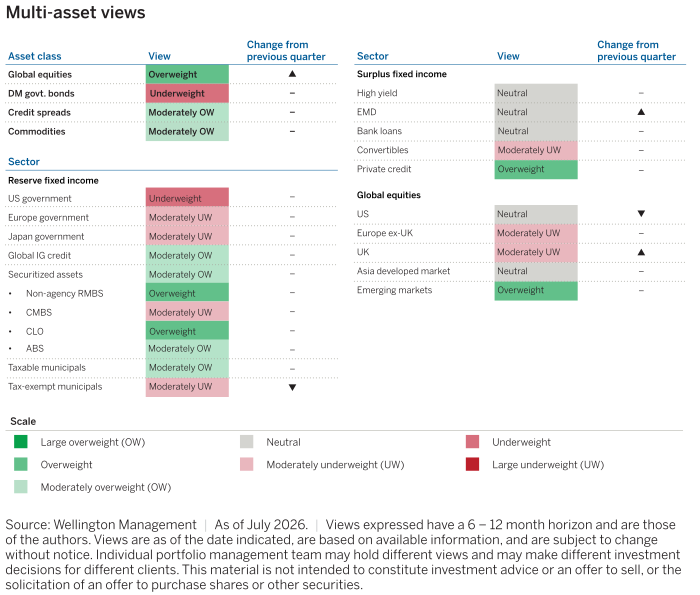
Equities
Despite the effects of the Middle East conflict, we think conditions for equities have remained supportive, driven by strong earnings revisions and a resilient manufacturing cycle. The durability of the global earnings and macro cycle is a sign of the profound impact of the technological shift we’re witnessing and the capex wave it’s fueling.
In nearly every market except Japan, most of the year-to-date gains in equities have been driven by EPS growth. Given that returns have been tied to earnings, valuations have derated and we don’t expect them to be a headwind.
Looking ahead, we think the market's performance will come down to earnings expectations, which we estimate will be in the low- to mid-double digits for global equities over the coming 12 months, with some room for modest valuation expansion. In our view, high expectations for EPS growth over the short- and mid-term are justified. Beyond earnings, balance sheets are strong, with relatively low debt to equity and high operating cash flows to debt.
There are incipient signs of equity market broadening. This includes a growing awareness of the layers beneath the big AI names, including the companies supporting the AI-driven build-out of infrastructure, chips, energy, and other parts of the economy. The recent outperformance of US small caps relative to large caps and the underperformance of hyperscalers relative to areas such as industrials and financials are also indications of some rotation coming through. Amid this rotation, volatility has picked up, and any technical correction driven by these dynamics would, in our view, present a tactical opportunity to add exposure, given solid fundamentals.
We have moved to a neutral view on US equities. Earnings growth remains robust and valuations appear reasonable. The spate of IPOs will likely drive positive to neutral net issuance this year. While we expect the market to absorb this new issuance, we think the growth in net issuance and larger deal sizes could make equity supply something of a headwind for the market over the coming 12 months. We do not see evidence of stretched positioning in aggregate across a range of investor groups, but there are signs of exuberance in some areas, such as leveraged ETFs.
In Europe ex-UK and the UK, we think earnings expectations remain too high and stagflationary concerns are more relevant. France and Germany have been hurt by competition from China, and risks related to political instability in France ahead of the 2027 presidential election could weigh on sentiment. We would stress, however, that we are not negative on Europe and there is potential for positive surprises, such as progress on financial markets reform in the European Union or quicker-than-expected deployment of fiscal stimulus in Germany.
Relative to Europe, we have a higher-conviction view on EM equities. In our view, emerging markets in Asia are critical to the AI supply chain. In addition, China’s resilience during the Middle East conflict has stood out.
We are neutral on Japan. The market continues to benefit from buybacks, high/improving return on equity (ROE), and corporate reforms, but we are concerned about the potential for blowback from rate and currency volatility at a time when valuations are more stretched, based on some metrics, than they have been for some time.
Commodities
We maintain a modest overweight view on commodities, driven by our upgraded stance on oil. We believe the market is already pricing in a medium-term increase in supply despite lingering uncertainties about the resumption of exports from the Middle East, demand growth, and the supply response (e.g., the development of new pipelines to bypass the Strait of Hormuz).
On the cyclical demand side, we anticipate that many countries, including the US, will need to replenish their reserves given the large drawdowns during the conflict. However, structural demand also carries uncertainties, particularly from China given its focus on renewables.
On the supply side, the urge by OPEC member nations to flout OPEC agreements or even consider exiting the organization as the UAE did in May could be limited by breakeven oil prices, which are much higher than the cost of production in many Middle Eastern countries.
The near‑term setup for oil is therefore finely balanced, and we think our modest overweight view is warranted based on fundamental upside. While there could be an additional relief rally, the outlook appears asymmetric from here, particularly as prospects for an enduring resolution to the Middle East conflict and a fuller resumption of flows in the Strait of Hormuz remain in flux.
On gold, we have moved from our small overweight view to a neutral view. Our conviction has fallen materially, as the thesis has weakened from a two‑engine demand story (central bank and ETF demand) to a single propeller (central bank demand). To reiterate a point we made previously, we don’t view gold as an inflation hedge, as correlations are weak or nonexistent. The primary long-term relationships are negative correlations to the US dollar and real yields. We don’t see significant upside emerging in either, but a fundamental reengagement with a bull case in the dollar could be a risk.