Investment Angles

Is AI the new China? Three lessons for investors

•
7 min read
2027-10-31
Archived info
Archived pieces remain available on the site. Please consider the publish date while reading these older pieces.
2293224701
Wendy Cromwell, CFA, Vice Chair, Wellington Management
2293224701

Key points

  • China’s rise may offer a useful lens for understanding AI’s potential economic reach. AI could reshape energy demand, capital investment, productivity, labor markets, and national competitiveness.
  • The opportunity set is likely to broaden beyond today’s AI leaders. Investors may want to consider looking across public and private markets for potential beneficiaries, such as infrastructure, power, commodities, water solutions, and companies using AI to improve productivity.
  • Leadership could shift as the AI cycle evolves. With bottlenecks, overinvestment, and winners and losers likely to change over time, active management, valuation discipline, and a flexible cross-asset approach may be critical.

What if AI is not simply the next great technology cycle, but a macroeconomic shock on the scale of China’s rise? Comparisons with railways, telecommunications, and the internet help illustrate how quickly AI could spread. But China’s integration into the global economy may offer a more powerful framework for understanding the breadth of the disruption ahead.

Like China’s ascendency, AI could reshape energy demand, capital investment, productivity, labor markets, and national competitiveness — while producing winners and losers in unexpected places. For investors, the comparison offers important lessons about how AI’s influence on markets and portfolios may unfold over time.

1. Look beyond the obvious winners

China’s emergence on the global stage was the most significant macroeconomic development of the first quarter of this century. Its admission to the World Trade Organization effectively added nearly a billion workers to the global workforce. This labor-supply shock dramatically increased manufacturing capacity while raising standards of living in China and around the world. Falling goods prices contributed to disinflation and, ultimately, higher global profits.

China’s industrialization also fueled a commodity supercycle and a prolonged bond bull market, as disinflation reduced the need for central banks to raise interest rates. Over time, China’s rise benefited commodity producers, industrial companies, infrastructure providers, exporters, and, eventually, consumer businesses.

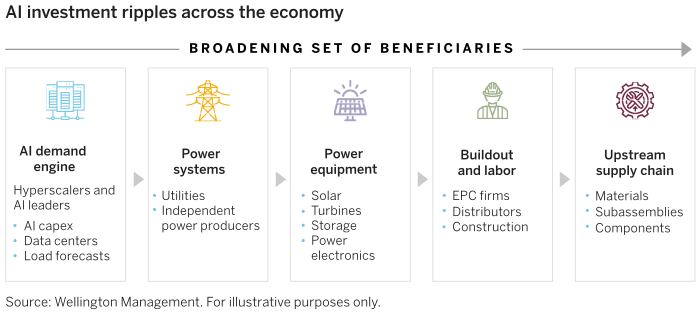
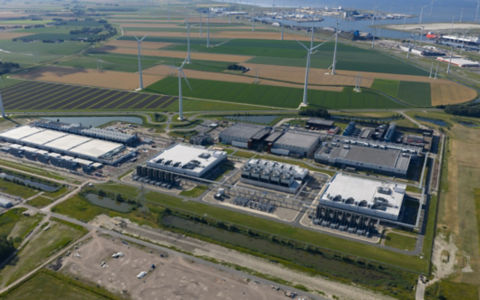
I believe AI could be the most significant development of the next quarter century. The AI revolution’s “second-order” economic beneficiaries may be found beyond the chipmakers, cloud platforms, and model developers leading the first wave. As AI investment drives demand for data centers and power, the effects are already rippling through utilities, grid equipment, construction, and other areas of the AI ecosystem (Figure 1). Over time, the opportunity should broaden further to companies that use AI to improve productivity, reduce costs, and strengthen their existing businesses.

Investment lesson: Treat AI as a cross-asset, cross-sector theme rather than a narrowly defined technology equity allocation. For example, consider infrastructure opportunities and real asset strategies that hold commodities, natural resource equities, and infrastructure-related assets. Read more from my colleagues on the structural growth opportunity in infrastructure and about harnessing that potential.


Figure 1

AI investment ripples across the country

2. Find opportunity in AI’s growing pains

China’s industrialization and economic growth were supported largely by coal and contributed to massive growth in emissions. But those rising emissions ultimately prompted industrial policy that supported green-energy innovation. Today, China is the global leader in the production of solar panels, electric vehicles, and other clean-energy technologies.

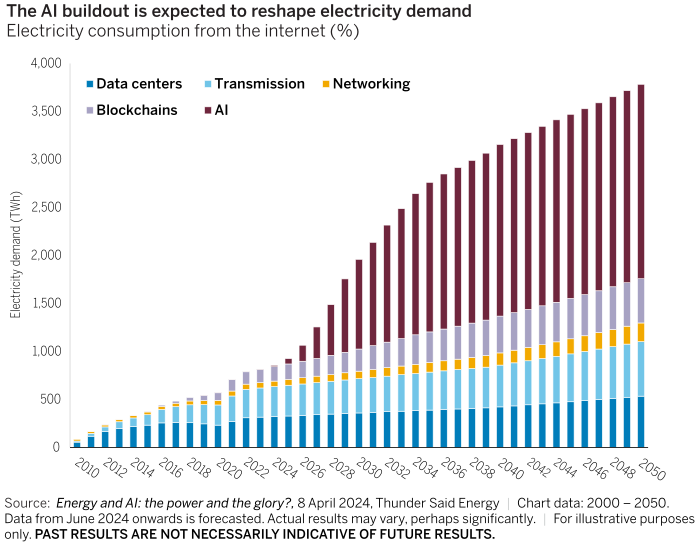
AI may create a similar paradox. A single ChatGPT query, for example, requires roughly 10 times as much electricity as a Google search, while an agentic AI system can require up to 1,000 times more power than a single chatbot interaction.1 I think there is little question that AI will increase electricity consumption (Figure 2). But as the China experience suggests, necessity can spur innovation. AI leaders are investing heavily in renewable energy, storage, and related infrastructure — and are likely to continue doing so.

Figure 2

1050646-investment-angles-fig2-v1

China’s emergence also showed how economic bottlenecks can become investment opportunities. As industrialization accelerated, demand surged for essential inputs needed to build factories, power grids, cities, and transportation networks.

AI may be creating a similar dynamic. The opportunity lies not simply in identifying where capital is being spent, but in determining which constraints could limit the buildout — and which companies are best positioned to relieve them.

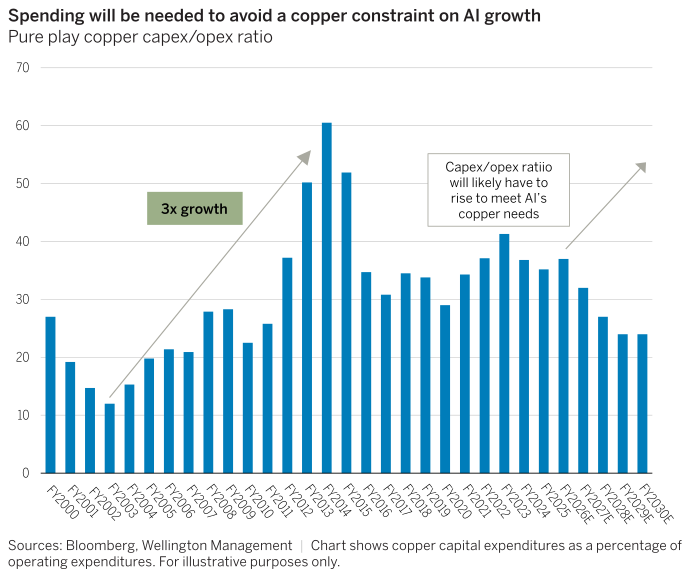
Copper illustrates the point. The AI buildout is driving demand for copper across data centers, power equipment, transmission networks, and supporting infrastructure. At the same time, copper mine productivity is declining and new supply is difficult to develop. To meet even conservative assumptions for growth in AI infrastructure, miners may need to increase capital expenditures relative to operating expenditures (Figure 3). To incentivize that investment, copper prices will likely need to rise. Even then, the industry may struggle to increase supply because of limited exploration over the last 15 years, skills shortages, and permitting and environmental challenges. Both the copper commodity and copper miners could benefit.

Figure 3

1050646-investment-angles-fig3-v1

Water is another emerging constraint. Data centers need it for cooling, while semiconductor manufacturers rely on it throughout production — often in regions already facing water stress. These pressures could create investment opportunities in companies that enable water resilience, whether through liquid cooling, water treatment, recycling, reclamation, or other technologies.

Investment lesson: Consider investing in the potential solutions to AI-related challenges. Public and private markets can each provide access to distinct stages of innovation. Public markets may provide access to scaled incumbents at later stages of adoption, with established revenue streams and greater liquidity. Private markets may provide earlier exposure to emerging categories, as discussed in this recent article by members of our Private Investments team.

3. Stay nimble as AI leadership shifts

As China demonstrated, an enduring megatrend can bring rotating winners and losers, along with periods of overinvestment. The companies and sectors that benefited from China’s rise varied over time as the cycle evolved.

With AI, we’ve already seen swings in market sentiment and business results for hyperscalers, model providers, software companies, and other parts of the ecosystem. These fluctuations underscore how quickly perceived winners and losers can shift as the technology advances and adoption spreads across the economy.

The AI investment cycle may also prove more durable than some expect. Countries increasingly view AI models, semiconductors, and computing capacity as strategic assets — critical not only to economic growth but also to long-term competitiveness and national security (a theme discussed by my colleague).

This strategic dimension matters for investors. Productivity gains may emerge unevenly, corporate returns may disappoint, and today’s bottlenecks may eventually become areas of overcapacity. But once a capability is considered strategically essential, the willingness to invest can persist well beyond a typical technology cycle.

Investment lesson: Consider leaning into active management. The China experience reminds us that a powerful macro trend does not diminish the importance of valuation, timing, or returns on capital. A compelling growth story can still produce both spectacular winners and disappointing investments. In such a dynamic environment, investing in a passive semiconductor or AI index fund may simply not be enough.

¹Sources: Electricity 2024: Analysis and forecast to 2026, January 2024, IEA; How Do AI Agents Spend Your Money? Analyzing and Predicting Token Consumption in Agentic Coding Tasks, October 2026, Longju Bai, Zhemin Huang, Xingyao Wang, Jiao Sun, Rada Mihalcea, Erik Brynjolfsson, Alex Pentland, Jiaxin Pei.

The views expressed are those of the author at the time of writing. Other teams may hold different views and make different investment decisions. The value of your investment may become worth more or less than at the time of original investment. While any third-party data used is considered reliable, its accuracy is not guaranteed. For professional, institutional or accredited investors only.

Experts

Read more from our experts