


- Global Investment Strategist

The views expressed are those of the author at the time of writing. Other teams may hold different views and make different investment decisions. The value of your investment may become worth more or less than at the time of original investment. While any third-party data used is considered reliable, its accuracy is not guaranteed. For professional, institutional or accredited investors only.
Emerging markets (EMs) — both equities and debt — have performed relatively well in 2025 so far. In fact, this year, EM equities have experienced their strongest year-to-date performance of the last seven years, signaling investor interest and momentum in this space.
We believe this trend has room to run and demonstrate the case for EMs today in three charts:
Figure 1
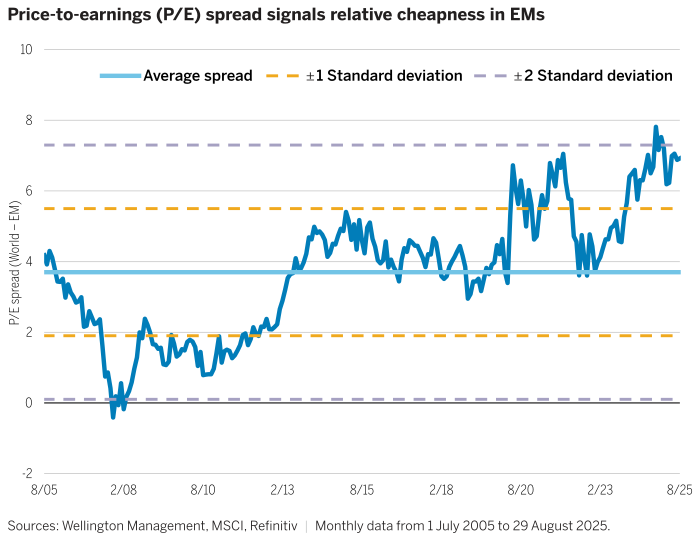
Figure 1 illustrates the relative value of developed market (DM) and EM equities, measured by the difference in price-to-earnings ratios. The current spread is nearly two standard deviations above its 20-year historical average. This suggests EMs may still be undervalued relative to their DM counterparts. So, although recent performance has been strong, today may still reflect an attractive entry point for the asset class.
Figure 2
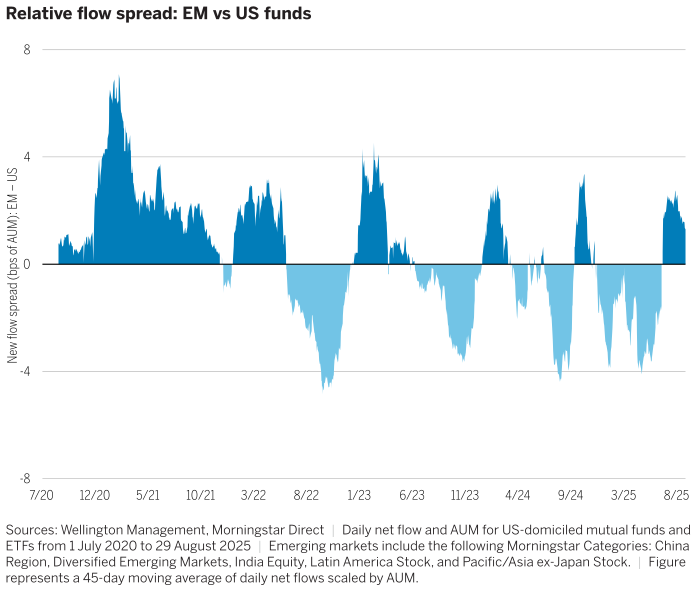
For the last three years, EM equity funds have lagged their US counterparts in terms of net flows relative to assets under management. Strong EM equity performance in 2025 — bolstered by, but not entirely attributed to, US dollar weakness — indicates a potential reversal. As Figure 2 reveals, EM funds are beginning to attract more capital, speaking, perhaps, to shifts in investor sentiment.
Figure 3
Figure 3 emphasizes the range of policy rates across EMs, whose central banks tend to hold much higher real rates (policy rate minus inflation) than the US Federal Reserve (Fed), whose rates align relatively closely with other DM counterparts. The interest-rate differential between EM and DM central banks suggests greater monetary flexibility among EMs, as they have more room to introduce future interest-rate cuts, a potential structural tailwind for the EM asset class. The Fed, meanwhile, has been more cautious about the risks between a softer labor market and higher inflation.
Why investors should care:
These charts paint an optimistic picture of emerging markets. What are the investment implications?
- Don’t miss out — Many investors have structurally underweight allocations to EMs because they experienced several years of underperformance. In my view, the signals illustrated in these three charts make a case for reassessing exposure to avoid missing out on potential opportunities.
- Be selective — Although the case for EMs is arguably strong, there’s high dispersion between countries for political, social, and industrial reasons, and some may fare better than others. Examples of EMs that could thrive given current and future market trends include Taiwan and other countries with exposure to AI supply chains; central Europe, which could benefit from “smartification” and electrification of vehicles; and Mexico, whose companies may look more attractive against a volatile US political backdrop. And within these markets, of course, some companies are more attractive than others.
- Consider active management — Active managers may be better positioned than their passive peers to pinpoint those attractive EM companies and seek to avoid those whose risks outweigh potential benefits. In my view, the dynamism of active management may help investors strike the balance between correcting structural underweights and being selective.
The bottom line? Attractive relative valuations in EMs suggest a compelling entry point, with shifts in investor sentiment visible through renewed relative capital inflows into EM equities, and structural policy flexibility given high real rate spreads relative to developed markets. These factors present tailwinds that the major developed markets lack, meaning emerging markets might be worth a closer look.
Expert