


- Investment Strategy Analyst

The views expressed are those of the authors at the time of writing. Other teams may hold different views and make different investment decisions. The value of your investment may become worth more or less than at the time of original investment. While any third-party data used is considered reliable, its accuracy is not guaranteed. For professional, institutional or accredited investors only.
The US dollar hasn’t had such a rough start to the year more than a handful of times in the past 50 years (Figure 1). Why? Protectionist US tariff policies, announced in April 2025, rocked expectations of continued US exceptionalism.
More recently, the dollar has made modest steps toward recovery in light of the US reaching initial trade agreements with major trading partners such as the EU and Japan. However, the details still need ironing out and US President Donald Trump’s surprise tariff announcements on countries and sectors continue to make headlines, so uncertainty around trade and a resumption of dollar dominance remain in place.
Figure 1
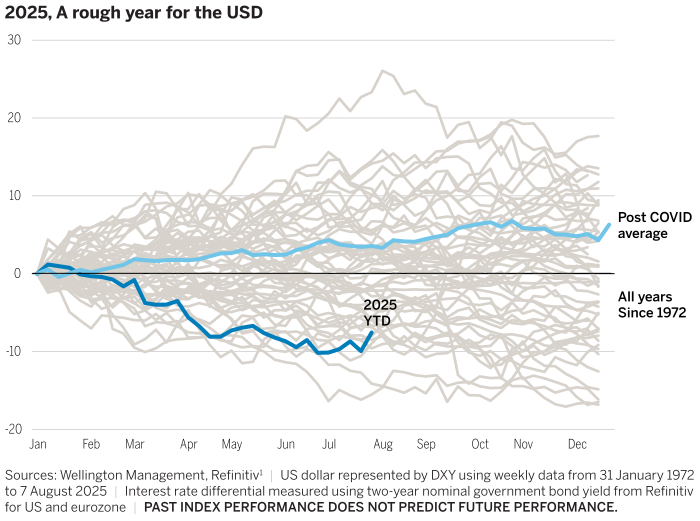
A continued rut in the dollar may signal something larger — declining US credibility. This would be significant because for many years the US dollar has served as a safe-haven currency. So, not only have good times supported the greenback, but also times of market stress based on the expectation US dollar-denominated assets would experience relatively less volatility than those associated with other, more volatile currencies. Now, interestingly, although US tariff policy seeks to stem trade deficits with other countries, ironically, the stability of the US dollar and its markets has often attracted these foreign excess capital flows. The bottom line is, should the US dollar lose this status, it would reflect a structural decline, reshaping portfolio currency-hedging needs and accelerating a rotation out of US risk assets, like equities.
What are we watching?
Given this backdrop, we’re monitoring three things:
- US political developments: Trade policy resolution and budget outcomes could influence dollar sentiment.
- Capital flows: Shifts in foreign demand for US Treasuries and equities may indicate the magnitude and sustainability of a shift in US dollar strength.
- US Federal Reserve (Fed) policy: Forward guidance and balance-sheet signals remain key, especially if inflation or growth surprises shift expectations.
Three investment implications
- A weaker US dollar typically supports global equities, commodities, and emerging markets, but US tariff uncertainty could complicate this dynamic. Tariff-induced dollar weakness could also impact corporate earnings, providing a boost for US multinationals while pressuring US-sourced earnings of non-US companies.
- Should the US dollar remain relatively weak, investors’ portfolio currency-hedging needs may change, with an impact on return and volatility potential predicated on base currency and foreign exposure.
- The Fed has held interest rates steady, but addressing the backlog of cuts could further pressure the dollar.
1 Republication or redistribution of Refinitiv content, including by framing or similar means, is prohibited without the prior written consent of Refinitiv. Refinitiv is not liable for any errors or delays in Refinitiv content, or for any actions taken in reliance on such content. Refinitiv’s logo is a trademark of Refinitiv and its affiliated companies. www.refinitiv.com