

- Multi-Asset Portfolio Manager

This is a monthly snapshot of Wellington Solutions’ asset allocation views as of September 2026. It covers global equities, bonds and commodities and complements the more detailed analysis we share in our Quarterly Asset Allocation Outlook.
Key*

*Please note that we use a more detailed key in our Quarterly Asset Allocation Outlook.
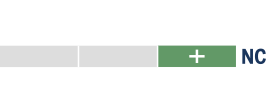
We are still positive on global equities but have moderated our overweight stance. Strong earnings, a resilient global economy and continued AI-related investment support our constructive 12-month outlook. However, higher oil prices, rising bond yields and a more hawkish policy backdrop have weakened the near-term risk/reward balance. Regionally, we continue to favour emerging markets (EM) over the UK but have narrowed this preference, while maintaining a neutral view elsewhere.
US

We retain a neutral view on US equities. We think that solid earnings and continued AI-related investment remain supportive, but that these positive dynamics are being balanced by increased narrowness of price action, questions around the financing and sustainability of the AI investment cycle, as well as potential headwinds from high levels of prospective issuance. Taken together, these factors leave us constructive on the underlying fundamentals, but neutral on US equities overall.
Europe ex-UK

Our neutral view on Europe ex-UK equities remains unchanged. Resilient earnings and an improving macroeconomic backdrop have reduced the downside risks that previously supported our more cautious stance. However, persistent structural challenges and valuation considerations continue to constrain the upside, leaving the balance of risks broadly even.
UK

We retain an underweight view on UK equities, relative to EM. While the growth backdrop remains subdued, resilient energy-sector earnings, continued M&A activity and relatively attractive valuations provide some support, leading us to moderate our underweight stance.
Japan

We maintain a neutral view on Japanese equities. Earnings strength has been broad-based, with upgrades across banks and industrials as well as semiconductor and AI-related segments. A stronger yen is also likely to create winners and losers within the market rather than lead to broad weakness. Nevertheless, significant macroeconomic and policy uncertainty continues to limit our conviction in shifting to a positive stance.
Emerging markets

We still have an overweight view on EM equities, although we have moderated our stance in line with our more measured view on global equities. Over the longer term, attractive valuations and exposure to AI-related supply chains in East Asia remain supportive. Tactically, however, strong relative performance, the lack of broadening price action and headwinds from US-dollar appreciation argue for lower conviction at current levels.
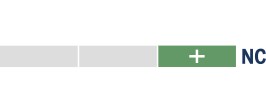
We maintain our moderately overweight view on global duration. Markets have priced in tighter monetary policy, with some central banks beginning to follow through with rate hikes. However, higher nominal and real yields have improved the starting point for government bonds, offering attractive carry and potential for capital appreciation. This continues to support our constructive stance.
US

We maintain our overweight view on US rates relative to Germany. Current yield levels offer attractive carry and could provide scope for capital appreciation if US growth moderates or inflation eases more quickly than expected. While fiscal and issuance risks remain relevant at the long end, we believe the current level of yields provides a more compelling starting point for US government bonds.
Europe ex-UK

We are still comfortable with our underweight view on Europe ex-UK government bonds, though our underweight stance is now expressed only through German rates as we think the increasing impact of the fiscal stimulus programme could place further upward pressure on Bund yields. Conversely, we have upgraded our view on French rates from underweight to neutral given recent sharp market moves.
UK

We maintain our overweight stance on UK rates relative to Germany. Gilt yields offer an attractive starting point, with a meaningful degree of fiscal and supply uncertainty already reflected in valuations. While challenges around budget execution and issuance remain, we see greater scope for UK yields to perform relative to Germany.
Japan
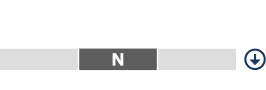
We moved to a neutral view on Japanese government bonds, having previously held a very modest overweight stance. Despite the repricing, the policy outlook remains unclear, and we no longer see a sufficiently compelling case to retain a positive view.
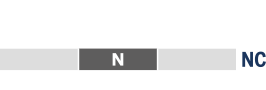
We don’t yet see catalysts to change our neutral view on credit. All-in yields are attractive and spreads have widened somewhat, but valuations still offer limited compensation for downside risks. We are also monitoring the growing use of credit markets to finance AI-related capital expenditure, which could create technical headwinds and greater differentiation across issuers. Taken together, these considerations inform our continued neutral stance.
Investment-grade credit

We still have a neutral view on investment-grade credit. Resilient fundamentals could provide support, but spreads offer limited value at current levels. Regionally, Europe provides a relatively more favourable backdrop, with stronger leverage and debt-servicing metrics and less exposure to the significant issuance expected in the US. However, the recent sell-off in French government bonds has had a knock-on effect on corporate spreads, leaving us comfortable with our neutral stance.
High yield

In our view, high-yield markets remain supported by attractive carry and broadly stable default expectations. However, we also believe that spreads offer limited protection against a meaningful deterioration in the economic or corporate backdrop, leading us to stick with our neutral stance.
Emerging markets

We are also neutral on EM debt. From our perspective, broad market valuations offer limited appeal, with the outlook likely to be shaped more by differences across countries than by a broad-based improvement in the asset class. This leaves us without sufficient conviction to adopt a more positive view.
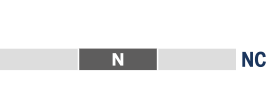
We remain neutral on commodities. The broadening Middle East conflict has pushed energy prices higher and increased uncertainty, reinforcing our neutral view on oil. In gold, the twin sources of demand from central banks and ETF investors are becoming less aligned, while higher interest rates pose an additional headwind. We maintain our neutral stance for now.
These asset allocation views are produced by Wellington Solutions, which provides client-centred investment solutions, research and advice ranging from whole portfolio solutions to bespoke single asset class and advisory partnerships. Our solutions platform incorporates expertise across multi-asset, fundamental factor investing and thematic approaches to deliver across a range of client outcomes and objectives. If you wish to discuss your investment challenges, and how Wellington Solutions can help, please contact your Wellington relationship manager or solutions@wellington.com.
Disclosure
For professional and institutional investors only. All investing involves risk. Investment markets are subject to economic, regulatory, market sentiment and political risks. All investors should consider the risks that may impact their capital, before investing. The value of your investment may become worth more or less than at the time of the original investment. If the strategies do not perform as expected, if opportunities to implement them do not arise, or if the team does not implement its investment strategies successfully, then a strategy may underperform or experience losses. Past performance is not a reliable indicator of future results and investments can lose value.
This material is prepared for, and authorised for internal use by, designated institutional and professional investors and their consultants or for such other use as may be authorised by Wellington Management. This material and/or its contents are current at the time of writing and may not be reproduced or distributed in whole or in part, for any purpose, without the express written consent of Wellington Management. This material is not intended to constitute investment advice or an offer to sell, or the solicitation of an offer to purchase shares or other securities. Investors should always obtain and read an up-to-date investment services description or prospectus before deciding whether to appoint an investment manager or to invest in a fund.
Any views expressed herein are those of the Wellington Solutions, are based on available information and are subject to change without notice. Individual portfolio management teams may hold different views and may make different investment decisions for different clients. While any third-party data used is considered reliable, its accuracy is not guaranteed.
This material represents an assessment of the market and economic environment at a specific point in time and is not intended to be a forecast of future events, or a guarantee of future results. Forward-looking statements are subject to certain risks and uncertainties. Actual results, performance or achievements may differ materially from those expressed or implied. Information is based on data gathered from what we believe are reliable sources. It is not guaranteed as to accuracy, does not purport to be complete and is not intended to be used as a primary basis for investment decisions. It should also not be construed as advice meeting the particular investment needs of any investor. Past performance does not guarantee future results.
The views expressed are those of the authors at the time of writing. Other teams may hold different views and make different investment decisions. The value of your investment may become worth more or less than at the time of original investment. While any third-party data used is considered reliable, its accuracy is not guaranteed. For professional, institutional or accredited investors only.
Experts

- Multi-Asset Portfolio Manager

- Investment Specialist


















Monthly Market Review — August 2026
A monthly update on equity, fixed income, currency, and commodity markets.
By