2026 MIDYEAR BOND MARKET OUTLOOK — RATES

No rerun of the 2022 rates scenario but flexibility is key

7 min read
2027-12-30
Archived info
Archived pieces remain available on the site. Please consider the publish date while reading these older pieces.
Categories final
Martin Harvey, CFA, Fixed Income Portfolio Manager
Categories final
Marco Giordano, Investment Director
Categories final

This is an excerpt from our Investment Outlook, in which specialists from across our investment platform share insights on the economic and market forces that we expect to influence portfolios.

Key points

  • Structurally higher yields inform our continued positive outlook for the remainder of 2026, despite ongoing volatility.
  • Markets have reached a crossroads, with investors having to decide whether to focus more on the growth hit or the higher inflation impact of the US-Iran war.
  • Our base case is that oil prices will remain structurally higher than their pre-conflict levels, even if tensions ease, at a time when inflation is stubbornly stuck above target and risk premia continue to rise.
  • This fragile equilibrium represents an extraordinarily complex challenge for policymakers.
  • Against this backdrop, we would advocate a flexible approach to rates exposure.
  • Over time, we anticipate greater policy divergence, which flexible, active investors may be able to exploit.

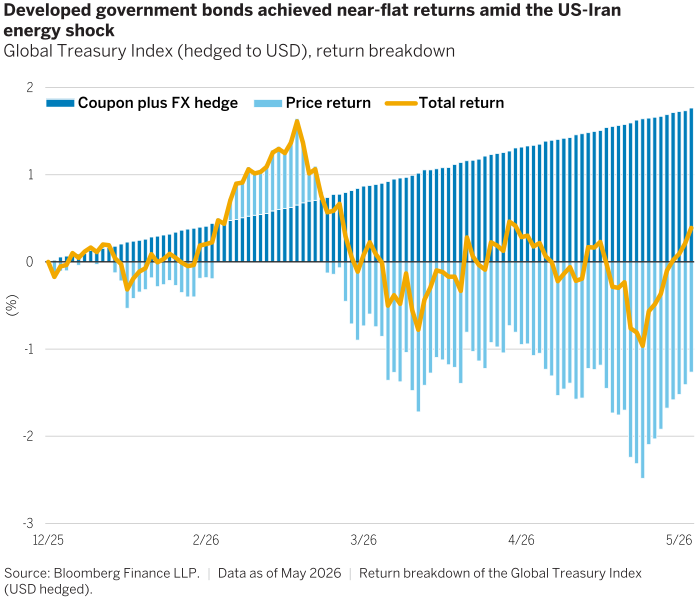
The first half of this year has reinforced the key message from our original 2026 rates outlook that generationally high yields make core fixed income attractive, but that a flexible approach is required given ongoing risks. The point is illustrated by the year-to-date performance of developed government bond indices, which ended May with nearly flat returns (Figure 1). This outcome highlights the benefit of higher starting yields, as the income component has smoothed an otherwise tumultuous journey of price volatility — a very different scenario from what occurred in 2022, when low starting yields and price volatility led to heavily negative total returns. These dynamics underline our view that the total return outlook for rates remains attractive, even with heightened volatility.

Figure 1

Developed government bonds achieved near-flat returns amid the US-Iran energy shock

Markets at a crossroads

Following a period of strong, AI-led returns in early 2026, the conflict in the Middle East caused a sharp and synchronised rise in yields. This reaction reflects a combination of geopolitical uncertainty, higher energy prices and, increasingly, a renewed investor focus on the persistence of inflation. Even allowing for a potential reduction in geopolitical risks, the exogenous shock of the US-Iran war will have long-term ramifications. In an environment where commodity prices will continue to drive yields, investors find themselves at a crossroads heading into the second half of 2026: should they brace for a growth hit or seek to hedge against higher inflation?

Following the spike in rates, increasing duration exposure can be an attractive proposition, as long-end yields (particularly in markets like the UK) present a compelling entry point. We have already noted the benefit of high starting yields to the total return equation via the income component. This attractive starting point provides a cushion against a further rise in yields as central banks contemplate tighter monetary policy. Conversely, if geopolitical tensions ease and oil prices fall back, or if the market’s focus shifts to the negative growth implications of the energy supply shock, there is the potential for yields to decline. Such a shift would provide additional price return at a time when risk assets are likely to face a tougher outlook.

Our base case is that oil prices will remain structurally higher than their pre-conflict levels, even if tensions ease, as global supply chains will need to adjust to a more fractured trading environment. Moreover, inflation was above policy targets for five years before the current crisis, and mounting questions over public debt have already contributed to a structural rise in term premia, which has pushed yields higher in recent years.

This crisis will do nothing to help maintain this fragile equilibrium, leaving policymakers with an extraordinarily complex challenge: monetary and fiscal policies will have to address potentially conflicting inflationary and growth trends, while limiting a further deterioration in public finances. How well the major central banks deal with this conundrum will likely determine the direction of yields and where we fall between the two scenarios outlined above.

Against this backdrop, we would advocate a more cautious and flexible approach to increasing duration risk.


Local opportunities

Looking further ahead, we believe the global growth-inflation trade-off will become more visible at the local level, giving investors opportunities to generate returns across and within markets. While the initial inflation shock was global and synchronised, the next phase is likely to be more uneven, as energy prices remain a key driver but local factors become more prominent.

The extent to which commodities are imported and exported, the resilience of labour markets and the flexibility of economies to adjust to the shock will determine the path for rates in respective countries. Divergence, rather than synchronisation, is therefore likely to become the main theme across markets.

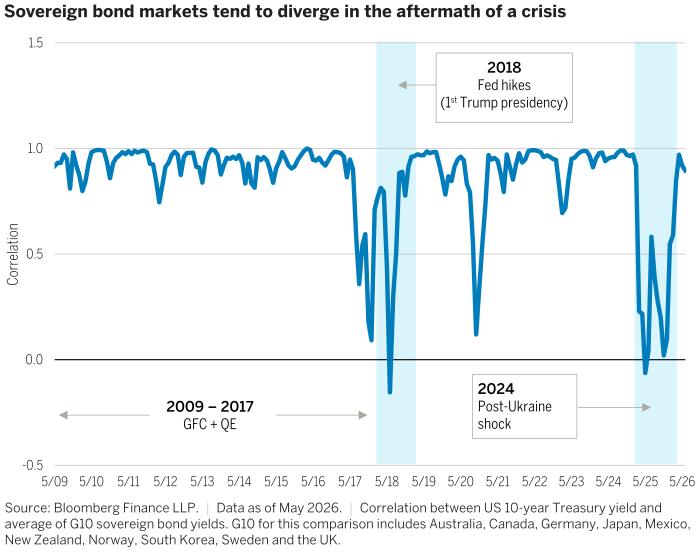
This trend would echo what we saw following the 2022 energy price shock. In the early months after energy prices spiked, yields moved higher in lockstep as central banks faced down the immediate threat of stagflation. As we progressed through 2023 and into 2024, the second-order impact of the shock and the subsequent policy responses led to divergence and, with that, a lower yield correlation across countries, as illustrated in Figure 2. In early 2026, the global nature of the energy shock caused correlations to move higher again. Once we move beyond the acute phase of this crisis, we expect lower correlation across global rates markets to return. Such a shift would, in our view, create meaningful opportunities for flexible global investors.

Figure 2

Sovereign bond markets tend to diverge in the aftermath of a crisis

Recent developments suggest that differentiation across cycles and policy responses is already taking hold:

  • In the US, despite the energy shock, growth remains above trend, with strong fiscal accommodation, persistent consumer growth and accelerating inflation. We expect AI to continue to fuel (at least nominal) growth, while the midterm elections will start to drive market pricing over the summer.
  • In the UK, a persistent political and fiscal risk premium means gilts move at a higher beta to global markets. If we see some political stabilisation, the recent, aggressive sell-off in long-end yields may provide an attractive entry point.
  • Growth prospects for the euro area remain more mixed. Much depends on whether the industrial cycle is sufficiently robust to maintain positive momentum despite the inflation shock.
  • Japan continues to operate monetary policy that is inconsistent with domestic inflation. A long-awaited policy adjustment could have global implications for both currency and rates markets.

In essence

We believe that the opportunity set for global government bonds (rates) remains compelling. Yields across developed markets are elevated, providing both attractive income and an even stronger cushion against downside risks, as already evidenced this year. The combination of these features strengthens fixed income’s potential role as both a provider of diversification and liquidity, but also a return generator, moving us further away from the low-yield environment that characterised much of the previous cycle. A proactive and flexible approach can help manage likely ongoing volatility and enhance the total return potential of core fixed income allocations.

The views expressed are those of the authors at the time of writing. Other teams may hold different views and make different investment decisions. The value of your investment may become worth more or less than at the time of original investment. While any third-party data used is considered reliable, its accuracy is not guaranteed. For professional, institutional, or accredited investors only.

Experts

Read more from our experts