





- Head of Private Credit
Portugal, Intermediary
ChangeThis is an excerpt from our Investment Outlook, in which specialists from across our investment platform share insights on the economic and market forces that we expect to influence portfolios.
Private credit entered 2026 with familiar momentum: durable investor demand, an expanding opportunity set, and a growing role in institutional portfolios. Yet the first half of the year also brought a noticeable shift in market sentiment. Headlines around redemptions from semi-liquid funds, default activity, and pockets of borrower stress have challenged the perception of private credit as a uniformly resilient and continuously expanding asset class.
In our view, these developments do not undermine the long-term case for private credit. Rather, they point to a market moving from rapid growth and broad-based enthusiasm, predominantly within the corporate sector, into a more mature and nuanced ecosystem — one marked by greater scrutiny, increased dispersion, diversification across collateral types and a stronger emphasis on manager capability.
Several of the structural themes shaping private credit are not new. The opportunity set is broadening beyond direct lending, issuers are evaluating public and private financing alternatives, and banks are increasingly important partners to private credit managers. What appears different in 2026 is that these trends are more visible in market behavior, underwriting outcomes, and the evolution of the broader credit ecosystem.
As we look ahead to the second half of 2026, the central question is not whether private credit remains attractive. It is how investors should navigate a market that is broader, more specialized, and more dispersion-driven, with outcomes increasingly shaped by relative-value assessment, sourcing breadth, underwriting discipline, and access to liquidity tools.
Growing connectivity between public and private credit markets is one indication of how the opportunity set is evolving. Issuers are increasingly evaluating financing alternatives in parallel, weighing execution certainty, cost of capital, structuring flexibility, documentation requirements, and long-term funding needs across a broader range of public, private, and bank capital sources.
Data-center financing provides a useful example of this broader toolkit available to borrowers. Wellington analysis of PitchBook data identified 330 data-center financing transactions from January 2024 through June 2026. By transaction count, banks and public markets each represented about 1/3 of activity, while private credit represented ~1/4 and mixed sources 10%.
Figure 1
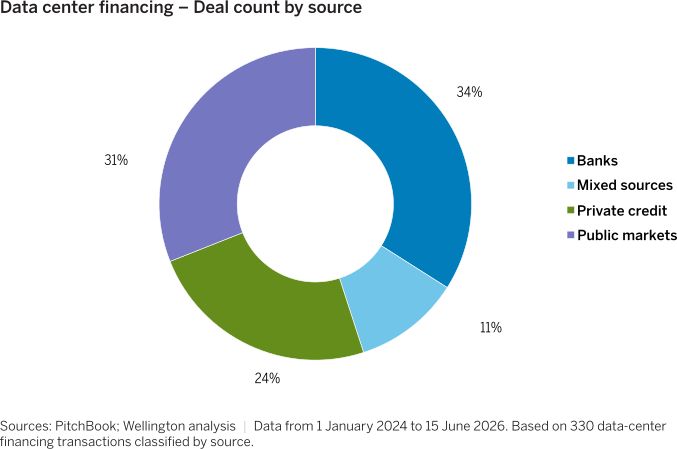
Rather than a dominant source of capital, this chart illustrates how complex financing needs are being addressed through a diverse and more interconnected set of capital sources. For managers, this may increase the importance of cross-market sourcing, relative-value assessment, documentation discipline, and risk selection.
As private credit broadens across borrower types, collateral pools, and financing channels, underwriting is more complex. Opportunities tied to areas such as artificial intelligence, data-center development, power infrastructure, and asset-backed finance may require different capabilities than traditional corporate cash-flow lending. At the same time, emerging credit stress is making the quality of underwriting, documentation, and portfolio management more visible across managers.
Artificial intelligence and data-center development are examples of this shift. McKinsey estimates that approximately US$6.7 trillion of global data-center capital expenditures may be required through 2030 to support AI-related demand.1 The scale and duration of these financing needs are likely to create debt opportunities across commercial real estate, infrastructure, asset-backed finance, and other private credit segments, but we would caution that these opportunities are not uniform.
The same need for underwriting depth is evident in recent performance dispersion. Credit stress has become more visible in 2026, although its impact has not been uniform across portfolios. Among publicly traded Business Development Companies (“BDCs”), median non-accrual rates increased from 0% in 2022 to 0.33% in the first quarter of 2026. Over the same period, the 75th percentile increased from 0.61% to 1.37%, while the 25th percentile remained at 0%.2
Figure 2
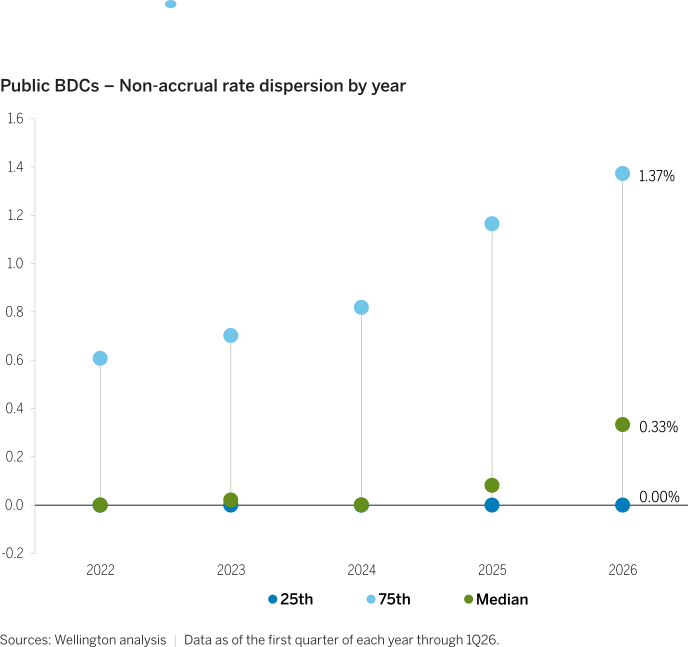
The divergence suggests that recent credit challenges stemming from concerns in the software and technology sectors, have been concentrated among certain portfolios rather than broadly distributed across the market. While default rates, non-accruals, payment-in-kind interest, and amend-and-extend activity have received increased attention, outcomes continue to vary meaningfully across managers.
Some of this stress appears concentrated among companies financed during the highly competitive underwriting environment of 2021 and 2022, when elevated valuations and abundant liquidity created a more challenging backdrop for lender discipline. Cliffwater Direct Lending Index data shows that the 2021 and 2022 origination vintages had the largest amount of non-accrual loans outstanding as of Q1 2026, with non-accrual balances more than three times the level of the 2024 vintage and approximately 2.5 times the level of the 2023 vintage.3
For investors, the implication is that manager selection may increasingly require a view not only on current yield, but also on sourcing advantages, underwriting discipline, sector expertise, structuring capabilities and portfolio monitoring. As the market matures, we believe dispersion may become a more important driver of outcomes than broad asset-class growth alone.
The private credit ecosystem is also beginning to be supported by a broader set of liquidity, financing, and capital-management tools. According to PitchBook, capital raised for private credit secondaries increased more than 14x between 2023 and 2025. Through the first quarter of 2026, fundraising had already reached approximately 75% of the total capital raised during all of 2025.4
Figure 3
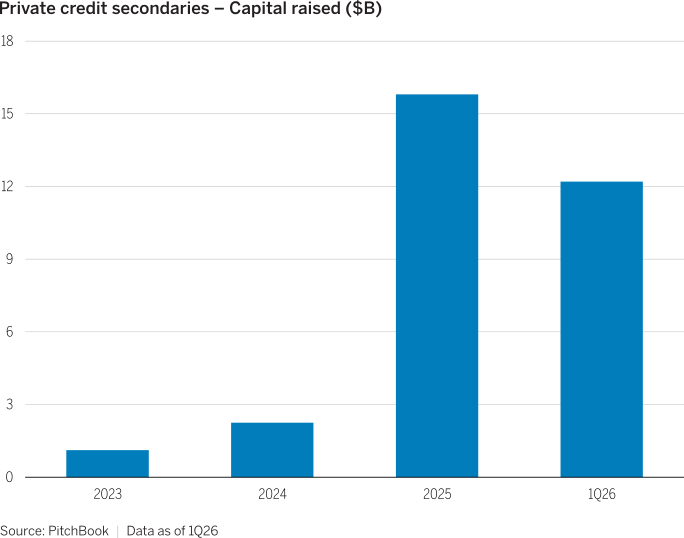
The growth of continuation vehicles, portfolio transactions, and secondary-market solutions is expanding the set of liquidity and capital-management tools available to investors. For investors, this may create additional ways to manage liquidity needs, rebalance exposures, and access private credit opportunities beyond primary fund commitments.
At the same time, banks and private credit managers are participating in a growing number of partnership structures. Financing arrangements, origination partnerships, distribution relationships, and risk-transfer transactions are contributing to a more interconnected financing ecosystem than existed only a few years ago.
Collectively, these developments suggest a market that is becoming more institutionalized and more accessible through a broader set of channels. For investors, this places an emphasis not only on evaluating asset quality, but also on liquidity terms, financing arrangements, secondary-market optionality, and the overall strength of a manager's platform.
Private credit capital formation remains resilient, but the pace and composition of fundraising has become more selective. This selectivity is also visible in how new capital is being allocated across the private credit market. According to PitchBook, direct lending accounted for 58.4% of all private debt capital raised in 2024. By the first quarter of 2026, that figure had fallen to 31%, while fundraising activity expanded across strategies including infrastructure debt, real estate credit, special situations, and other asset-backed opportunities.5 In our view, the investment takeaway is not simply that more capital is being raised outside direct lending. It is that investors are increasingly allocating across a broader opportunity set, where borrower types, collateral pools, cash-flow profiles, and economic drivers can vary meaningfully by strategy.
Figure 4
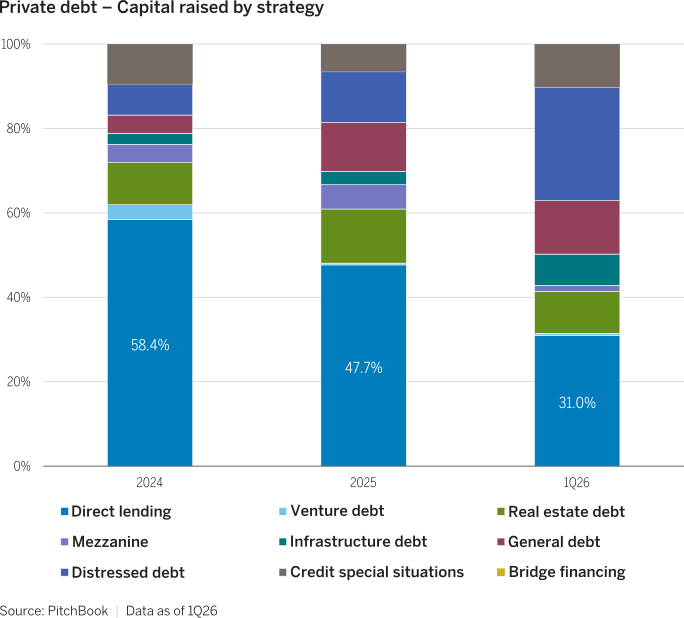
Certain retail-oriented vehicles and publicly traded structures have also continued to face pressure. Reflecting this divergence, Moody's revised its outlook on the BDC sector to negative in April, citing redemption pressures, elevated leverage among publicly traded BDCs, and weaker access to unsecured debt and equity markets.6 These pressures reinforce the importance of liquidity design and liability management, particularly as the market becomes more differentiated across structures and investor bases.
Taken together, these developments point to a more selective phase of market development. In our view, scale, liquidity management, liability structure and exposure diversification may increasingly favor larger, well-resourced organizations with the ability to evaluate relative value and allocate across the full credit ecosystem.
The first half of 2026 highlighted an important transition for private credit. The asset class continues to benefit from durable demand and an expanding opportunity set, but the drivers of return appear to be shifting away from broad asset-class growth toward specialization, dispersion, and cross-market investment judgment.
We believe this environment may create a stronger backdrop for managers that can underwrite across the full credit ecosystem, evaluate relative value across public and private markets, manage liquidity and liability structures, and navigate stress with discipline and experience.
As we see it, private credit is maturing not as a function of capital flows, but because the ecosystem supporting the asset class is becoming broader, deeper, and more interconnected. Investors that succeed moving forward may be those that can look beyond the headlines to discern where they are being adequately compensated for illiquidity and risk complexity in an increasingly diverse private credit market.
1Source: McKinsey Themes: Who's Funding the AI Data Center Boom, September 2025 | 2Source: Wellington analysis, PitchBook | 3Source: Cliffwater Direct Lending Index, data as of Q1 2026 | 4Source: PitchBook | 5Source: PitchBook | 6Source: Moody's Global Credit Outlook, 2026
The views expressed are those of the authors at the time of writing. Other teams may hold different views and make different investment decisions. The value of your investment may become worth more or less than at the time of original investment. While any third-party data used is considered reliable, its accuracy is not guaranteed. For professional, institutional, or accredited investors only.
Experts