Portugal, Intermediary
Change





Private biotech sits apart from traditional venture capital and growth equity for three key reasons. First, the potential for value creation is driven by clinical inflection points (scientific derisking) instead of revenue growth or operating scale. Second, outcomes at key readouts are often binary rather than incremental, producing wider dispersion. Finally, as private biotech companies are generally pre-revenue, they remain capital-dependent throughout their life cycle.
We believe these features make the private biotech opportunity set unique and complementary to other venture and growth allocations.
In this paper, we explore the private biotech asset class in depth across four parts:
- Part 1: Defining the private biotech asset class
- Part 2: What drives risk and return in biotech investing
Part 1: Defining the private biotech asset class
Private biotech generally refers to investments in nonlisted companies whose core assets are therapeutic programs grounded in biological science. These companies are typically built around a drug candidate, a biological target, or a therapeutic modality intended to improve real-world patient outcomes. Value creation for these companies begins with scientific evidence generation.
Progress is therefore measured by the ability to demonstrate safety, efficacy, and clinical relevance through regulated development pathways. These dynamics mean private biotech companies are research-intensive, capital-dependent from inception, and structured around long development timelines with uncertain outcomes. Yet when that scientific risk is well underwritten and clinical milestones are met, these same features can drive meaningful value creation long before revenue or broad market recognition.
How biotech differs from technology-led venture
When investors think about venture capital, many envision technology companies pursuing product-market fit, user growth, and eventual profitability. Private biotech sits within that ecosystem but behaves very differently from technology-led venture or growth equity. The sector has become more prominent over the past decade as scientific understanding and technological innovations have created a secular tailwind of novel drug development. Large pharmaceutical companies often lack the internal risk capital, tolerance, or flexibility to pursue these highly novel and risky programs directly, so private biotech investors help fund early development with the goal of generating returns through an acquisition or public listing. This capital structure and potential for significant returns resembles technology venture investing, but the underlying investment diligence, return drivers, and risk dynamics are inherently unique and therefore offer an opportunity for diversification in a venture allocation.
Part 2: What drives risk and return in biotech investing
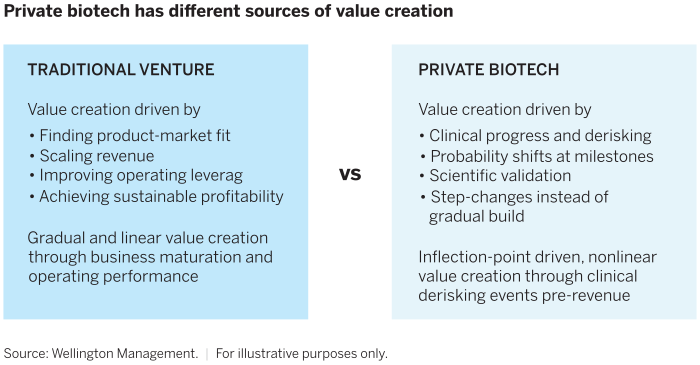
Traditional venture and growth equity value is often created through product-market fit, commercial scaling, and business maturation. Private biotech underwriting, in contrast, is concerned with scientific validity, clinical trial design, probability-weighted outcomes, and competitive positioning (Figure 1). Value is created primarily in step-changes at clinical derisking events, most or all of which occur before any revenue exists.
Figure 1
Three variables behind biotech returns
Simplistically, one way to think about biotech returns is through the interaction of three variables: the size of the market a drug could serve, the price at which it could be sold, and the probability that it successfully reaches commercialization. As clinical data improves and assuming the other variables remain static, the probability of success increases, and that change is what drives incremental value.
Because a pre-clinical asset is inherently less valuable than the same asset after validated trial results, the return profile for private biotech is therefore nonlinear.
Biotech outcomes are often binary
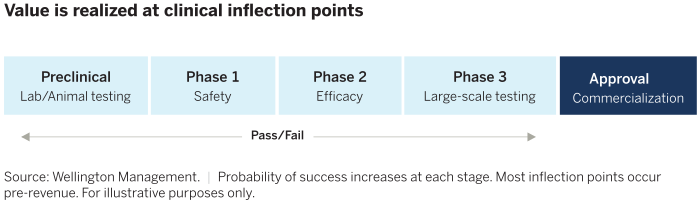
One of the defining characteristics of private biotech is the relatively binary nature of outcomes at key clinical readouts. While success allows a program to move forward and often materially increases its value, failure can render a program nonviable overnight. This is a feature of how drug development is structured, with clinical and regulatory milestones designed as pass-or-fail gates (Figure 2). In our view, the result is wider dispersion of outcomes than in most venture-backed companies, where a disappointing quarter may slow progress but rarely destroys an asset entirely if there is remaining cash runway.
Figure 2
Cash runway is a central underwriting variable
Because these assets are pre-commercial, private biotech companies cannot self-fund during development. There is generally no revenue and only limited ability to slow spend without jeopardizing the program’s development. A key feature of diligence for investors therefore is not only whether a product is likely to work but whether it can be financed through the next critical milestone.
How biotech IPO and M&A dynamics differ
Biotech companies often access public markets earlier than technology or consumer companies because of the financing needs described above. In many cases, an IPO is not an exit but a financing event that allows a company to continue development with a broader investor base. Biotech issuance can persist even when broader IPO markets are muted because companies with compelling clinical data have the potential to access capital largely independent of macro conditions. Likewise, strategic M&A remains a parallel and potential exit path throughout development, with high-quality assets negotiating from a position of strength when differentiated data combines with a credible alternative path to market.
Part 3: A market without walls
These IPO and M&A dynamics are two reasons the distinction between public and private biotech is generally considered less meaningful than in other sectors. Private companies can go public quickly without the typical emphasis on a strong growth rate and profitability, and some public companies may even be earlier in development than private peers. Both compete for capital, talent, regulatory approval, and, ultimately, patients. Notably, broad biotech index performance can mask the extreme dispersion beneath the surface because winners and losers coexist in the same benchmark.
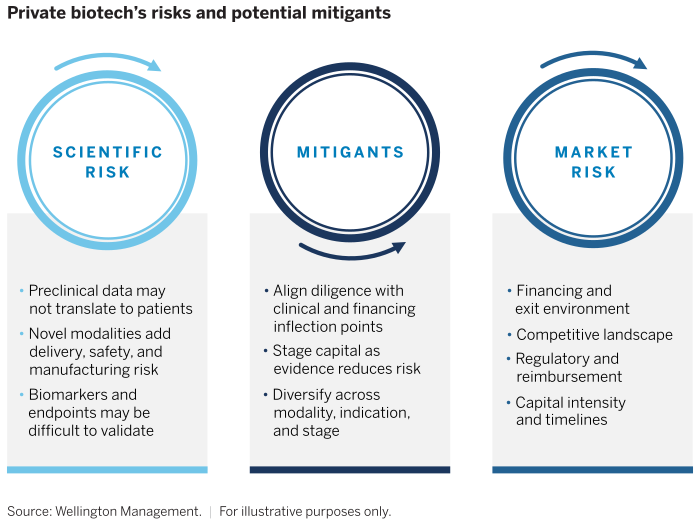
In our view, the biotech market’s fluidity means that underwriting private opportunities in isolation is insufficient as it lacks the full picture of the opportunity set. Understanding the potential risks (scientific and market) and mitigants (Figure 3) requires visibility across both public and private markets and competing therapeutic modalities.
Figure 3
Biotech investing is also inherently complex, as evaluating clinical data, trial design, and competitive landscapes requires specialized knowledge that most generalist investors lack. This complexity creates information asymmetry, and that asymmetry drives inefficiency.
Importantly, specialization functions as both a risk control and a potential alpha engine. We believe domain expertise, deep underwriting capabilities, and cross-market fluency are all required to interpret science, clinical data, and competitive dynamics accurately, and to avoid the costly mistakes that complexity invites.
Part 4: Private biotech’s role in a portfolio
Binary outcomes are inherent to this asset class and therefore must be managed structurally. Because individual private biotech outcomes are difficult to predict, portfolio construction becomes a primary risk-management tool. Key decisions include number of portfolio investments, position sizing, whether to tranche investments via milestones, and aggregate exposure by therapeutic area or modality.
Varying risk/return profiles by stage
Different stages of biotech investing carry different risk/return profiles and require distinct analytical frameworks. Seed-to-early-stage investing emphasizes team building, company creation, scientific hypothesis generation, and initial validation. The primary question is whether the underlying biology is sound and whether early proof of concept can be established. Returns are driven by the power law concept, similar to the equivalent venture capital stages. Mid-to-late-stage investing shifts toward data interpretation, competitive differentiation, and regulatory positioning. The focus becomes whether the asset can succeed relative to alternatives and meet the standards required for approval. Investors at these stages expect higher hit rates with lower loss ratios.
Allocators can express different views and risk tolerances by choosing where along this spectrum they concentrate exposure. In biotech investing, stage selection is a deliberate portfolio expression instead of a reflection of manager style.
Standalone private biotech allocations
The private biotech asset class is structurally different from other areas of private markets and we believe broad-based exposure can be less effective than it is in other innovation-led sectors in certain circumstances. In our view, commingling with other sectors ignores biotech’s potential premium on specialized underwriting (higher potential “alpha” that dedicated investors can provide in this asset class). Furthermore, standalone allocations can also offer the portfolio construction discipline and dedicated oversight necessary to manage biotech’s distinct readout risk, pacing assumptions, and volatility expectations.
Many allocators therefore approach private biotech as a satellite allocation providing diversification within private markets, or as a thematic sleeve aligned with long-term innovation in health care. Given the relatively inelastic demand for the underlying therapeutic assets, returns should be less correlated with traditional venture and may also be less correlated to economic growth cycles. This can potentially enhance diversification within private market portfolios. In our view, an asset owner’s specific sizing decision should reflect their distinct tolerance for volatility and their level of belief in long-term secular drivers in health care innovation and demographic trends.
Bottom line on private biotech investing
Private biotech investing is defined by scientific uncertainty, binary outcomes, and capital-intensive development. In our view, it requires specialization, broad market awareness, and thoughtful portfolio construction to access the asset class’s distinct opportunity.
When scientific risk is correctly underwritten and clinical milestones are achieved, private biotech companies can experience meaningful value creation before commercialization, revenue generation, or broad market recognition. The result is an asset class that can offer allocators exposure to differentiated and complementary sources of long-term returns driven less by economic growth or operating leverage and more by scientific innovation, unmet medical need, and the advancement of novel therapies.
The views expressed are those of the authors at the time of writing. Other teams may hold different views and make different investment decisions. The value of your investment may become worth more or less than at the time of original investment. While any third-party data used is considered reliable, its accuracy is not guaranteed. For professional, institutional or accredited investors only.