

- Fixed Income Portfolio Manager
Explore our insights
Asset class
Formats
2026 Midyear Investment Outlook

2026 Midyear Investment Outlook
The views expressed are those of the author at the time of writing. Other teams may hold different views and make different investment decisions. The value of your investment may become worth more or less than at the time of original investment. While any third-party data used is considered reliable, its accuracy is not guaranteed. For professional, institutional, or accredited investors only.
This article was originally published in Financial Times on 5 August 2025.
Every five years, the US Federal Reserve (Fed) updates its “Statement on the Longer-Run Goals and Monetary Policy,” which describes how the central bank will achieve its dual mandate of maximum employment consistent with stable prices. The last time the Fed issued this statement was during the COVID-19 pandemic, when it highlighted its average-inflation-targeting framework. When the central bank issues its next statement later this year, I believe it should reconsider the dual mandate altogether and reorient monetary policy toward maximizing productivity.
Since 2008, annual US productivity growth has slowed to 1.6%, down from 2.4% for the prior 18 years.1 I believe that a focus on reaccelerating productivity will enable the Fed to achieve the dual mandate’s goals without the negative externalities it has caused, including worsening income inequality and higher debt levels.
The dual mandate officially began as an amendment to the Federal Reserve Act in 1977, and it has guided monetary policy decision making ever since. While it has benefited the economy in some ways, the dual mandate has also had negative consequences, including worsening income inequality and increasing debt levels, both of which lower productivity. In my view, this trajectory necessitates the dual mandate’s revision.
The Fed’s ability to adjust interest rates to blunt the effects of inflation and unemployment has helped smooth the business cycle time and time again, generating three of the four longest economic expansions in US history since the dual mandate’s adoption. The policy has also afforded the Fed flexibility to step in when needed to prevent severe economic harm. Until the pandemic, inflation had been in long-term decline, owing to globalization, technological advancements, and a general belief that central banks would raise interest rates if price increases got out of hand. With inflation largely beat, central bankers felt comfortable cutting rates dramatically and engaging in quantitative easing (QE) at any sign of economic trouble. For the past 40 years, the Fed has intervened many times to stave off disaster, from the collapse of Long-Term Capital Management in 1998 to the Silicon Valley Bank (SVB) failure in 2023.
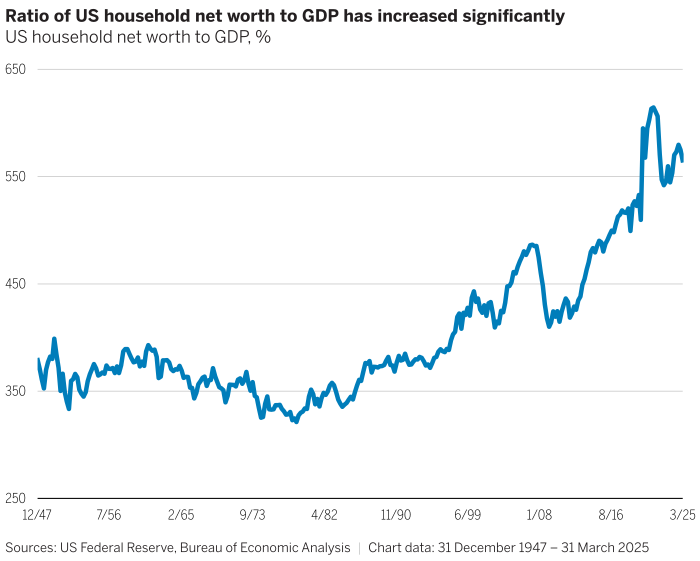
As a result of the likelihood of a policy backstop, investors took to “buying the dip” whenever asset prices fell, keeping equity prices and valuations high. Thanks in part to this dynamic, the ratio of household net worth to GDP, which had remained steady since the early 1950s, has exploded since the late 1990s (Figure 1).
Figure 1
Income inequality
While a rising market is not a problem in and of itself, it has contributed to greater US income inequality, with the top 1% of US households now holding 31% of total wealth, up from 24% in 1990.2 The substantial increase in both asset prices and income inequality has exacerbated other socioeconomic challenges:
Growing debt
The central bank’s willingness to run negative real rates (interest rates below the level of inflation) has increased the amount of leverage in the economy. Following the global financial crisis (GFC), for example, public companies were quick to issue debt and repurchase shares amid negative real rates. Meanwhile, the proliferation of private equity has fueled the ideology of leverage as the surest path to superior risk-adjusted returns. While buybacks and dealmaking have benefited shareholders, this capital has generally not funded investments that boost the supply side of the US economy. Low real rates have also encouraged increased merger activity, with companies using debt to grow much larger and more powerful. And while investors will pay high multiples for companies with large moats, monopolies hamper innovation and creative destruction, which are critical for improving productivity.
The public sector has also taken advantage of low real rates. After the pandemic, the US government borrowed heavily, as the Fed cut rates to zero and initiated large-scale QE. Again, this capital did not fund investments that increased aggregate supply; rather, it boosted demand as handouts to juice household consumption.
Net-net, the dual mandate has led to long economic expansions and a very wealthy US upper class. It has also created an unequal, debt-laden, and under-invested economy that is short on productivity.
This brings me to my central thesis: Increasing productivity should be the new goal for US monetary policy. I believe this shift in focus would inherently support the dual mandate, as a more productive economy can generate stronger growth, improve living standards, and support low unemployment, all without increasing inflation. Over time, these improvements should naturally mitigate income inequality (by bringing up wages) and reduce debt levels. While the Fed lacks the means of targeting productivity directly, here are some indirect steps it could take:
While this might seem a revolutionary change in monetary policy, the Fed largely followed this framework in the aftermath of the SVB crisis, when it continued to raise interest rates amid lofty inflation, but temporarily expanded its balance sheet to prevent the risk of financial contagion.
How would this fundamental change in framework alter Fed policy from here? Given its progress in reducing inflation, I believe that the Fed should modestly reduce policy rates, while maintaining positive real rates. It should also be cautious about reducing or ending its current quantitative tightening program. One reason why inflation rose during the pandemic was because the central bank grew its balance sheet faster than nominal growth. It now risks the progress it has made on inflation by ending quantitative tightening too early.
While the US economy overall has been resilient in the face of higher interest rates, this is largely because of persistent fiscal deficits and AI-related spending. Notably, interest-rate sensitive parts of the US economy, particularly manufacturing and small businesses, have struggled amid stubbornly high short-term yields. The National Federation of Independent Business has found that capital expenditure intentions are similar to where they were during the GFC and the depths of the pandemic.3 By encouraging companies to invest in capital formation, higher productivity growth should follow.
When the dual mandate was added to the Federal Reserve Act of 1977, it was a clear guiding principle for policymakers that helped restore credibility to the institution that had been blamed for the disastrous stagflation during that decade. Nearly 50 years later, however, the negative consequences of the Fed’s dual mandate have multiplied and now threaten to stagnate the economy all over again. It is time for the central bank to focus its policy directives on boosting US productivity. In so doing, I believe the central bank will not only be able to keep prices and employment stable, but it will also help usher in a new era of broad-based growth, prosperity, and competitiveness.
1 US Bureau of Labor Statistics. | 2 Board of Governors of the US Federal Reserve System. | 3 “NFIB Monthly Economic Newsletter,” NFIB Research Center, June 2025.
Expert

Resilient growth, rising risks: Investing through the energy shock
Continue readingHigh asset prices, not low interest rates, are driving inflation
Continue readingBy
Warsh’s first FOMC: We have a task force for that
Continue readingThe questions incoming Fed Chair Warsh will need to answer
Continue readingBy
The Fed’s growing footprint on the market has a cost
Continue readingBy
URL References
Related Insights
Stay up to date with the latest market insights and our point of view.

Resilient growth, rising risks: Investing through the energy shock
Macro Strategist Eoin O’Callaghan explores the drivers of resilient growth amid the continued energy shock and discusses why investors need to keep a close eye on evolving macro conditions.

September FOMC: Doves capitulate
For the first time in over three years, the Fed raised the target rate range to 3.75%-4.00% in September. Our team looks at what's driving the shift and what it means going forward.
High asset prices, not low interest rates, are driving inflation
Wealth distribution in the US has rendered the Federal Reserve’s usual tools less effective. The Fed will need to address asset prices head-on in creative ways if it is going to return inflation to target.
By
Warsh’s first FOMC: We have a task force for that
Our experts highlight new task forces, examine evolving inflation and labor dynamics, and contend that the Fed soon may need to choose between growth support and price stability.
The questions incoming Fed Chair Warsh will need to answer
We examine the key questions that incoming Fed chairman Kevin Warsh may need to confront as monetary policy faces new limits and new risks.
By
The Fed’s growing footprint on the market has a cost
Brij Khurana explains what the Federal Reserve's balance sheet expansion may mean for inflation and asset prices.
By
Warsh as Fed chair: Something for everyone
Macro Strategist Juhi Dhawan shares five key takeaways on Kevin Warsh, President Trump’s nominee to be the next Fed chair, including thoughts on interest rates, deregulation, and the market impact.
FOMC: Easing into uncertainty
Fixed Income Portfolio Manager Jeremy Forster profiles the Fed's December rate cut, labor market trends, inflation pressures, and the role of anticipated changes to FOMC leaders in 2026.
Chart in Focus: Is the Fed rate cut positive for risk?
In this edition of Chart in Focus, we examine how the Fed’s long-awaited interest rate cut may influence risk assets.
The Fed architecture under scrutiny: What are the investment implications?
Macro Strategist Juhi Dhawan looks at how changes in the Federal Reserve's personnel and decision making could impact policy, the US dollar, and financial markets.
FOMC: Cushioning the US labor market
Fixed Income Portfolio Manager Jeremy Forster analyzes the Fed's decision to cut interest rates at the September FOMC meeting.
URL References
Related Insights