


- Global Investment Strategist
Explore our insights
Asset class
Formats
2026 Midyear Investment Outlook

2026 Midyear Investment Outlook
The views expressed are those of the author at the time of writing. Other teams may hold different views and make different investment decisions. The value of your investment may become worth more or less than at the time of original investment. While any third-party data used is considered reliable, its accuracy is not guaranteed. For professional, institutional or accredited investors only.
The One Big Beautiful Bill Act (OBBBA) is now law. Considering the bill’s heft — almost 1,000 pages — the long-term economic and market implications are still being weighed and debated. I see two initial takeaways that allocators can incorporate into their investment decisions. First, I expect the Act to be a net positive for economic growth and company earnings over the next 12 months due to its pro-business stance. Second, the clear negative for markets is the postponement of meaningful spending cuts, which will put US debt on a trajectory toward 125% of GDP by 2034, according to the Congressional Budget Office — a level that could increase long-term US Treasury yields and weaken the US dollar further.
The Act reinstates and/or makes permanent changes that should benefit businesses and boost economic growth, including: 1) increasing the bonus depreciation rate for qualified property (e.g., certain machinery and equipment) from 40% to 100%; 2) providing an immediate ability to deduct R&D expenses; and 3) returning to a more generous EBITDA-based limit for interest deductibility on loans.
Combined, these and other changes will likely increase cash flow for companies and encourage investment spending. Independent estimates suggest these measures could boost growth in the medium term by as much as 0.7%, but as I explain below, we see potential for the effects to be felt sooner and to a greater degree.
Spending cuts, estimated at a net US$1.1 trillion and phased in over 10 years, are concentrated in Medicaid, Medicare, and SNAP (Supplemental Nutrition Assistance Plan), with most changes becoming effective after the US mid-term elections in 2026. Clean energy tax credits are also scheduled to sunset by the end of 2027.
While these cuts are designed to offset the cost of the tax breaks and other provisions, the Act is still expected to add US$3.4 trillion to the federal deficit over the next 10 years. Additionally, it is uncertain whether the spending cuts will ultimately be implemented. Legal challenges could delay implementation, and Congress could amend or repeal parts of the OBBBA before full implementation, especially if political control of the White House and Congress shifts. Similarly, some provisions set to expire could become permanent, also raising the deficit.
It is worth mentioning that the US is not alone in increasing government spending. As my colleague and I discuss in our latest Asset Allocation Outlook, Europe and Japan are loosening fiscal policy, which has implications for inflation and yields.
While passage of the Act on July 4 as planned likely avoided a market hiccup, I’m not sure it reduced policy uncertainty meaningfully, given that tariffs remain the biggest policy-driven risk for markets, as President Trump issues new threats to various countries and a new deadline of August 1 approaches. Still, risk assets seem to have become inured to tariff threats, assuming they will again be walked back or postponed.
As for the OBBBA, the market may be underappreciating the growth impulse the business-focused provisions of the legislation could deliver. Heretofore, the assumption has been that tariffs will hurt US growth and elevate inflation. But Wellington Macro Strategist Mike Medeiros thinks the new law could add up to a full percentage point in aggregate to GDP in 2025 and 2026 from the corporate side, offsetting the negative growth impact of tariffs. We are also hearing from our Global Industry Analysts about productivity gains from AI at the company level, which could also be a non-inflationary source of growth.
Deregulation efforts by the Trump administration could be another fillip to growth. For example, liquidity rules have hindered US banks’ efforts to lever their excess capital, constraining credit creation in the banking system and shifting activity to the nonbank financial system. Less restrictive capital rules could make it easier for banks to lend and further spur US growth.
If growth surprises to the upside, what about inflation? Growth-induced inflation is better than supply-shock-induced inflation and would be more likely to be tolerated by businesses and consumers. And as noted, improved productivity could be a limiting factor for inflation.
Bond markets may not be sufficiently pricing in the risks of stronger nominal US growth. This may translate into higher nominal bond yields.
Stronger growth may mean that rate cuts by the Federal Reserve are delayed. Expectations for two 25 bp rate cuts this year may not be met if nominal growth surprises to the upside.
The backdrop for US equity returns is more balanced in my view, with two-sided risks. On the downside, they may be vulnerable if higher-than-expected tariffs spark supply-induced inflation. On the upside, the incentives for greater business spending and deregulation could spur growth and offset the adverse effects of tariffs.
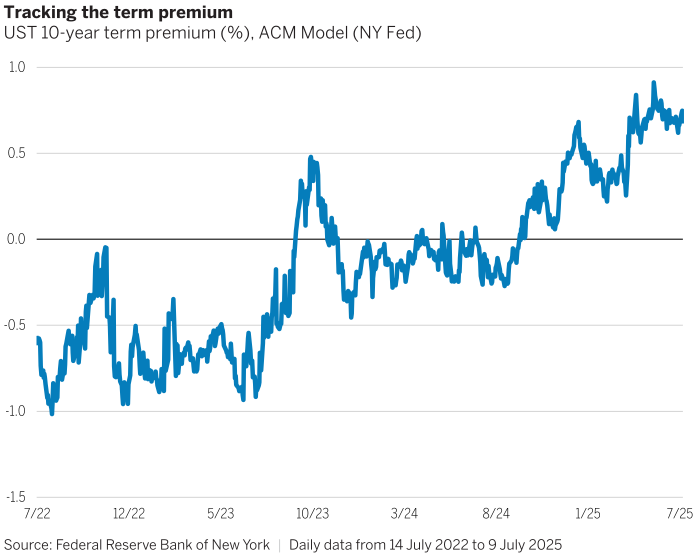
Keep watching the term premium on US 10-year Treasuries. Markets will signal displeasure with fiscal policy via the term premium (the extra yield investors expect for holding longer-term bonds over shorter-term bonds), which has been rising recently (Figure 1) and has done so in the past due to government spending concerns.
Figure 1