




- Equity Strategist
Netherlands, Institutional
ChangeThe views expressed are those of the authors at the time of writing. Other teams may hold different views and make different investment decisions. The value of your investment may become worth more or less than at the time of original investment. While any third-party data used is considered reliable, its accuracy is not guaranteed. For professional, institutional or accredited investors only.
This is an excerpt from our Investment Outlook, in which specialists from across our investment platform share insights on the economic and market forces that we expect to influence portfolios.
2025 saw the global economy and markets contend with rising trade tensions and tariffs, ongoing conflicts in Europe and the Middle East and persistent weakness in China. Yet despite these headwinds, global growth remained resilient, and inflation stayed relatively benign. Earnings growth exceeded expectations – most notably in the US – but also broadening to Japan and some emerging markets.
It would be overly simplistic to just characterize 2025 as a year where “the rich got richer.” Mega-cap tech leaders continued to thrive, but overlooked segments of the economy got “less bad”: the narrative around narrow markets may be true within the US, but if you look outside the US, market leadership is already broad
As we look toward 2026, equity markets continue to persevere in a world of heightened geopolitical uncertainty. Supported by fiscal and monetary accommodation, deregulation and the AI capex cycle, we anticipate further broadening of economic growth in 2026. Here are six themes we're monitoring closely for 2026.
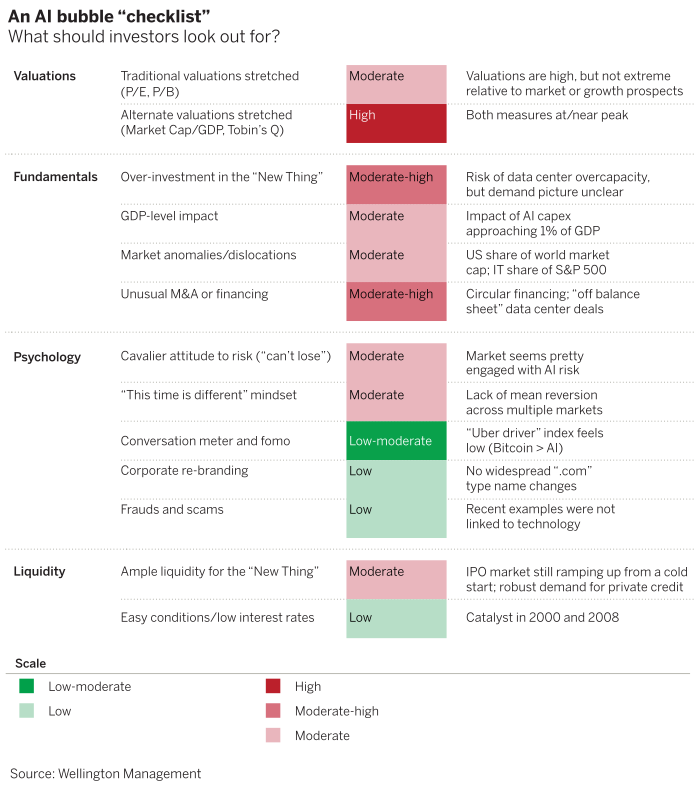
In 2026, we believe there are clear reasons to be optimistic about AI. Continued technological developments could not only accelerate capital investment but also begin translating into meaningful gains in productivity and economic growth. That said, alongside this constructive outlook, we are mindful of several flashing “yellow lights” —such as rising debt-financed capex, increased interrelated-party transactions and financings, and more speculative activity in high-beta parts of the equity market (Figure 1). These will be important trends to watch throughout the year.
So far, most of the AI-induced equity market moves have been supported by strong fundamental trends. Unlike the debt-fuelled financing of the telecom buildout in the late 1990s, most AI capex has been funded from free cash flow, though this is beginning to change on the margin. From a valuation perspective, big tech valuations significantly trail those of the late 90s. Rising rates helped burst the last bubble — this time, the Fed is easing, not tightening.
Finally, the 1990s internet build-out was driven by a ‘build it and they will come’ mindset. In contrast, AI is delivering real consumer and enterprise use cases, with enterprise demand both for primary enablers—such as power, labor, and natural resources—as well as the necessary infrastructure, such as data centers, compute, and GPU, already exceeding AI capacity supply.
Figure 1
Investment implications
While so far, we don’t see a bubble on the immediate horizon, investors should watch for signs that one is emerging. It will be increasingly important to understand whether companies deploying AI capex are seeing returns, if today's demand-driven supply and demand dynamics remain favorable and whether monetary policy and financial conditions stay accommodative, thereby continuing to support investment and lending.
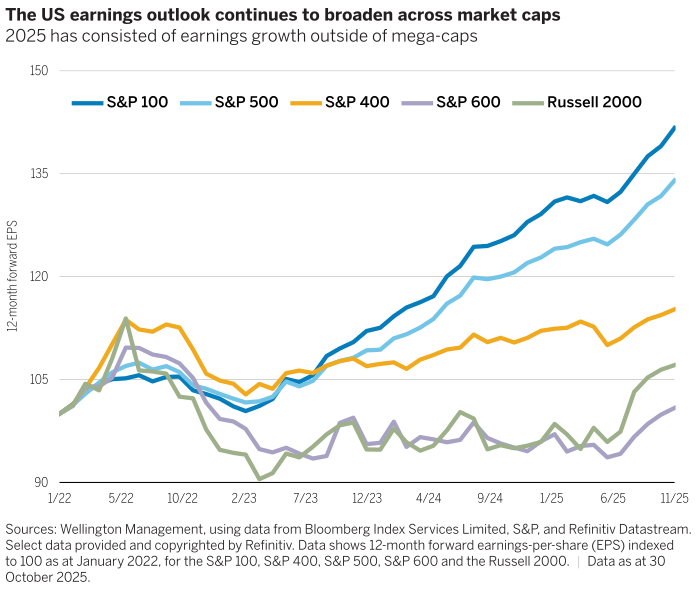
For the last three years, earnings growth has largely been confined to mega-caps. In 2025, US large caps continued to lead the way, but signs have emerged in recent months of broadening of earnings growth, both in terms of market cap and region (Figure 2). Positive earnings-per-share (EPS) revisions across large-, mid-, and small-caps within the US, as well as within Japan and parts of emerging markets — particularly Taiwan and South Korea — point to the potential for a wider set of beneficiaries. A broader macroeconomic growth backdrop should further support this trend.
Figure 2
Investment implications
Earnings growth is broadening beyond mega-caps, with positive revisions across regions and market caps. We see the potential for a revival of earnings growth in Europe and emerging markets more broadly, suggesting investors may wish to position for more diversified sources of growth.
Historically, globalization created a highly correlated and synchronized global economy. There was little scope for divergent cycles in an era when economies were closely interlinked and dependent on each other. In a world that tended to move in unison, markets were highly coordinated, and volatility, inflation, and interest rates remained low. This is now changing as the world deglobalizes — or at least reorders itself. We’re increasingly seeing greater cyclical divergence between countries and the need for different central bank responses, leading to the reverse: lower correlations, less synchronization and increased volatility and inflation and structurally higher interest rates.
Investment implications
The growing desynchronization of equity market moves — evident in 2025 and likely to continue into 2026 — underscores the benefits of diversifying across geographies, industries, styles, and factors. Within styles, the dramatic lag of quality in 2025 compared to the strength in beta and momentum may highlight an attractive entry point: Quality can offer both offensive and defensive attributes in a more volatile, less synchronized global environment.
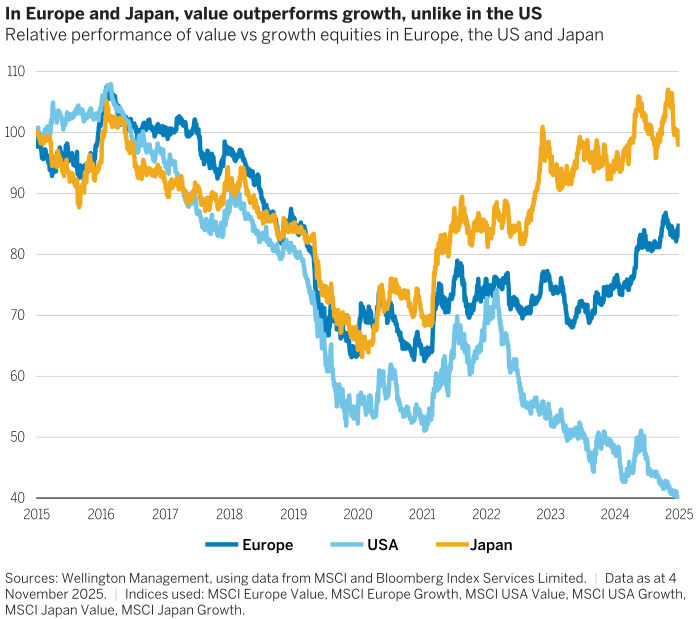
The US market is driven by the AI boom but, for once, Europe and Japan have their own idiosyncratic drivers — drivers that are differentiated enough to help keep global markets and economies desynchronized (Figure 3).
Things are starting to look quite different for Europe. Globalization is slowing and inflation is structurally higher, leading to interest rates that are likely to be higher in the long term. At the same time, the region is becoming more domestically focused and interventionist, with national security, economic resilience and competitiveness now all key priorities for European policymakers. We see the likely winners of the next regime as domestic value rather than international growth stocks. This leadership shift is likely to be supported by a recovery in European domestic demand.
An equally important shift is occurring in Japan. After decades of deflation and weak growth, Japanese nominal growth is finally accelerating. Inflation has broadened, wages are rising, and both companies and households are shedding their deflationary mindsets. Fiscal stimulus, easy monetary policy, and shifting demographics support these trends.
This shift matters for equity investors for two key reasons. First, nominal growth drives equity returns by improving corporate earnings and margins, making equities more attractive than cash for households. Valuation outlooks are also improving amid more predictable earnings. Second, corporate governance reform is enhancing shareholder value, making Japanese equities more attractive.
Figure 3
Investment implications
Within Europe, investors may wish to avoid erstwhile winners in favour of domestically focused companies, with robust margins, that are aligned with regime-change beneficiaries. Along with sectors that are geared toward domestic demand, such as telecoms, banks, and construction, select defence stocks and utilities with high barriers to entry may emerge as winners of Europe’s transformation.
Within Japan, the combination of fiscal support and loose monetary policy should support domestic cyclicals. Two sectors that stand out are banks and services.
Until 2025, emerging market (EM) equities lagged developed market performance for nearly 15 years amid the relative underperformance of EM EPS growth. But the narrative is shifting, with EM equities experiencing their strongest year-to-date performance in seven years.
Like the US, 2025 returns derived mainly from tech or AI-related mega caps, and while EM equity valuations are low versus the US, they are no longer particularly cheap relative to history. However, we expect broadening EM EPS growth in 2026, supported by several factors.
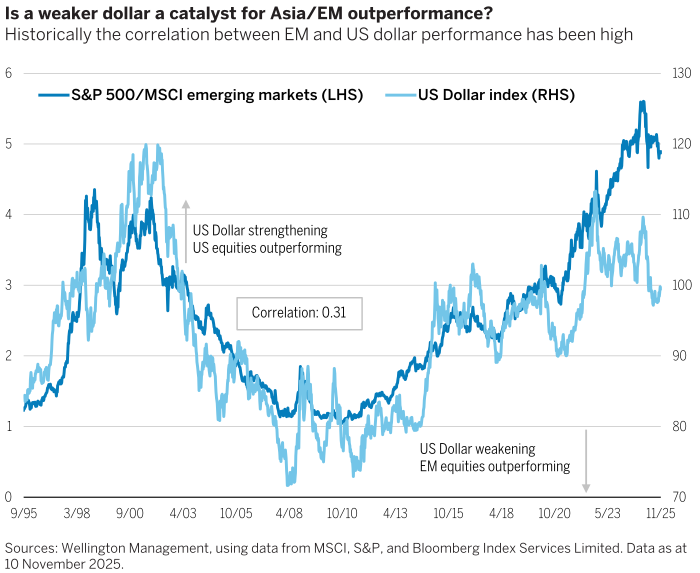
First, broadening global growth should benefit emerging markets. Second, the US dollar’s reserve currency primacy is threatened by the US fiscal deficit, growth and inflation headwinds, and capital flows to other regions. Given that a weaker US dollar is advantageous for the US administration, further weakening could occur, which would augment returns for EM investors and support EM economies with dollar-denominated debts (Figure 4).
Meanwhile, a growing focus on shareholder value is driving increased capital discipline and prioritizing shareholder return. South Korea’s equity valuations have been hit by its poor corporate governance record, but the government’s Corporate Value-Up Program is making solid progress toward changing corporate behavior and increasing shareholder value. China’s anti-involution campaign — while different in scope — also exemplifies this new focus on reform, which should help to drive performance in emerging markets.
Lastly, the immediate impact of tariffs on EM growth has been milder than anticipated, and in several cases, policy responses have supported growth by prioritizing domestic markets and enhancing economic resilience. At the same time, lower central bank policy rates have been a meaningful net positive for financial conditions within emerging markets, with more rate cuts globally in 2025 than in any other year over the past two decades.
Figure 4
Investment implications
After years of neglect, investors might wish to reassess their allocation to emerging markets within a global portfolio. However, there is high dispersion between countries for political, social, and industrial reasons, and some may fare better than others. While emerging markets can potentially offer investors a rich opportunity set, selectivity is key.
The sixth theme we’re monitoring is, of course, what could go wrong.
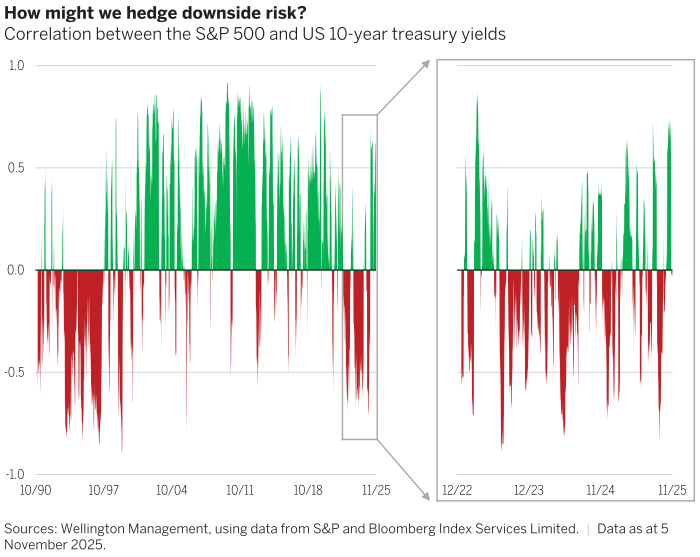
Equity investors are increasingly focused on the growing challenge of hedging downside risks in a world of changing correlations. Stocks and bonds have become more correlated in recent years (Figure 5), which means bonds have lost some of their value as the “all-weather” risk mitigator and diversifier for equity exposures. And as long as US equities and the USD remain positively correlated, the USD loses its historic safe-haven profile and becomes a risk-multiplier. In this scenario, downside risk for non-USD investors increases and currency hedging or alternative protection strategies become increasingly important.
The most challenging risk environment would be a reflationary scenario, which could drive interest rates higher and stock and bond prices lower in tandem (as we saw in 2022).
Figure 5
Investment implications
To help protect against the downside, equity investors should consider the following risk-mitigation approaches:
1) Fund structures that can short, such as hedge funds or extension strategies
2) Portable alpha strategies
3) Stocks or strategies positioned to outperform in a higher-rate environment
4) Alternative asset classes or commodities that are positioned to outperform amid higher rates.
Accommodative monetary and fiscal policy and sharply accelerating AI capex buoyed global growth in 2025. Looking ahead to 2026, growth should remain robust, but the investment landscape will be defined by broader earnings dispersion, shifting correlations, and regime transitions in Europe, Japan, and select emerging markets. Against this backdrop, we believe equity investors will need to balance AI enthusiasm with discipline, diversify exposures across regions and styles, and expand their risk mitigation toolkit to navigate a more volatile, less synchronized world.
BLOOMBERG®” and the Bloomberg indices listed herein (the “Indices”) are service marks of Bloomberg Finance L.P. and its affiliates, including Bloomberg Index Services Limited (“BISL”), the administrator of the Indices (collectively, “Bloomberg”) and have been licensed for use for certain purposes by the distributor hereof (the “Licensee”). Bloomberg is not affiliated with Licensee, and Bloomberg does not approve, endorse, review, or recommend the financial products named herein (the “Products”). Bloomberg does not guarantee the timeliness, accuracy, or completeness of any data or information relating to the Products.
Republication or redistribution of Refinitiv content, including by framing or similar means, is prohibited without the prior written consent of Refinitiv. Refinitiv is not liable for any errors or delays in Refinitiv content, or for any actions taken in reliance on such content. Refinitiv’s logo is a trademark of Refinitiv and its affiliated companies. www.refinitiv.com
Neither MSCI nor any other party involved in or related to compiling, computing or creating the MSCI data makes any express or implied warranties or representations with respect to such data (or the results to be obtained by the use thereof), and all such parties herby expressly disclaim all warranties of originality, accuracy, completeness, merchantability or fitness for a particular purpose with respect to any of such data. Without limiting any of the foregoing, in no event shall MSCI, any of its affiliates or any third party involved in or related to compiling, computing or creating the data have any liability for any direct, indirect, special, punitive, consequential or any other damages (including loss of profits) even if notified of the possibility of such damages. No further distribution or dissemination of the MSCI data is permitted without MSCI’S express written consent.
The "S&P 500" “S&P 100”, S&P 400”, “S&P 600” are a product of S&P Dow Jones Indices LLC or its affiliates (“SPDJI”) and has been licensed for use by Wellington. Standard & Poor’s® and S&P® are registered trademarks of Standard & Poor’s Financial Services LLC (“S&P”); Dow Jones® is a registered trademark of Dow Jones Trademark Holdings LLC (“Dow Jones”). Wellington’s products are not sponsored, endorsed, sold or promoted by SPDJI, Dow Jones, S&P, or their respective affiliates, and none of such parties make any representation regarding the advisability of investing in such product(s) nor do they have any liability for any errors, omissions, or interruptions of the S&P 500, the S&P 100, the S&P 400, or the S&P 600.
Experts