Netherlands, Institutional

Changechevron_right
menu
search

Another banner year for emerging markets local debt in 2026?

4 min read
2027-02-28
Archived info
Archived pieces remain available on the site. Please consider the publish date while reading these older pieces.
Multiple authors
1306077623

Key takeaways:

  • Emerging markets (EM) local debt experienced strong performance in 2025 after a decade of muted returns and relatively high volatility.
  • We believe this bull run could continue based on improving sentiment, the ratio of foreign to domestic investment, and structural improvements in the asset class.

EM local debt: Standout return-to-risk in 2025

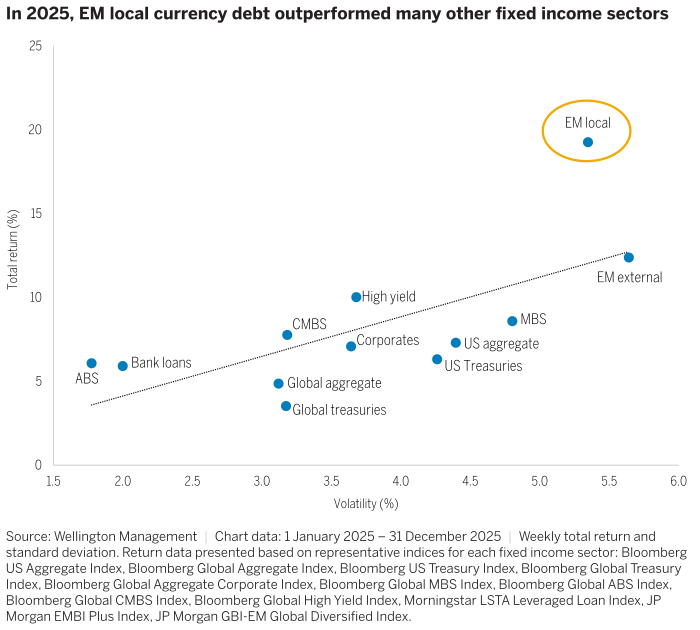
Last year, EM local currency debt outperformed almost all other fixed income sectors on both a total return and risk-adjusted return basis. The asset class, as represented by the JP Morgan Government Bond Index – Emerging Markets Global Diversified, returned 19.3% in US dollar terms in 2025.

Figure 1

Chart illustrating EM local currency debt outperforming other fixed income sectors, including asset-backed securities, bank loans, collateralized mortgage-backed securities, global aggregate bonds, global treasuries, high yield, corporate bonds, the US ag

The sector printed a return-to-risk ratio greater than three for the first calendar year in its history.1 For perspective, the long-run return-to-risk ratio has been 0.55 since the inception of the Index in 2003 and 0.23 since the global financial crisis.

Last year was also the first since 2017 in which EM local debt posted a positive total return in each quarter of the year and outperformed the US aggregate index in every quarter. With such strong returns throughout the year, one could say EM debt investors had very few sleepless nights in 2025.

What’s more, while investors often think of EM local debt returns as analogous with currency risk, returns in 2025 were well balanced between local rates and local currencies. No single risk factor dominated the sector’s 19.3% total return. Of the total return, 8.3% came from EM currencies and the remainder from EM local rates. Returns were also well balanced across the index from a country perspective. In fact, 15 of the 19 countries in the JPM GBI-EM Global Diversified Index, a proxy for EM local currency debt, posted total returns in US dollar terms greater than 10% for the year.

Four reasons the bull market in EM local debt could continue in 2026

We believe EM local debt can continue its run throughout this year for four key reasons:

1. Improving sentiment — In the decade prior to 2025, the EM local debt sector underperformed other areas of fixed income from a risk/reward standpoint, producing a flat annualized return with 11% volatility. This engendered negative sentiment, which can take several years to unwind, even after fundamentals begin to turn positive, as we’re seeing in the asset class now. So, even though sentiment has begun to lift, it could improve further, which means there’s room for the bulls to keep running.

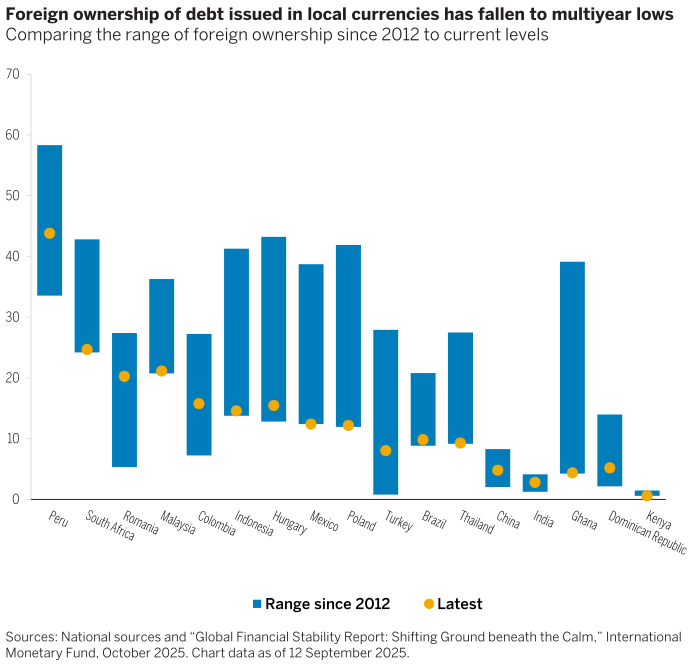
2. Ratio of foreign to domestic ownership — Because EM local currency debt has a recent track record of muted returns and relatively high volatility, many fixed income investors have been reluctant to commit capital. This is positive for the asset class for two reasons:

  • With foreign investment so low, many countries rely more on demand from domestic investors. Greater domestic ownership of local currency debt reduces EM debt’s sensitivity to global shocks, which supports the asset class from a structural perspective.
  • At the same time, from this point, there is room for foreign investment to tick up, which would also benefit the asset class.

Figure 2

Bar chart outlining the range of foreign ownership in EM local debt from 2012 through 2025 and highlighting the relatively low current levels of foreign ownership by comparison.

3. USD depreciation cycle, then vs now — The last big USD depreciation cycle was in 2002 – 2007. Then, more, if not most, EM currencies were either pegged to the USD or tightly managed. Practically speaking, this means that investors have not experienced a USD depreciation cycle where there is more EM currency flexibility to the upside. Because there is not a mental model for this regime, we expect that most investment managers are likely to underestimate the appreciation potential of EM currencies.

4. Positive structural change? — The majority of EM policymakers seem to be acting in a fairly orthodox manner. The South African Reserve Bank recently shifted its inflation target from a 3% – 6% range to a new, lower 3% target with a 1% tolerance band (2% to 4%). Chile is going back to the pre-2019 period of political and social stability, and President-elect José Antonio Kast has pledged to deliver fiscal adjustment by cutting spending. On average, EM central banks are having more success than their developed market counterparts in bringing inflation back to their target range.

The stage appears set for a longer-term positive trend

It takes time for investors to appreciate structural change. Mindsets and biases shift slowly, and movements of capital tend to be incremental, but this can underpin long-term bull markets.

In our view, strong EM local debt performance in 2025 isn’t a one-off. Better investor sentiment, underinvestment in EM local debt, and structural improvements may have set the stage for a positive, longer-term reversal in the asset class. Ultimately, we believe EM local debt’s bull run has scope to continue.

1Return-to-risk ratio calculated as average total returns over volatility, using daily observations. History based on JP Morgan Government Bond Index – Emerging Markets Global Diversified since inception in 2003.

The views expressed are those of the authors at the time of writing. Other teams may hold different views and make different investment decisions. The value of your investment may become worth more or less than at the time of original investment. While any third-party data used is considered reliable, its accuracy is not guaranteed. For professional, institutional or accredited investors only. 

Experts

Get our latest market insights straight to your inbox.

Read more from our experts