




- Investment Director, Private Investment Capital Formation
Luxembourg, Intermediary
ChangeThis is an excerpt from our Investment Outlook, in which specialists from across our investment platform share insights on the economic and market forces that we expect to influence portfolios.
AI-focused capital flows are reshaping private markets, concentrating capital, and creating consensus exposure. We believe this dynamic has contributed to a growing divide between large- and mega-cap (predominantly) AI companies and perhaps overlooked small- and mid-cap opportunities often found in sectors outside of AI.
For many allocators, the key question is (of course) not whether to participate in AI or large-cap private companies. Instead, it is how to balance exposure between a single theme or consensus winner and a wider set of differentiated private market return drivers.
The implications of these shifts are changing the venture and growth opportunity set for the second half of 2026 and beyond.
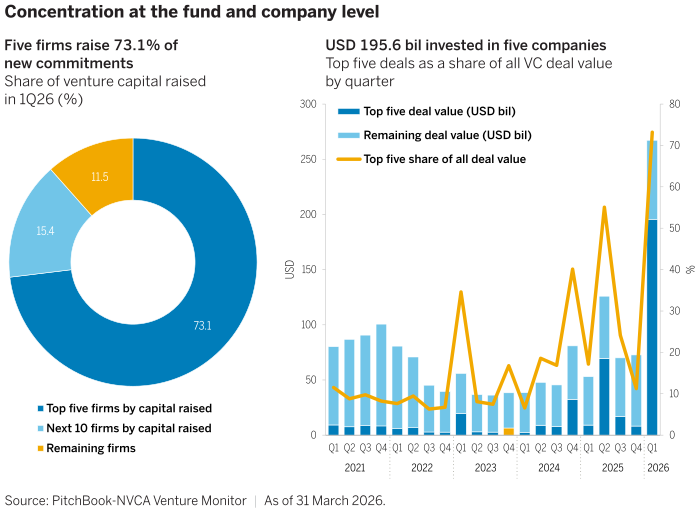
Capital is increasingly flowing into mega-cap venture and growth funds that need to deploy at scale, resulting in larger rounds, bigger positions, and greater concentration across the market (Figure 1). In our view, this is not a cyclical phenomenon but rather is structurally driven by fund size, capital supply, and the practical constraints of deploying very large pools of capital into private companies. At the upper end of the market, financing rounds have expanded from single-digit billions to tens of billions of dollars, with a small number of AI-driven consensus “category winners” absorbing a disproportionate share of capital.
The scale of this shift is now visible in the data from the first quarter of 2026. The top five managers by capital raised captured 73.1% of all venture commitments, while the top 15 firms captured 88.5%. A similar pattern is emerging on the deal side where the five largest financings accounted for almost US$200 billion in investment, pushing the top-five share of total venture deal value to over 70%, its highest recorded level.
Figure 1
For allocators invested in several large managers, this means they may have overlapping exposures across portfolios, mirroring how public market mega-cap names have dominated index returns in recent years. We believe this has led to the emergence of venture/growth “mega-cap indices,” as large funds, and even publicly listed closed-end funds, effectively create broad-based exposure to the same set of leading companies.
Venture and growth markets are becoming more segmented as a result. We believe this is changing who gets access to the most competitive rounds, which investments are large enough to matter for different fund sizes, and which parts of the market offer the potential for differentiated underwriting.
At the large end of the market, rounds are dominated by mega funds, strategic investors, hyperscale cloud providers, sovereign wealth funds, and public-private crossover funds. Check size matters, but access often depends on the strategic relevance, information flow, global reach, and customer relationships a company can expect from its investors. Limits on syndicates and special purpose vehicles are one result of that selectivity. For smaller managers, the issue is often not whether they can assemble capital, but whether the company wants that capital in the round.
The other side of the barbell is shaped by a different constraint. Smaller, more specialized companies, both in AI and outside it, may be attractive investments, but they may not absorb enough capital to be material to a US$5 billion or US$10 billion platform.
For example, a US$5 billion growth fund seeking a 3x gross multiple would need about US$15 billion of gross proceeds. A US$50 million investment that returns 5x would generate US$250 million of gross proceeds, including US$200 million of gross profit. That is a strong outcome in absolute terms, but it represents only 4% of the fund’s capital and about 1.7% of the gross proceeds required to reach a 3x fund-level result.
For a large platform, the question has become whether that type of outcome justifies the diligence, governance, and portfolio support required to lead many similar rounds.
We believe the buyout universe offers a useful comparison for this transition. Over time, buyout separated into lower-middle-market, middle-market, large-cap, and mega-cap strategies, each with different return drivers, capital bases, and operating models.
Venture and growth appear to be moving in a similar direction as fund size increasingly shapes which companies a manager can access and what return profile it can reasonably underwrite.
In the wake of these changes, a broader, less efficient opportunity set is emerging across non-consensus segments of the market. We’re seeing opportunities in underfollowed, non-AI sectors like consumer, financials, and health care.
In our view, the venture and growth barbell has implications for both entry points and go-forward return profiles. Forward-looking returns are not solely based on company quality, and must take into account entry price, capital structure, and exit path. Even high-quality AI leaders may deliver modest multiples from current valuations, depending on an allocator’s entry point.
In contrast, we believe compelling opportunities may exist in smaller, less competitive segments with lower entry valuations. We think underwriting should increasingly focus on relative entry valuations, expected time horizons, and realistic exit scenarios.
For allocators, the question has shifted from “Is this a great company?” to “What return is realistically achievable from this entry point, and what alternatives exist?”
An “all-cap private market” that spans mega-, mid-, and small-cap opportunities offers a wider opportunity set with the potential for greater portfolio construction flexibility. Critically, this concept is not anti-AI but rather is about understanding what strategies can broaden exposure beyond consensus trades.
Balancing mega-cap opportunities with a wider set of potential exposures requires a more deliberate approach to portfolio construction. In our view, allocators should consider four key frameworks:
AI and IPO dynamics are understandably the dominant market narrative. But less attention has been paid to the significant opportunities these trends are leaving in their wake. The current private market cycle is increasingly defined by a narrow set of consensus opportunities. While these investments may continue to create substantial value, they also introduce portfolio-level concentration risk and potentially more index-like return profiles.
For the second half of 2026 and beyond, this is creating a broader opportunity set across less efficient segments of the market, where capital is scarcer and competition is lower. In fact, it is also contributing to a structural change in the venture and growth asset class itself.
For allocators, the challenge is now balancing large- or mega-cap consensus exposure with a more flexible, all-cap opportunity set that can potentially capture differentiated sources of return.
The views expressed are those of the authors at the time of writing. Other teams may hold different views and make different investment decisions. The value of your investment may become worth more or less than at the time of original investment. While any third-party data used is considered reliable, its accuracy is not guaranteed. For professional, institutional, or accredited investors only.