
Luxembourg, Intermediary

Changechevron_right
menu
search

IPOs aren’t dead, they’re just napping

Multiple authors
5 min read
2026-07-31
Archived info
Archived pieces remain available on the site. Please consider the publish date while reading these older pieces.
alarm-clock

The views expressed are those of the authors at the time of writing. Other teams may hold different views and make different investment decisions. The value of your investment may become worth more or less than at the time of original investment. While any third-party data used is considered reliable, its accuracy is not guaranteed. For professional, institutional or accredited investors only. 

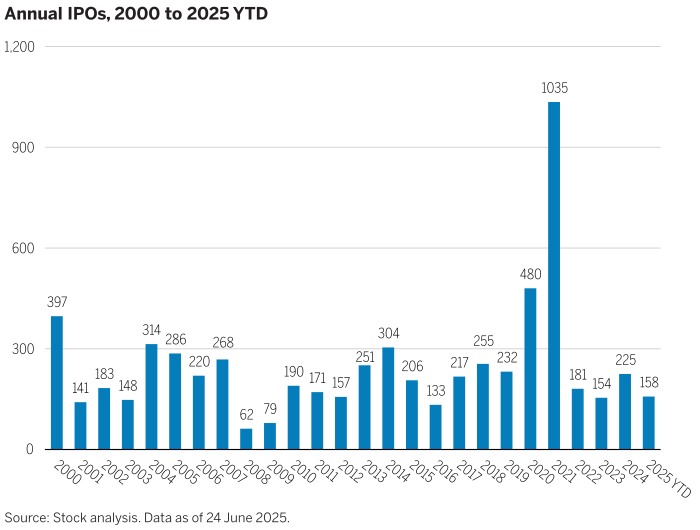
It would be a massive understatement to say that the IPO market has seen fluctuations over the past five years. Only four short years ago, US markets experienced a record-breaking 1,035 IPOs, driven largely by the near-zero interest-rate market environment. These giddy years stand in sharp contrast to the more than 80% drop that followed in 2022 and 2023 (Figure 1) — and to the 20-year historical average of 254 IPOs per year.1

Not surprisingly, the relatively muted IPO environment of the last three years has led many to question whether companies will stay “private forever,” and if the path to public listing is permanently challenged. In our view, the answer to both is a definitive “no.”

Below we explore the underlying issues in today’s IPO environment, key lessons learned for private companies, and reasons why we believe the death of the IPO market has been greatly exaggerated.

Figure 1
ipos-graph

What kills an IPO?

Though each IPO is a distinct pricing event — reflective of a company’s unique quality, desired pricing, and overall demand — we see three common mistakes that lead to issues at IPO (and stock performance thereafter).

  1. Raising private-market rounds at valuations that are too high
    Can there be such a thing as a valuation that’s so high it hurts current owners? In our view, when it stands in the way of real liquidity, then yes, there can. We have seen many cases of private companies taking capital at the highest possible valuation, which serves as a short-term win, but can ultimately harm investors in a resulting IPO.

    In practice, when private-market valuations are too high relative to public-market expectations, it results in a wide bid–ask spread that can hurt the demand for and performance of the IPO. Moreover, the taboo of pricing a down round IPO drives many companies to push off an IPO until they can grow into their previous private-market valuation. These dynamics highlight the importance of doing pre-IPO rounds at the right price, not just the highest price. If going public is the company’s eventual goal, we believe it is critical to price these rounds (considering the comparable public companies and how they trade) to avoid this bid–ask spread problem.
  2. Pricing mechanisms that are disconnected
    Private markets are inefficient, with prices generally set by one or two investors’ opinions. In contrast, an IPO is the first step to entering a more efficient marketplace with a more consistent pricing mechanism. Further, we believe it’s critical that these two markets value a company in the same manner. For example, a “technology company” with a consumer buyer warrants a much different multiple than “consumer company” with a technology feature.

    While companies want to trade at the same multiple as their top comparable public companies, they likely should be valued at a discount given float considerations. A company that is going public typically floats around 10% and has an overhang of around 90% that will come to market over time. This can lead to dynamics that a fully floated, public company would not experience, such as shorting in anticipation of an increased float.
  3. Behavioral (mis)alignment with underwriters
    Finally, underwriters compete for IPO listings on pricing. For this reason, they are generally incentivized to optimize for the near-term IPO performance instead of long-term public-market performance. Given the overhang noted above, it is important to value how the longer-term performance will impact the around 90% that is not on offer at IPO.

    In addition, these challenges have broader implications for the company’s venture capital investors. For instance, if a recently IPO’d company trades well below its previous private-market valuation, existing investors risk exposing their remaining private portfolio to valuation methodology inquiries.

Overall, companies get caught up on where their IPO is priced, whereas we believe they should be more concerned about where it goes. In our view, companies that price modestly and beat expectations will fare much better than those who go as high as possible and then face the risk of underperformance. 

Why the IPO market will come back to life

While IPOs are currently delayed without a stable public-market backdrop, we believe they are not canceled. In our view, it’s inevitable that many leading private companies will eventually go public for three key reasons: 

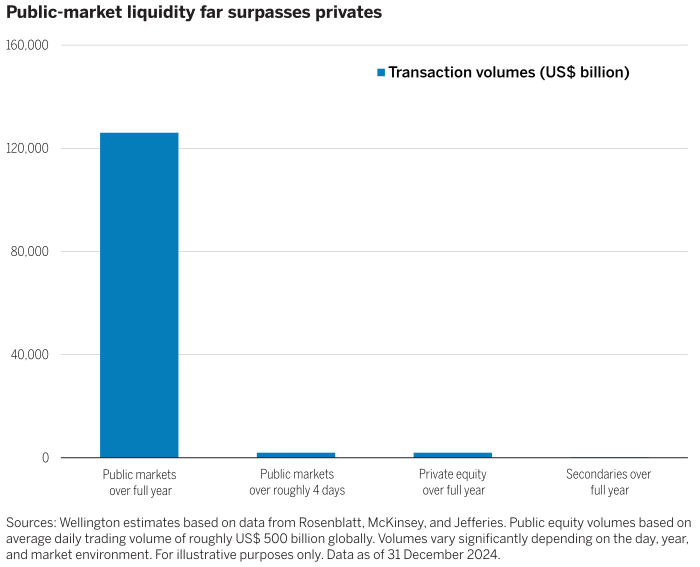
  • Liquidity — Private markets lack the liquidity necessary for investors, founders, and employees to cash out. The public market processes more volume in roughly four days than all of private equity does in a year (Figure 2). This makes going public crucial for most successful private companies (and highly likely once the public market stabilizes).

Figure 2

ipos-arent-dead
  • Capital access and efficiency — A critical benefit of this liquidity is that public markets can provide much greater amounts of capital at lower costs than private markets and with less friction.
  • Brand — Few events in the life of a company offer the level of brand recognition and trust that becoming publicly traded does. When a company is public, its business metrics are accessible to everyone and there is much greater transparency. This openness can foster customer trust and enhance the company's public brand among retail investors.

Private for longer, not forever

While companies may continue to stay private longer, we believe leading companies will not remain private forever. The trend of extended private ownership allows private-market investors to benefit from higher growth profiles, sector diversification, and value creation potentially unavailable in public markets. However, we believe the IPO’s significant value proposition remains strongly intact. 

So, IPOs are not dead, in our view, but it’s critical for investors and companies to understand the dynamics driving their long and misleading nap. By addressing these issues, stakeholders can better navigate the complexities of IPOs, prepare for a smoother transition from public to private, and capitalize on opportunities in both private and public markets.

1 “IPO trends: First half of 2024 and beyond,” Stout, 26 August 2024.

Experts

Related insights

Showing of Insights Posts
Article
5 min
Archived info
Archived pieces remain available on the site. Please consider the publish date while reading these older pieces.

Venture capital outlook for 2026: 5 key trends

Continue reading
event
5 min
Article
2026-12-31
Archived info
Archived pieces remain available on the site. Please consider the publish date while reading these older pieces.
Article
5 min
Archived info
Archived pieces remain available on the site. Please consider the publish date while reading these older pieces.

Private credit outlook for 2026: 5 key trends

Continue reading
event
5 min
Article
2026-12-31
Archived info
Archived pieces remain available on the site. Please consider the publish date while reading these older pieces.
Article
6 min
Archived info
Archived pieces remain available on the site. Please consider the publish date while reading these older pieces.

Investing in climate solutions across public and private markets

Continue reading
event
6 min
Article
2026-10-14
Archived info
Archived pieces remain available on the site. Please consider the publish date while reading these older pieces.
Article
7 min
Archived info
Archived pieces remain available on the site. Please consider the publish date while reading these older pieces.

Human capital management for private companies

Continue reading
event
7 min
Article
2026-11-30
Archived info
Archived pieces remain available on the site. Please consider the publish date while reading these older pieces.
Article
5 min
Archived info
Archived pieces remain available on the site. Please consider the publish date while reading these older pieces.

What’s the Fed got to do with it? The impact of rate cuts on CLO equity

Continue reading
event
5 min
Article
2026-10-31
Archived info
Archived pieces remain available on the site. Please consider the publish date while reading these older pieces.
Article
6 min
Archived info
Archived pieces remain available on the site. Please consider the publish date while reading these older pieces.

Commercial real estate debt: Transitional assets deep dive

Continue reading
event
6 min
Article
2026-10-31
Archived info
Archived pieces remain available on the site. Please consider the publish date while reading these older pieces.
Article
10 min
Archived info
Archived pieces remain available on the site. Please consider the publish date while reading these older pieces.

Venture and growth equity: The future of private-market evergreen funds?

Continue reading
event
10 min
Article
2026-10-31
Archived info
Archived pieces remain available on the site. Please consider the publish date while reading these older pieces.

Read next