






- Lead Client Services Writer
Iceland, Institutional
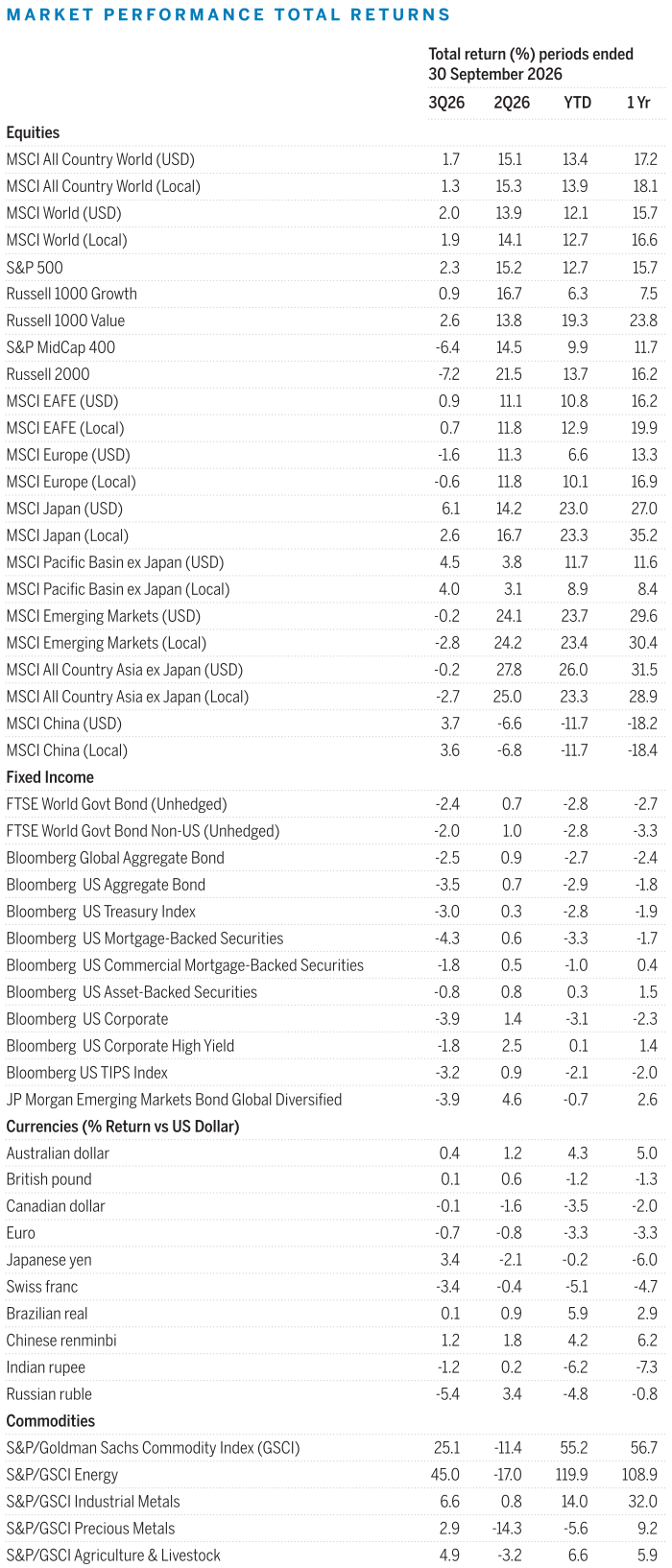
ChangeGlobal equities (+1.3%) rose in the third quarter as strong corporate earnings and AI investment supported markets despite higher energy costs and rising bond yields. S&P Global’s preliminary September business surveys identified AI investment, defense spending, and consumer demand as sources of growth, as its GDP-weighted G4 Composite Purchasing Managers’ Index (PMI) Output Index showed aggregate business activity across the US, the eurozone, Japan, and the UK expanding at its fastest pace since March 2022. Stronger activity coincided with renewed inflation pressures. US businesses reported the fastest increase in input costs since October 2022, while input-cost inflation also accelerated in the eurozone and the UK. This combination strengthened the case for further monetary tightening in several major economies, with higher bond yields weighing on equity valuations even as earnings prospects improved. Higher energy prices lifted revenues for energy producers able to sustain output and exports but eroded household purchasing power, particularly in energy-importing economies, and pressured margins in energy-intensive industries. In China, strong exports contrasted with subdued retail sales and declining property investment, underscoring the gap between external and domestic demand.
Global fixed income markets came under pressure in the third quarter of 2026 as persistent inflation, higher energy prices, and a broad repricing of central bank policy pushed government bond yields sharply higher. Commodities (+25.1%) rallied in the third quarter, with energy, industrial metals, agriculture & livestock, and precious metals all contributing during the period.
US equities (+2.3%) finished higher in a volatile third quarter, registering a 12.7% gain year to date. Robust and better-than-expected second-quarter earnings and solid economic data were countered by a sharp rise in US Treasury yields, technology sector volatility, and anxiety about higher interest rates amid stubbornly high inflation. Second-quarter annualized GDP was revised significantly higher to 2.2%, and the economy maintained good momentum in the third quarter, thanks to resilience in the labor market and consumer spending, along with expansionary activity across the manufacturing and services sectors. The US Federal Reserve (Fed) raised interest rates by 25 basis points (bps) in September — the first increase since 2023 — following Fed Chair Kevin Warsh’s hawkish comments about the strength of the US economy and elevated inflation risks. A vast majority of Fed officials projected another hike this year. Annual core Personal Consumption Expenditures inflation was 3.0% in August, below expectations but still well above the Fed’s target. According to FactSet, 86% of the companies in the S&P 500 Index reported better-than-expected earnings in the second quarter, the highest proportion in five years. In aggregate, earnings were more than 25% above expectations, with 9 out of 11 sectors posting double-digit year-over-year growth in earnings and net profit margins.
Economic data released during the quarter showed that the economy remained on a solid footing. A sizable rebound in job growth in August helped to ease concerns of a rapidly slowing labor market. Unemployment fell to 4.1%, initial jobless claims remained exceptionally subdued, and job openings slipped to a five-month low in August, as a “low-hire, low-fire” environment prevailed. Consumer spending rebounded in August on the back of a stable job market and recent stock market gains. Retail sales grew at a robust 1.2% monthly pace following a 0.5% decline in July, while personal spending increased by 0.6%, the largest gain since March 2025. However, consumer confidence slid during the quarter, with the Conference Board’s Consumer Confidence Index deteriorating in September to its lowest level since April 2014 amid anxiety about high energy prices, rising interest rates, and elevated inflation. The housing market continued to weaken as mortgage rates hit a nearly three-year high. The manufacturing sector expanded at a stout pace during the quarter after the Institute of Supply Management (ISM) Manufacturing Index in July reached its highest level in four years. The services sector, which accounts for more than two-thirds of economic activity, also expanded at a solid pace throughout the quarter, with August business activity growing at the fastest rate since 2022.
Within the S&P 500 Index (+2.3%), 4 of the 11 sectors posted positive results for the quarter. Energy (+17.2%) was the best-performing sector. Information technology (+7.3%) and health care (+6.5%) also registered strong results. By contrast, utilities (-12.4%) was the worst-performing sector followed by industrials (-9.7%) and real estate (-5.4%), which also underperformed.
European equities (-0.6%) were weighed down by the ongoing energy-driven inflation shock and surging bond yields, which sharply increased borrowing costs. Despite geopolitical uncertainty and elevated energy prices, the eurozone economy grew 0.6% in the second quarter, better than the initial estimate of 0.4% and the highest rate since the second quarter of 2022. Eurozone business activity expanded over the quarter, as accelerated growth across the manufacturing and services sectors boosted the S&P Global Flash Eurozone Composite PMI to 53.1 in September — the highest since April 2023 and a significant improvement from 50.0 in June. German output expanded at its fastest pace in almost a year, while French business activity returned to growth for the first time in 10 months. In response to upward inflation pressures and the risk of a lengthy period of elevated energy prices, the European Central Bank (ECB) raised interest rates for the second time this year. The decision exacerbated a government bond sell-off, which drove borrowing costs in Germany and France to their highest levels since 2011 and 2008, respectively. Norway’s central bank also raised interest rates, while the central banks of Sweden, Switzerland, and the UK left rates unchanged. Annual headline inflation rose more than expected to a three-year high of 3.8% in September, increasing pressure on the ECB to raise interest rates again by year end. According to LSEG, second-quarter earnings for companies in the STOXX 600 Index are forecast to increase by 23.9% from a year earlier.
In September, the S&P Global Eurozone Manufacturing PMI rose for the third consecutive month to 52.9, the highest since May 2022, as resilient demand drove new orders and output to multiyear highs. The S&P Global Flash Eurozone Composite PMI revealed that services sector activity expanded markedly to a 10-month high. Inflationary pressures intensified, with both input costs and output prices increasing at the fastest rates in four months. The European Commission’s Economic Sentiment Indicator rose to 97.9 in September from 95.6 in June.
Germany’s (+1.3%) economy expanded more than expected at 0.3% in the second quarter on higher exports, while household consumption and capital investment struggled. Encouragingly, strong growth in production and new orders in September helped to sustain the country’s manufacturing upturn. The ZEW Indicator of Economic Sentiment edged up in September to its highest level since February amid optimism about Germany’s economic recovery, which is expected to remain supported by fiscal stimulus and measures to boost exports. In the UK (+1.8%), the newly appointed Labour Party leader Andy Burnham became prime minister after Sir Keir Starmer’s resignation. The economy grew more than expected at 0.4% in July, supported by the services sector. However, the S&P Global Flash UK PMI Composite Output Index expanded at a softer pace in September due to a loss of momentum in both the manufacturing and service sectors. Annual headline inflation accelerated to a five-month high of 3.1% in August, driven by rising energy prices, while core inflation was steady at 2.6% for the fourth straight month. The Bank of England (BOE) warned that it may hike interest rates if higher inflation becomes entrenched in the economy.
Pacific Basin equities (+3.1%) rose over the period. In Japan (+2.6%), rate-hike expectations built steadily over the quarter as inflationary pressures intensified. The US Fed’s hawkish pivot, worsening public finances, and sharply rising oil prices exacerbated pressure on the yen, which slid to a 40-year low and eroded the country’s purchasing power despite a coordinated US-Japan currency intervention. The case for a Bank of Japan (BOJ) rate hike strengthened further amid concerns that additional currency intervention alone would be ineffective without coordinated monetary policy tightening. Still, mixed economic data and political priorities complicated the path toward policy normalization. Second-quarter annualized GDP was revised higher to 1.4%, and nominal wage growth was the fastest since 1997. However, stagnant consumer spending underscored fragile domestic demand. Japan’s underlying inflation trend remained solid, even as core inflation slightly decelerated to 1.7% in August, with government fuel subsidies offsetting rising import costs from a weak yen and surging oil prices. Fiscal concerns also intensified after Prime Minister Sanae Takaichi’s administration unveiled a ¥370 trillion investment plan with limited funding details. Against this backdrop, the BOJ raised its benchmark rate by 25 bps to 1.25% in September, as widely expected.
In Australia (+1.2%), shifting labor market and inflation data repeatedly shaped the monetary policy outlook over the quarter. While easing core inflation, an unexpected rise in unemployment, and a weakening housing market initially curbed rate-hike expectations, stronger-than-expected second-quarter GDP growth, rising energy costs, and firm household and business demand sustained pressure on the Reserve Bank of Australia (RBA) to tighten policy further. Expectations for a rate increase continued to build amid a series of hawkish signals from the RBA, with the central bank ultimately raising the cash rate by 25 bps to a 15-year high of 4.6% in September. Resilient domestic demand and rising energy costs were cited as key risks to the inflation outlook, although RBA Governor Michele Bullock’s measured tone and softer-than-anticipated inflation in August led markets to scale back expectations for another hike in November.
In Singapore (+12.2%), the Monetary Authority of Singapore tightened policy in July, modestly raising the appreciation rate of its currency band to counter upside inflation risks. Strong AI-related demand, an upward revision to second-quarter GDP, and surging non-oil domestic and electronics exports reinforced economic momentum, prompting the government to raise its 2026 growth forecast to 4.5% – 5.5%. Core inflation rose for a third consecutive month to 2.2% in August, strengthening expectations for modest tightening in October.
In Hong Kong (+6.7%), the Hong Kong Monetary Authority raised interest rates by 25 bps to 4.25% — the first hike since 2023 — to defend the Hong Kong dollar’s peg to the US dollar. Economic conditions remained robust, as strong exports, resilient domestic demand, and buoyant financial markets supported the government’s upgraded 2026 GDP growth forecast of 3.5% – 4.5%. However, higher borrowing costs and tighter mainland capital controls threatened the property market’s nascent recovery.
Emerging markets (EM) equities (-2.8%) fell in the third quarter. Asia declined, while Latin America and Europe, the Middle East, and Africa (EMEA) gained.
In Asia (-4.1%), China’s (+3.6%) economic conditions remained uneven but showed signs of improvement. Consumer spending remained lackluster, while the economy was supported by robust exports, which rose 25% year over year in August thanks to hearty demand for high technology and AI-related products. September data showed that services activity expanded at its fastest pace in three months, while factory activity returned to expansionary territory with modest growth. Policymakers introduced additional measures to support economic growth and the struggling property sector, including targeted bank lending and new subsidies for homebuyers’ mortgage interest payments. This came after the government unveiled its first-ever national five-year plan specifically dedicated to bolstering consumption, targeting ¥60 trillion (US$8.3 trillion) in total retail sales of consumer goods by 2030. Taiwan’s (+4.9%) economy continued to benefit from strong demand for semiconductors and AI-related technologies, prompting the country’s statistics agency to raise its 2026 GDP growth forecast to 11.05% in August, from 9.64% in May. Exports hit a record high of US$81.4 billion in August, up 41% year over year. South Korea (-20.9%) declined sharply amid concerns that growing Chinese competition in memory chips could undermine the sustainability of the AI-driven semiconductor boom. Nevertheless, exports jumped 83.5% in September from a year earlier to a record US$120.9 billion, as semiconductor shipments more than tripled thanks to robust global AI-related spending. India (-4.4%) was dragged down by record foreign outflows, soaring crude prices, and rising global bond yields. Consumer price inflation accelerated for the tenth straight month to 4.82% in August as broadening price gains pressured the central bank to raise interest rates.
In Latin America (+5.0%), Brazil (+8.3%) advanced despite signs of moderating economic momentum. The Finance Ministry lowered its 2026 GDP growth forecast to 2.0% from 2.3%, citing weaker services and industrial activity, while the central bank continued its easing cycle with a fifth consecutive 25 bps interest-rate cut in September to 13.75%. Inflation subsequently accelerated more than expected to 4.47%, stoking concerns about persistent price pressures ahead of a tightly contested presidential election in October. Mexico’s (-2.2%) central bank signaled a prolonged pause in interest-rate cuts given the uncertain global economic backdrop. Annual inflation rose to 3.42% in September, although core inflation continued to trend lower. The S&P Global Mexico Manufacturing PMI edged back into expansionary territory at 50.3 in September.
In EMEA (+3.7%), Saudi Arabia’s (-0.6%) economy faced headwinds from the ongoing US war with Iran and recent drone attacks, which temporarily shut down the strategically important East-West Pipeline, threatened a key oil export route, and pushed global energy prices higher. However, the strongest expansion in non-oil private sector activity since February lifted the Riyad Bank PMI to 55.3 in September from 53.8. South Africa (+1.4%) faced a more challenging global environment that pushed the economy into contractionary territory for the first time in nearly two years. Second-quarter GDP declined 0.2%, reflecting weaker domestic demand and higher imports due to the conflict in Iran, alongside underperforming mining and manufacturing sectors.
Global fixed income markets came under pressure in the third quarter as persistent inflation, higher energy prices, and a broad repricing of central bank policy pushed government bond yields sharply higher. Renewed US-Iran hostilities disrupted shipping through the Strait of Hormuz and drove oil prices markedly higher, adding to inflation concerns and weighing on risk sentiment. In the US, Fed Chair Warsh reinforced his focus on price stability at the Fed’s annual economic policy symposium in Jackson Hole, culminating in the Fed’s first interest-rate hike in three years. Several other central banks, including the ECB, the BOJ, and the Reserve Bank of New Zealand also raised rates, while policymakers increasingly signaled that restrictive policy may need to remain in place for longer.
Global sovereign bond markets declined as yields rose sharply across developed markets. US Treasury yields led the sell-off, driven by resilient economic data, persistent inflation, a more inflation-focused Fed, and concerns about fiscal deficits and government borrowing. Yields also rose materially in Europe, Canada, Australia, and Japan, while EM bonds generally proved more resilient. China was a notable outperformer as weak domestic demand, fiscal restraint, and fading inflation expectations continued to support its bond market.
Corporate credit markets also weakened as spreads widened across regions, sectors, and ratings categories amid higher government bond yields, persistent inflation concerns, and geopolitical uncertainty. US credit underperformed European credit on a total-return basis. Despite the more challenging backdrop, investor demand remained strong and investment-grade fund flows stayed positive. Investment-grade issuance remained exceptionally strong, with US issuance running at a record year-to-date pace through September, driven partly by large technology and data-center financings, while European investment-grade issuance was also robust and generally well absorbed.
Currency markets reflected diverging monetary policy expectations and shifting geopolitical developments. The US dollar strengthened against several major developed market currencies as persistent inflation and a more hawkish Fed outlook supported US rates. The Japanese yen proved resilient as a more hawkish BOJ and coordinated US-Japan currency intervention provided support, while the Norwegian krone benefited from higher energy prices. EM currencies generally weakened against the dollar, although performance varied considerably. The South Korean won appreciated on record-high exports, semiconductor-related inflows, corporate repatriation flows, and tighter monetary policy.
Commodities (+25.1%) broadly rallied in the third quarter, led by a surge in energy (+45.0%). Gas oil (+80.2%), heating oil (+60.6%), crude oil (+42.4%), and gasoline (+39.1%) posted outsized gains as escalating Middle East tensions disrupted Gulf exports and shipping routes. Distillates led the advance, with constrained diesel supplies, refinery outages, export disruptions, and elevated refining margins lifting gas oil and heating oil. Gasoline benefited from transportation demand and low inventories. Crude oil rose as persistent risks to regional production, infrastructure, and shipping sustained a substantial supply risk premium, despite weaker Chinese demand and global growth uncertainties. Natural gas (-11.5%) was dragged down by robust US production and storage builds, which outweighed support from hot summer weather and strong liquefied natural gas exports. Inventories above their five-year average and expectations of cooler weather added to concerns about the supply outlook.
Industrial metals (+6.6%) generated good gains. Zinc (+10.5%) benefited from constrained mine supply and low inventories, alongside improving demand expectations in China, although worries about slower industrial activity limited gains. Copper (+9.4%) advanced on mine disruptions, low inventories, and demand linked to electrification. Uncertainty over potential US tariffs on refined copper also encouraged inventory shifts and raised concerns about non-US supplies. Aluminum (+4.0%) benefited from declining inventories and solid demand across construction, infrastructure, manufacturing, renewable energy, and electric vehicles. Lead (-0.8%) declined amid rising inventories and softer battery-sector demand, while nickel (-2.4%) fell as expanding Indonesian production and ample refined metal availability reinforced signs of oversupply.
Precious metals (+2.9%) were led higher by gold (+3.2%), as geopolitical tensions, US fiscal concerns, and uncertainty around the Fed’s policy path supported safe-haven demand. A stronger US dollar and higher expectations for restrictive monetary policy tempered gains during the quarter. Silver (+0.9%) also advanced, with safe-haven demand offsetting softer industrial demand expectations, while industrial consumption provided additional support.
Agriculture & livestock (+4.9%) gained. Sugar (+20.4%) was driven sharply higher by weather-related production risks and tightening global supply expectations. Corn (+15.2%) advanced on Black Sea supply disruptions, adverse weather, and strong Chinese demand, although favorable US crop prospects tempered gains. Soybeans (+14.2%) were lifted by higher fertilizer, energy, and freight costs, which sparked anxiety about future crop yields and global supply availability. Feeder cattle (-2.6%) and live cattle (-6.6%) weakened as improving supply conditions, including the resumption of Mexican cattle imports, eased supply concerns and triggered profit-taking. Lean hogs (-7.3%) remained under pressure from ample pork supplies and uncertain export demand.
The views expressed are those of the authors at the time of writing. Other teams may hold different views and make different investment decisions. The value of your investment may become worth more or less than at the time of original investment. While any third-party data used is considered reliable, its accuracy is not guaranteed. For professional, institutional or accredited investors only.





















Monthly Market Review — September 2026
A monthly update on equity, fixed income, currency, and commodity markets.
By