Iceland, Institutional

Changechevron_right
menu
search

Insurance Asset Allocation Outlook: 3Q26

Finding opportunity in a narrowing market

13 min read
2027-07-30
Archived info
Archived pieces remain available on the site. Please consider the publish date while reading these older pieces.
Multiple authors
multi asset outlook

Key points:

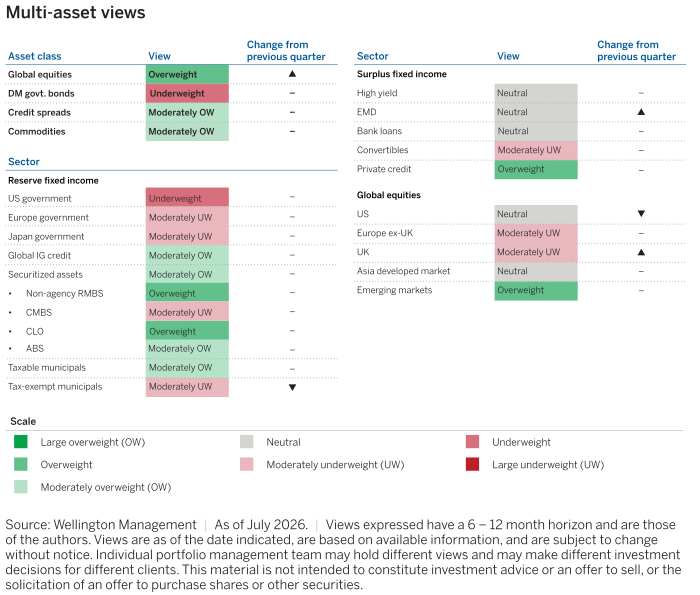
  • We expect a modest, near-trend US expansion supported by AI-related investment, infrastructure spending, and resilient corporate profits, but with growth increasingly concentrated and inflation risks elevated by energy prices, tariffs, and supply chain pressures.
  • We believe insurers should maintain a moderately constructive but selective risk posture, emphasizing dependable income, downside resilience, liquidity, and reinvestment flexibility rather than adding broad credit beta at tight spreads.
  • Within fixed income, we favor securitized credit, particularly senior CLOs, alongside selective front-end and intermediate investment-grade corporates, agency MBS, and high-quality taxable municipals; evolving NAIC rules have the potential to further improve the relative capital efficiency of senior CLO tranches.
  • Across other asset classes, we are neutral on US equities as strong earnings are balanced by rising issuance and pockets of exuberance, favor emerging market equities relative to Europe, hold a small overweight to oil following its sharp decline, and have moved to neutral on gold.
Multi-asset views

Macro overview

We continue to expect a modest, near-trend US economic expansion, with growth remaining resilient but increasingly concentrated. AI-related investment, infrastructure spending, resilient corporate profits, and generally supportive financial conditions continue to underpin activity, but consumption is uneven and earnings outside technology are less robust. This leaves the economy in a stable but more complicated position: We are not underwriting a broad reacceleration, but neither do we see clear evidence of imminent deterioration.

Inflation remains the principal macro uncertainty. Recent pressures have increasingly reflected supply-side forces, including energy, tariffs, and supply chains, which are more difficult for central banks to address without weighing on growth. Our base case assumes energy prices remain above last year’s levels but below their earlier peak, allowing purchasing power and broader economic activity to improve gradually. A renewed energy shock, however, could weigh on consumer spending and profit margins while putting upward pressure on bond yields.

Against this backdrop, our base case is that the US Federal Reserve (Fed) remains on hold. The more important issue is not simply the next policy move, but how the Fed’s reaction function may be evolving. A greater emphasis on inflation credibility, less reliance on forward guidance, and a more judgment-based distinction between supply- and demand-driven inflation could make policy less predictable. We therefore expect US rates to remain broadly rangebound with a modest downward bias in the near term, but with greater volatility and a wider distribution of potential outcomes over the medium term.

Labor market conditions remain a meaningful counterbalance. A more stagnant employment backdrop and future fiscal drag argue against a significant reacceleration, while structural labor constraints and resilient income among higher-wealth households continue to limit downside risks. For insurers, this reinforces the importance of looking beyond individual data releases: Growth remains stable, but its durability increasingly depends on the links between labor participation, financial conditions, consumer purchasing power, and the breadth of corporate earnings.

Beyond the near-term cycle, AI remains both a meaningful support and a source of uncertainty. AI investment is contributing to growth, infrastructure demand, and credit issuance, but its benefits remain concentrated and the broader productivity gains may take time to spread across the economy. In the near term, AI-related capital spending may also be inflationary as it drives up demand for power, infrastructure, and other inputs. The durability of AI-related earnings, margins, and household wealth, and whether investment broadens beyond a relatively narrow group of companies, will be key determinants of the economic outlook.

For now, we think this backdrop supports a selective, income-oriented approach. Attractive all-in yields and strong structural demand from aging populations, pensions, insurers, and global investors remain supportive of fixed income. At the same time, tight valuations, persistent inflation risk, and the potential for episodic volatility argue for emphasizing resilience, liquidity, and security selection rather than relying on further valuation expansion.

Fixed income

We believe insurers should maintain a moderately constructive but selective risk posture. Economic growth remains stable, credit fundamentals are resilient, and attractive all-in yields continue to support the case for owning measured amounts of risk. However, tight spreads, a less predictable Fed reaction function, and the concentration of growth and market confidence around AI argue against adding broad credit beta.

With valuations generally fair to tight and limited scope for further spread compression, we continue to favor carry, structural protection, and security selection. Strong technical demand may help support spread stability, but income is likely to remain a more dependable source of return than capital appreciation from tighter spreads. For insurers, we think this argues for portfolios built around high-quality income, downside resilience, liquidity, and the flexibility to reinvest should volatility create more compelling opportunities.

A few sector-specific thoughts to share:

  • Corporates — We favor front-end and intermediate investment-grade corporates while remaining more cautious on long-duration credit. Within sectors, we continue to prefer financials, followed by utilities, and we maintain an underweight view on industrials. Implementation should remain selective, particularly as AI-related capital spending and prospective issuance increase the importance of issuer concentration and sector balance within investment-grade benchmarks.
  • Securitized credit — Securitized assets remain among our highest-conviction opportunities. We favor senior CLOs, high-quality non-agency RMBS, select ABS with exposures backed by prime borrowers and equipment, and agency MBS, where attractive income and structural characteristics can support portfolio resilience. We remain cautious on CMBS given valuations and refinancing risk in the underlying loans.
  • Taxable municipals — We continue to view taxable municipals as an attractive high-quality allocation, offering income comparable to investment-grade corporates and supported by strong fundamentals. Limited supply may constrain implementation, but the sector may provide useful diversification for insurance portfolios when individual opportunities are available.
  • High yield and bank loans — We maintain a measured posture toward leveraged credit and prefer the higher-quality BB segment of high yield. Issuer dispersion is increasing, reinforcing the need for security selection. We think bank loans continue to offer attractive income, but refinancing risk and AI-related disruption warrant caution among the highest-spread issuers.

On a risk-adjusted basis, we believe the current environment favors a moderate rather than aggressive risk posture. Credit fundamentals remain supportive, but tight spreads provide limited compensation for adding broad beta. We therefore prefer concentrating active risk in higher-quality carry sectors with stronger downside structure, while preserving liquidity and reinvestment flexibility.

At the same time, we remain mindful of downside risks. A renewed rise in energy prices could weigh on consumer purchasing power and corporate margins while complicating the inflation outlook. The increasing dependence of growth, earnings, and market sentiment on AI-related investment also creates vulnerability if capital spending, earnings expectations, or the associated wealth effect weaken. Persistent inflation or a less predictable Fed could produce additional front-end volatility, while private credit refinancing conditions and broader credit availability remain important indicators of financial stress.

Overall, we believe insurance portfolios should remain focused on maximizing dependable income through securitized credit, selective investment-grade exposure, agency MBS, and high-quality taxable municipals where available. A modest duration cushion and a continued emphasis on liquidity may help provide resilience across a wider range of outcomes. This balanced posture is designed to support book yield and capital efficiency while retaining the flexibility to add risk if volatility produces more attractive valuations.

Potentially positive regulatory backdrop for CLOs

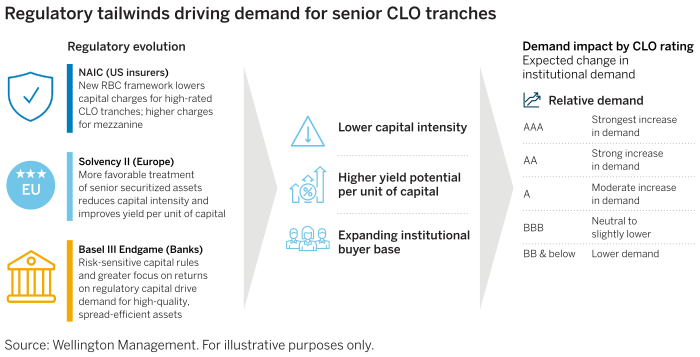
The regulatory and ratings environment for CLOs is evolving in a way that should increasingly differentiate senior, conservatively structured tranches from mezzanine risk (Figure 1). Beginning with year-end 2026 reporting, the NAIC’s new Life RBC framework will make high-quality CLOs more capital efficient while materially increasing capital requirements for lower-rated and thinner tranches. Notably, capital treatment will no longer be driven by credit rating alone as tranche thickness and structural protection will also influence the required capital. The framework applies across both broadly syndicated and middle-market CLOs, as well as CDOs and CBOs, although the additional charge for thin tranches applies specifically to broadly syndicated CLOs.

Figure 1

Stellar tech margins and return on invested capital

For insurance investors, we view the change primarily as a relative value shift rather than a catalyst for broad selling or significant balance sheet stress. Most life insurers are already concentrated in higher-quality CLO tranches, and the new rules should reinforce that positioning by favoring AAA through A rated debt and larger, more defensively structured tranches, while creating headwinds for BBB and BB mezzanine exposure. In our view, this should support demand for senior CLOs, where investors can continue to earn attractive income with substantial credit enhancement and improved capital efficiency.

At the same time, recent rating agency methodology changes appear to be a reasonable recalibration to the CLO market’s realized performance. The agencies are incorporating a longer performance history, updated default and recovery assumptions, and more granular loan-level analysis. This supports the view that portions of the market, particularly senior tranches, may previously have been rated too conservatively. However, ratings remain only one input to our underwriting. More permissive assumptions for subordinate tranches could allow CLO structures to employ additional leverage, potentially making BBB and BB debt less attractive at the margin and increasing the risk profile of CLO equity. We therefore continue to emphasize collateral quality, manager selection, attachment point, tranche thickness, recovery assumptions, and market value metrics rather than relying on the rating alone.

Our investment conclusion: We maintain a high-quality bias, continuing to view single A and higher-rated CLO tranches as highly default remote, and believe the combination of strong structural protection, attractive income, and increasingly favorable capital treatment makes senior CLOs particularly compelling for insurance portfolios. Conversely, the evolving regulatory framework reinforces the importance of selectivity lower in the capital structure, where greater leverage, thinner protection, and higher regulatory capital requirements may offset the additional spread.

Equities

Despite the effects of the Middle East conflict, we think conditions for equities have remained supportive, driven by strong earnings revisions and a resilient manufacturing cycle. The durability of the global earnings and macro cycle is a sign of the profound impact of the technological shift we’re witnessing and the capex wave it’s fueling.

In nearly every market except Japan, most of the year-to-date gains in equities have been driven by EPS growth. Given that returns have been tied to earnings, valuations have derated and we don’t expect them to be a headwind.

Looking ahead, we think the market's performance will come down to earnings expectations, which we estimate will be in the low- to mid-double digits for global equities over the coming 12 months, with some room for modest valuation expansion. In our view, high expectations for EPS growth over the short- and mid-term are justified. Beyond earnings, balance sheets are strong, with relatively low debt to equity and high operating cash flows to debt.

There are incipient signs of equity market broadening. This includes a growing awareness of the layers beneath the big AI names, including the companies supporting the AI-driven build-out of infrastructure, chips, energy, and other parts of the economy. The recent outperformance of US small caps relative to large caps and the underperformance of hyperscalers relative to areas such as industrials and financials are also indications of some rotation coming through. Amid this rotation, volatility has picked up, and any technical correction driven by these dynamics would, in our view, present a tactical opportunity to add exposure, given solid fundamentals.

We have moved to a neutral view on US equities. Earnings growth remains robust and valuations appear reasonable. The spate of IPOs will likely drive positive to neutral net issuance this year. While we expect the market to absorb this new issuance, we think the growth in net issuance and larger deal sizes could make equity supply something of a headwind for the market over the coming 12 months. We do not see evidence of stretched positioning in aggregate across a range of investor groups, but there are signs of exuberance in some areas, such as leveraged ETFs.

In Europe ex-UK and the UK, we think earnings expectations remain too high and stagflationary concerns are more relevant. France and Germany have been hurt by competition from China, and risks related to political instability in France ahead of the 2027 presidential election could weigh on sentiment. We would stress, however, that we are not negative on Europe and there is potential for positive surprises, such as progress on financial markets reform in the European Union or quicker-than-expected deployment of fiscal stimulus in Germany.

Relative to Europe, we have a higher-conviction view on EM equities. In our view, emerging markets in Asia are critical to the AI supply chain. In addition, China’s resilience during the Middle East conflict has stood out.

We are neutral on Japan. The market continues to benefit from buybacks, high/improving return on equity (ROE), and corporate reforms, but we are concerned about the potential for blowback from rate and currency volatility at a time when valuations are more stretched, based on some metrics, than they have been for some time.

Commodities

We maintain a modest overweight view on commodities, driven by our upgraded stance on oil. We believe the market is already pricing in a medium-term increase in supply despite lingering uncertainties about the resumption of exports from the Middle East, demand growth, and the supply response (e.g., the development of new pipelines to bypass the Strait of Hormuz).

On the cyclical demand side, we anticipate that many countries, including the US, will need to replenish their reserves given the large drawdowns during the conflict. However, structural demand also carries uncertainties, particularly from China given its focus on renewables.

On the supply side, the urge by OPEC member nations to flout OPEC agreements or even consider exiting the organization as the UAE did in May could be limited by breakeven oil prices, which are much higher than the cost of production in many Middle Eastern countries.

The near‑term setup for oil is therefore finely balanced, and we think our modest overweight view is warranted based on fundamental upside. While there could be an additional relief rally, the outlook appears asymmetric from here, particularly as prospects for an enduring resolution to the Middle East conflict and a fuller resumption of flows in the Strait of Hormuz remain in flux.

On gold, we have moved from our small overweight view to a neutral view. Our conviction has fallen materially, as the thesis has weakened from a two‑engine demand story (central bank and ETF demand) to a single propeller (central bank demand). To reiterate a point we made previously, we don’t view gold as an inflation hedge, as correlations are weak or nonexistent. The primary long-term relationships are negative correlations to the US dollar and real yields. We don’t see significant upside emerging in either, but a fundamental reengagement with a bull case in the dollar could be a risk.

The views expressed are those of the authors at the time of writing. Other teams may hold different views and make different investment decisions. The value of your investment may become worth more or less than at the time of original investment. While any third-party data used is considered reliable, its accuracy is not guaranteed. For professional, institutional or accredited investors only.

Experts

Get our latest market insights straight to your inbox.

Read more from our experts