Finland, Institutional

Changechevron_right
menu
search

Why targeted European equity exposure matters in 2026

6 min read
2027-02-23
Archived info
Archived pieces remain available on the site. Please consider the publish date while reading these older pieces.
european equity
Thomas Horsey, Equity Portfolio Manager
european equity
Arthur Lui, Investment Specialist
european equity

Key points

  • Early signs support our constructive view on the year ahead for European equities, underpinned by fiscal support, resilient consumers and a generally favourable policy backdrop.
  • While the backdrop for European equity markets remains broadly positive, the likely continued dispersion between relative winners and losers underscores the need for a highly targeted active approach.
  • A standalone allocation may help to deliver alpha while also acting as a diversifier to the US amid a fracturing geopolitical environment.
  • We see attractive idiosyncratic investment opportunities in building materials, infrastructure and consumption-related sectors. 

2025 was a reminder that Europe still matters (perhaps more than ever)

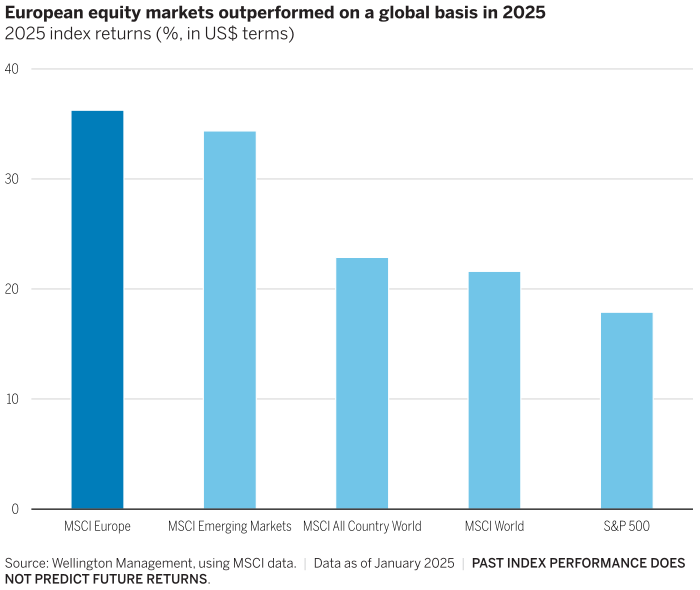
European equities rallied strongly in 2025, with the MSCI Europe among the best-performing indices, as illustrated in Figure 1.

Figure 1

Yied differential

Neither MSCI nor any other party involved in or related to compiling, computing or creating the MSCI data makes any express or implied warranties or representations with respect to such data (or the results to be obtained by the use thereof), and all such parties hereby expressly disclaim all warranties of originality, accuracy, completeness, merchantability or fitness for a particular purpose with respect to any of such data. Without limiting any of the foregoing, in no event shall MSCI, any of its affiliates or any third party involved in or related to compiling, computing or creating the data have any liability for any direct, indirect, special, punitive, consequential or any other damages (including loss of profits) even if notified of the possibility of such damages. No further distribution or dissemination of the MSCI data is permitted without MSCI’s express written consent.

More important than the headline return, however, was the shift in market sentiment. Investors are becoming less anchored to the familiar “Europe can’t grow” narrative and more willing to underwrite a cycle that is increasingly supported by policy, investments and domestic tailwinds.

The bear case on Europe is well-rehearsed: ageing demographics, chronically low growth, a perceived tech laggard versus the US and competitive pressure from China in areas like autos and manufacturing. Those challenges haven’t disappeared, but, in our view, Europe does not need to “beat the US at Big Tech” to deliver strong equity outcomes. Even small improvements may be sufficient for things to go right for Europe in 2026. That doesn’t mean, however, that the benefits will be equally spread. In fact, we anticipate a growing dispersion between relative winners and losers as Europe’s structural transformation takes hold, creating ample potential for active investors to add value through targeted exposure. 

And the opportunity to do so is exceptionally broad, given:

  • the range of attractive sectors, including industrials, financials, health care, specialised technology and building products, as well as defence.
  • the number of European companies that enjoy global revenues but still trade on European valuations.
  • the European market still trades at a meaningful discount relative to the US and compared to its own history. At the time of writing, the MSCI Europe’s price-to-earnings ratio stands at 17.2x versus 27.8x for the MSCI USA.

From an overall portfolio standpoint, we believe European equities can increasingly act as a diversifier to the US given the differentiated return profile and valuation gap. And we think maximising that return and diversification potential means treating European equities as a standalone allocation.

A strong setup for 2026 based on three positive developments

  1. Policy support and fiscal impulse — After the European Central Bank cut rates meaningfully last year, Europe has started 2026 with a more accommodative policy backdrop. Moreover, a growing share of fiscal spending for many European countries is focused on security, defence, infrastructure and industrial capacity. This is exemplified by Germany’s concerted effort to invest €500 billion across infrastructure, climate and transformation projects over the next decade, which we believe could kickstart and sustain a more durable multiyear domestic investment cycle. 
  2. Greater consumer resilience — European consumers appear to be better positioned than in prior years. Real wage growth continues to trend positively alongside stronger household balance sheets, all of which bode well for consumption in the region. 
  3. Continued repair and rebuild — One underappreciated feature of Europe today is the number of idiosyncratic “repair and rebuild” stories still playing out across countries and sectors. Greece is a good example of how parts of Europe have structurally improved since the financial and sovereign debt crisis that began in 2009. The country’s public balance sheet is stronger, with a larger share of debt locked in at longer maturities and lower funding costs, while the fiscal backdrop has continued to improve as inflation has lifted nominal revenues. The banking system has also undergone a meaningful reset: capital levels are materially higher and non-performing loans have declined towards more normalised European levels. Against this more favourable fiscal backdrop, the government has introduced several policies that should bolster Greece’s longer-term growth, including a cut to income tax, higher defence spending and measures to support loan growth.

Standout areas to watch

As active investors, we are particularly excited about the idiosyncratic opportunities within those segments that we expect to benefit the most from the positive developments we’re seeing in Europe, from both a near-term and structural perspective. These include:

  • Defence and building materials — In industrials, we think that defence companies remain positioned for structural growth, underpinned by increased fiscal spending and geopolitical tensions. The long-term nature of these drivers offers the added benefit of making defence companies less sensitive to broader economic cycles. We also believe that investors should take a broader view of domestic infrastructure. Building materials companies that specialise in high-performance building materials stand out here as both regulatory initiatives, such as the EU Renovation Wave and UK Future Homes Standard, and persistent housing shortages are spurring renewed investment in energy-efficient construction and water systems.
  • Med tech — We are seeing compelling opportunities in the medical devices and health care services industries, fuelled by durable demand drivers such as an ageing population and increased use of diagnostics and lab testing post-COVID. For instance, we observe sustained demand for age-related solutions such as orthopaedic implants, cardiovascular devices and home-based monitoring. The structural nature of this growing demand entails recurring revenue streams and greater pricing power for providers that can offer differentiated services or medical procedures.
  • Consumer staples — We are finding attractive opportunities across a diverse set of European consumer staples businesses as demand strengthens. For example, in food and beverages, healthier eating trends and evolving regulation are favouring companies that are successfully reformulating their products with higher fibre content and less sugar, salt and saturated fat. 

We think food retailing is another area to watch as it remains one of the most defensive consumer segments in Europe, underpinned by non-discretionary demand and resilient cash flows. With inflation having pushed consumers towards value formats, we see significant opportunities in private label, discount and convenience channels. Other potential beneficiaries include retailers with hybrid shopping models that can monetise their continued investment in e-commerce and last-mile delivery.

The bottom line: selective opportunities for focused investors

We are constructive on the near-term backdrop for European equities in 2026, given accommodative monetary policy, fiscal stimulus and more resilient consumer demand. We are conscious that global trade tensions, tariffs and heightened geopolitics may persist as headwinds for international cyclicals, but we remain positive on domestic-driven sectors such as defence, health care and construction materials. 

While we are positive on the immediate outlook for European equities in 2026, we believe that being able to identify potential earnings inflection over the long term may ultimately matter more. With that in mind, we see the most potential among those companies that are well-positioned to see earnings improvement from their cyclical lows, with the positive macro backdrop acting as an additional tailwind rather than as an essential ingredient for longer-term outperformance. As fundamentals stabilise and sentiment normalises, we think these companies offer scope for increased returns driven by earnings growth as well as selective re-rating.

The views expressed are those of the authors at the time of writing. Other teams may hold different views and make different investment decisions. The value of your investment may become worth more or less than at the time of original investment. While any third-party data used is considered reliable, its accuracy is not guaranteed. For professional, institutional or accredited investors only. 

Experts

Get our latest market insights straight to your inbox.

Read more from our experts