menu
search

Top of Mind: Three surprises — and one common thread

•
10 min read
2028-11-30
Archived info
Archived pieces remain available on the site. Please consider the publish date while reading these older pieces.
Top of Mind
Adam Berger, CFA, Multi-Asset Strategist
Top of Mind

Key points

  • Geopolitical fragmentation is shifting priorities from global efficiency toward national resilience, creating potential opportunities in defense, infrastructure, technology, supply-chain security, and active investment strategies.
  • AI fundamentals remain strong as adoption and compute demand grow. Investors should assess their total AI exposure, monitor fundamentals and bottlenecks, and favor measured allocation changes over dramatic shifts.
  • Liquidity remains relatively stable but may be shallower than in the past, making stress testing and portfolio flexibility increasingly important.
  • Long-term rates — shaped by fiscal policy, Treasury supply, inflation, and growth — may matter more than the Fed’s next move, while higher yields also improve bond income potential.

Investors have faced their share of surprises this year, from geopolitical upheaval and AI’s continued ability to exceed already elevated expectations to multi-decade highs in long-term bond yields. Yet each “surprise” reflects deeper structural forces that headlines may be missing.

In this quarter’s Top of Mind, I look beneath the headlines, drawing on insights from Geopolitical Strategist Thomas Mucha on the shift toward a more fragmented world and from our Technology Team on whether investors are underestimating the AI opportunity. I also examine liquidity conditions and the surprising rise in long-term rates. Finally, I offer my thoughts on the portfolio implications of all three themes.

Geopolitics: Navigating a more fragmented world

To put today’s geopolitical instability in perspective, Thomas advises looking beyond individual events and considering the broader forces shaping the global landscape. He highlights three key observations:

1. Today’s geopolitical instability, including military action in the Middle East and elsewhere, is not a surprise — it reflects the end of a long geopolitical cycle. The post-World War II order delivered decades of relative stability, economic integration, and rising prosperity. But these cycles have historically lasted roughly 80 to 100 years, and we are now more than eight decades into the current one. Its fragmentation is producing a more protectionist, competitive, and conflict-prone world. With more than 60 active conflicts globally — the highest total since World War II — geopolitics and national security have returned as powerful market forces.

2. Rather than predicting events, the focus should be on the structural shift from efficiency to resilience. In this fluid environment, betting on a single geopolitical outcome is unlikely to be a durable strategy. For investors, it’s more important to understand how the shift in the geopolitical cycle is affecting the behavior of governments, companies, and markets. For decades, during the heyday of globalization, economic efficiency was the world’s “operating system,” encouraging the free flow of trade, long and complex supply chains, and just-in-time production. Today, policy priorities are moving toward resilience — especially national-security resilience — as countries seek greater control over the resources, infrastructure, and technologies they need.

3. A more fragmented world may favor active management and broaden the global opportunity set. Policy disruption is likely to create clearer winners and losers across countries, industries, companies, and asset classes, strengthening the case for strategies that seek to take advantage of skilled active management, such as long/short and extension strategies.

This shift may also create investable themes around the idea of resilience mentioned above. Potential opportunities include semiconductors, critical minerals, cybersecurity, next-generation communications, green technology, and artificial intelligence. Europe, Japan, South Korea, Australia, and other countries are increasing investment in defense, infrastructure, technology, and supply-chain security.

Portfolio implications

From a portfolio perspective, I see three key implications for navigating a more fragmented geopolitical landscape:

Don’t try to time geopolitical events — Individual events are difficult to predict and often reflected in markets by the time they reach the headlines. They are also expensive to hedge.

Treat event risk as part of the cost of long-term investing — Markets can overreact to geopolitical shocks and subsequently reverse, making tactical responses especially challenging. A more viable approach may be to maintain appropriate diversification and focus on structural trends that are underappreciated by the markets.

Position for the resilience trade and other shifts stemming from geopolitical volatility — The long-term opportunities may include exposure to the resilience themes Thomas identified. The geopolitical environment may also require preparing for a more inflationary and less correlated world, including rethinking portfolio hedges and considering a role for global macro, long/short, and other active strategies. Learn more about investing in the Age of Resilience.

AI: The surprise may be that investors are underestimating what’s going right

The prevailing narrative may not tell the full story, so what signals should investors be following? My recent discussions with our Technology Team have yielded several worth considering:

1. AI fundamentals may be stronger than investor sentiment suggests. Many investors worry that AI-related equities are approaching bubble territory (63% of asset owners we polled in September said the market was either approaching or already in a bubble1), but the underlying fundamentals tell a different story. Technology companies continue to generate strong earnings growth, AI adoption is accelerating, and many technology stocks trade at valuations that appear attractive relative to their growth prospects (and P/E multiples have actually been contracting despite the earnings growth). In the team’s conversations with asset owners, the discussion is overwhelmingly centered on what could go wrong, even as the evidence supporting the investment case continues to improve. So, in that sense, there may even be a contrarian opportunity in taking a more constructive view of AI.

2. This cycle is being driven by real demand, not just expectations. Unlike past technology booms that relied heavily on future promises — such as the early days of the internet — today's AI cycle is supported by observable demand and measurable returns. Enterprises are reporting productivity gains and cost savings; spending tends to increase after initial adoption rather than decline; and demand for AI infrastructure continues to exceed supply.

One of the clearest signs of this demand can be seen in the compute market itself. Even older-generation GPUs continue to command meaningful rental rates and, in some cases, rising prices. If compute supply were abundant, prices of legacy hardware would likely fall sharply as newer generations came online. Instead, sustained demand for both new- and older-generation capacity suggests that the appetite for AI compute continues to outpace available supply. In some areas, the constraint is no longer identifying use cases for the technology but securing enough compute capacity to meet demand. The result is a cycle increasingly supported by real economic activity rather than by investor expectations alone.

3. Growth in the number of tasks, roles, and products being shaped by AI is accelerating. From that perspective, this cycle is similar to prior technology disruption cycles. What's different is the pace. Advances in model capabilities are unlocking new applications across science, physics, and other forms of knowledge work, while beginning to move into the physical world as well.

As more applications are unlocked, the opportunity set continues to broaden. The enabling technologies remain critical, from the companies bringing power to data centers and supplying the chips that fill them to the businesses building the services that sit on top of that infrastructure. In addition, businesses that use AI to solve problems cheaper, faster, or better may gain a meaningful advantage, while those that are slower to adapt risk falling behind.

4. Watch demand signals, not sentiment. Investors concerned that the market might be overextended should monitor whether enterprises continue expanding AI spending, whether next-generation models continue to deliver meaningful gains in efficacy, and whether supply begins to come more in line with demand. Those may be the developments most likely to indicate that AI adoption or infrastructure demand is beginning to moderate.

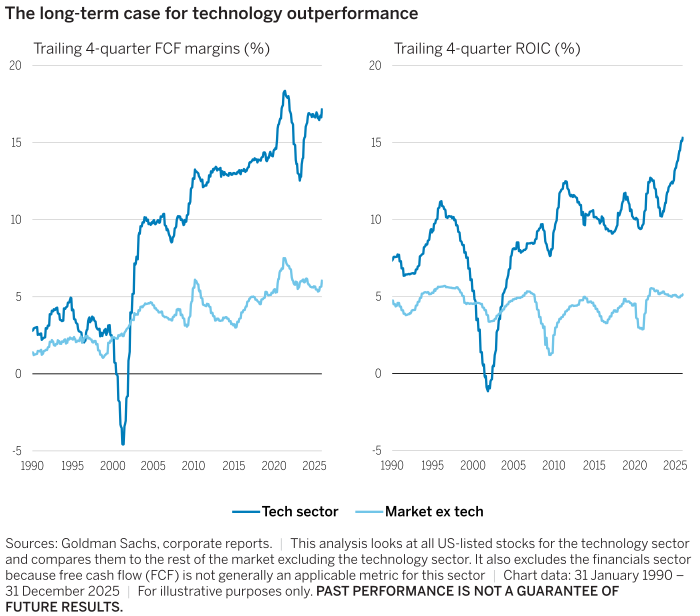
Until then, demand remains robust, adoption continues to broaden, and the long-term trend of tech companies delivering stronger free-cash-flow margins and ROIC is difficult to ignore (Figure 1). Technology adoption has experienced periods of acceleration and deceleration, but at every point in history the forward curve on technology adoption has ultimately pointed higher.

Figure 1

Top-of-Mind-2026_fig1_v1

Portfolio implications

I would focus on three portfolio considerations for balancing AI’s expanding potential against the risks of getting the exposure wrong:

Understand your AI exposure before making allocation decisions — Many investors might be surprised to learn how underweight AI they are. But whether investors are overweight or underweight technology and AI-driven stocks, they need to understand the size of their positioning, their confidence in the technology’s ability to keep driving growth, and their potential exposure if they are wrong. Getting a handle on AI exposure requires looking across sectors and beyond equities, particularly with fixed income markets playing a growing role in financing AI spending.

Set a fundamentals checklist or screen — Whatever weight is chosen, it may help to have a checklist of data points and a timeline that can aid decisions about whether to course-correct. Along with the indicators mentioned earlier, such as the strength of AI adoption and demand, keep an eye on earnings and margins and on potential AI bottlenecks (e.g., regulatory changes).

Maintain some guiding principles — The "right" level of AI exposure will vary across investors, but some basic principles can help maintain perspective. For example, balance the upside and the downside — as noted, it can be easy to focus exclusively on the risks and overlook what is already going right. And whichever direction you choose, favor moderate and deliberate tilts over dramatic positioning changes.

Read more in our latest insights on AI.

Liquidity and rates: Looking beyond the Fed

The market often focuses on the Fed, but the outlook for liquidity and rates extends well beyond the next policy decision.

1. Liquidity concerns have made headlines, but overall conditions remain relatively benign. Some of the biggest liquidity scares in 2026 emerged in private credit and wealth-oriented vehicles facing redemption pressure, but those episodes don’t appear to have meaningfully slowed activity or investment flows. While market liquidity has remained relatively stable, it has been somewhat shallower in recent years, perhaps reflecting some retrenchment by broker-dealers and a greater reliance on hedge funds and electronic market makers as marginal buyers. This suggests investors should remain vigilant even if current conditions feel stable.

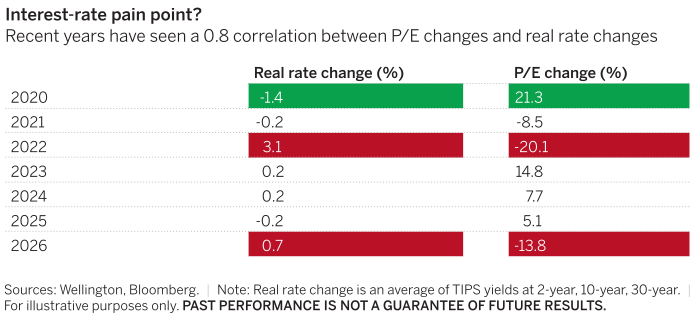
2. Long-term rates have been one of the year's biggest surprises. Few investors began the year expecting the 10-year Treasury yield to exceed 5%, particularly given expectations of Fed easing at the time. Higher real rates have already weighed on equity valuations, even as strong earnings growth has supported overall market performance. Figure 2, provided by my colleague Portfolio Manager Nick Petrucelli, looks at changes in the real rate (using TIPS yields) and the resulting impact on valuations. Historically, rising real rates have been challenging for the equity market. The key question now is whether rates move meaningfully higher from here or begin to stabilize.

Figure 2

Top-of-Mind-2026_fig2_v1

3. There are plausible paths for both higher and lower rates. On one hand, fiscal concerns, financing demands tied to the AI build-out, and additional supply shocks could continue pushing rates higher. On the other hand, moderation in economic growth, productivity gains from AI, or an easing of geopolitical tensions could help relieve inflation pressures and support lower rates. This mixed and uncertain picture makes long-term rates one of the most critical variables for investors to monitor.

4. The Fed still matters, but long-term rates may matter more. On this point, I’ll share three observations from my colleague Brij Khurana, fixed income portfolio manager. First, AI-related investment has thus far appeared to be relatively insensitive to higher rates; on the equity side, the return on invested capital has been compelling (as noted earlier) and higher rates don’t seem to be getting in the way. Second, current inflation pressures are more supply-driven (e.g., the energy shock), which is more challenging for the Fed to address. And third, long-term rates are being shaped by factors such as nominal growth expectations, Treasury supply, and fiscal policy. As a result, the trajectory of long-term rates is less dependent on short-term rates, meaning that long-term rates may have a greater influence on equity markets than the Fed's next move.

Portfolio implications

I would keep three portfolio priorities in mind amid uncertain liquidity conditions and the shifting outlook for rates:

Don’t get complacent about liquidity — Liquidity conditions appear healthy today, but don’t take that for granted at a time when rates have risen and demand for financing is growing. Stress test portfolio liquidity needs, monitor market conditions, and consider whether holding some dry powder in the portfolio could provide flexibility in a market crisis.

Rates remain a wild card — As noted, there are credible arguments for higher or lower rates from here, and investors should keep an eye on fiscal and economic developments. But in the meantime, it’s worth recognizing that higher yields mean investors can potentially earn substantially more income from simply holding bonds than they could a few years ago.

Focus on long-term rates — Pay attention to forces driving long-term rates, including Treasury supply, inflation dynamics, and growth. For many portfolios, and equity allocations in particular, these factors may have a greater impact on outcomes than the next Fed policy meeting.

1Wellington Management poll conducted at periodic webinar in September 2026. Responses reflect participant views at the time of the meeting, are subject to change, and are for illustrative purposes only.

The views expressed are those of the author at the time of writing. Other teams may hold different views and make different investment decisions. The value of your investment may become worth more or less than at the time of original investment. While any third-party data used is considered reliable, its accuracy is not guaranteed. For professional, institutional or accredited investors only.

Expert

Get our latest market insights straight to your inbox.

Read more from our experts