menu
search
Skip to main content

Insurance Asset Allocation Outlook: 4Q 2026

Seeking income without stretching for risk

•
14 min read
2027-10-31
Archived info
Archived pieces remain available on the site. Please consider the publish date while reading these older pieces.
Multiple authors
multi asset outlook

Key points:

  • We expect economic growth to remain resilient but uneven, supported by AI-related investment, household wealth, and steady income growth, even as housing, autos, and other rate-sensitive areas remain under pressure. The central inflation question is whether energy and supply pressures spread to wages and inflation expectations.
  • We believe insurers should maintain a moderate risk posture with a modest duration overweight, relying on income, structural protections, and security selection — not further spread compression — to drive returns.
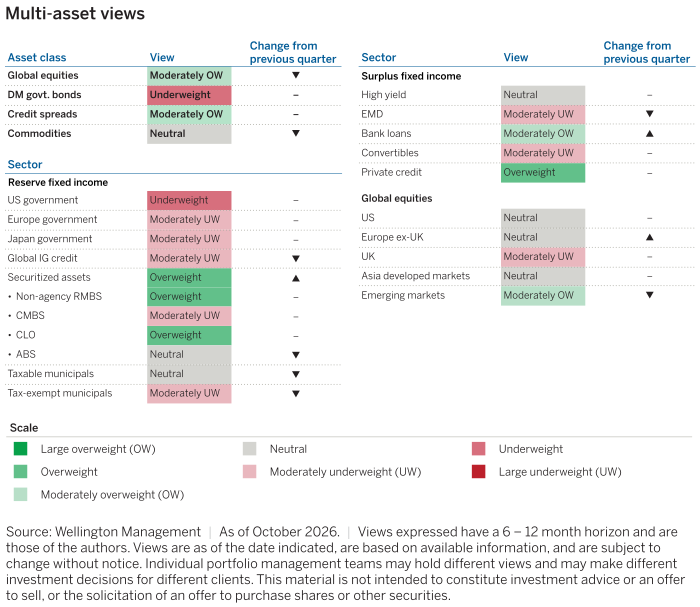
  • Within fixed income, we favor short and intermediate investment-grade corporates, senior CLOs, agency and non-agency RMBS, and select opportunities in investment-grade private credit. We have become more constructive on bank loans, while we are more selective on ABS, long taxable municipals, CMBS, emerging markets debt, and euro credit.
  • We think higher yields have made tax-loss harvesting a potentially timely tool for insurers seeking to raise book yield, while year-end tax swap selling may be creating opportunities in the municipal market.
  • We have reduced our view on global equities from overweight to moderately overweight. Strong earnings and continued AI-related investment support a constructive 12-month outlook, but higher oil prices, rising bond yields, and a more hawkish policy backdrop have weakened the near-term risk/reward trade-off.
Multi-asset views

Macro overview

Our central case remains trend US growth, supported by AI-related investment, household wealth, and steady aggregate income growth. The expansion is uneven, however, with housing, autos, and other rate-sensitive sectors under pressure. Wealth is supporting consumption but also creates vulnerability: An equity market drawdown could weaken spending and credit conditions at the same time. On balance, we think growth remains strong enough to support credit over the near term.

Inflation remains the key uncertainty: Will energy and other supply pressures spread to wages, broader prices, and expectations? Wage growth warrants attention, particularly if it outpaces productivity and raises unit labor costs, signaling more persistent inflation. If energy prices stabilize, base effects could help ease inflation in early 2027, although further energy increases, tariffs, or El Niño-related food pressures could delay improvement.

Against this backdrop, we expect a shallow Federal Reserve (Fed) tightening cycle, potentially less than markets are pricing, rather than a full demand-driven hiking cycle. The precise number of hikes is uncertain, and broader wage and inflation pressures could challenge this view and expose front-end and intermediate maturities to further repricing. We see a path to lower yields over the next six to 12 months, but expect a smaller, more volatile rally than we did last quarter. Catalysts could include easing energy pressures, contained inflation spillovers, or weaker growth. At the same time, fiscal deficits, US Treasury supply, and competition for global savings could keep long-end yields elevated.

Outside the US, European growth remains steady but vulnerable to higher energy and borrowing costs. The European Central Bank could deliver one to two further hikes — potentially fewer than markets expect if wages and inflation expectations remain contained. The UK faces a more difficult trade-off between inflation and growth, and we view one hike followed by a pause as a reasonable base case. Fiscal credibility remains an important driver of long-dated sovereign bonds, particularly gilts and French government debt.

Beyond the near-term cycle, AI continues to reshape growth, credit supply, and issuer risk. AI-related investment supports growth today, but broad productivity gains and investment returns remain uncertain. We think financing needs are creating opportunities across corporates, infrastructure, private credit, and securitized markets, while increasing supply and concentration risk. For insurers, we believe this argues for assessing aggregate exposure across hyperscalers, data centers, power, and related businesses, as well as disruption risk in software and other holdings.

For insurers with ongoing cash flows and long-term liabilities, elevated yields may create attractive reinvestment opportunities. However, tight spreads may leave less room for compression to drive returns, and attractive absolute yields do not necessarily imply attractive credit valuations. We therefore think portfolios should emphasize durable income while carefully managing the market-value, capital, and liquidity consequences of further rate increases.

Fixed income overview

We believe insurers should consider maintaining a moderate risk posture and a modest duration overweight. Resilient but uneven growth may support credit in the near term, particularly higher-quality securitized assets. We expect returns to be driven primarily by income, structural protections, and security selection rather than further spread tightening.

While income remains attractive in our view, compensation for risk varies across sectors, industries, and the quality spectrum. We think this argues for selectivity rather than simply owning broad market risk. We also believe public and private opportunities should be assessed using a common underwriting discipline that considers compensation, protections, liquidity, and client objectives. A rating or sector label should not be viewed as a substitute for rigorous underwriting.

A few sector-specific thoughts to share:

  • Corporates — We favor short and intermediate investment-grade credit over long credit, where heavy supply and spread duration exposure limit the appeal. We continue to prefer financials and utilities and maintain an underweight view on industrials, particularly at the long end. Issuer and quality dispersion can reveal opportunities obscured by broad index valuations. We think selectivity is warranted in AI-related issuance, with a distinction between tactical relative-value opportunities and assets suitable for long-term ownership.
  • Securitized credit — We maintain a constructive view on CLOs, with a preference for AAA over AA tranches given limited incremental compensation, while recognizing that floating-rate coupons do not eliminate spread or liquidity risk. We remain constructive on non-agency RMBS carry, emphasizing collateral, coupon, vintage, and extension sensitivity. We think recent underperformance has improved relative value in agency MBS, where we favor selective additions based on coupon and structure. We have moved to a neutral view on ABS as relative value has compressed and continue to favor select prime collateral. We remain cautious on CMBS given valuations and refinancing gaps.
  • Taxable municipals — We continue to favor a selective approach to intermediate taxable municipals. Long taxable municipals appear less attractive given rich valuations, except where liability needs justify ownership.
  • Investment-grade private credit — We favor club deals, shorter tenors, infrastructure finance, and structured transactions where sourcing and protections potentially provide a demonstrable advantage. We continue to think the focus should be on adequate compensation for illiquidity and disciplined management of construction, permitting, and refinancing exposure, particularly in data center and asset-based financing.
  • High yield and bank loans — Bank loans represent the clearest positive change in our sector preferences this year. We think attractive carry, improving technicals, and progress addressing near-term maturities support a larger allocation where guidelines permit. We advocate discipline around software disruption, debt-service capacity, and refinancing quality. In high yield, we prefer issuer-specific exposure rather than broadly increasing risk, as attractive yields coexist with tight spreads.
  • Global credit — We favor reducing broad emerging markets investment-grade and high-yield exposure on valuation grounds, as supportive fundamentals do not fully offset limited compensation for volatility and event risk. In euro credit, we remain cautious on technicals as sovereign alternatives and new issue supply compete for demand. We are neutral on short euro credit and less constructive on intermediate maturities.

We believe portfolio construction requires added discipline in this environment. Duration has become a less reliable hedge for credit risk, while mortgage extension and floating-rate allocations can alter curve exposure in ways that insurance portfolios typically cannot hedge. Given the limited use of derivatives in many insurance mandates, we think the management of curve exposure should focus on sector and security selection.

We remain mindful of downside risks. Broadening inflation pressures could push the Fed to tighten more than expected, while an equity market drawdown could weigh on consumption and credit simultaneously. We are monitoring energy and food prices, wage growth, unit labor costs, and inflation expectations; AI monetization, capital spending, and financing supply; Treasury issuance and foreign demand; and conditions in mortgages, commercial property, and leveraged credit.

Overall, we believe insurance portfolios should remain focused on dependable income through select securitized sectors, short and intermediate investment-grade credit, and, where eligible, a larger allocation to bank loans. A modest duration overweight and a continued emphasis on quality and liquidity may help provide resilience across a range of outcomes, while preserving the flexibility to add risk should valuations become more compelling.

Putting higher yields to work: The case for tax-loss harvesting

The rise in interest rates has widened the gap between the book yields on many insurers’ existing fixed income holdings and those available today. This has led more insurers, particularly those with realized gains elsewhere on the balance sheet, to consider whether realizing fixed income losses and reinvesting at higher yields could improve long-term income.

In our view, the decision ultimately comes down to payback: the realized loss divided by the incremental annual book income generated by reinvesting the proceeds. We typically evaluate this across a range of loss budgets and turnover levels. Several consistent lessons have emerged from this work:

  • The benefit tends to be front-loaded. Book yield improvement typically rises steeply with the first increments of turnover and then flattens, so beyond a certain point, additional trading or additional losses may add relatively little income.
  • Some improvement may not require a loss. Certain holdings may be sold near book value and reinvested at higher yields. We think any loss should be measured against this no-loss baseline, so that it is justified only by the additional income it generates.
  • Sector repositioning may matter more than like-for-like swaps. Replacing a bond with a similar bond at today's yields often pays back slowly. The more compelling opportunity may come from moving into higher-yielding, high-quality sectors where a portfolio is underweight while keeping duration and overall risk broadly unchanged.
  • Timing can shift the math. Market moves can increase realized losses faster than the income available to recover them, extending payback periods. Once an insurer decides to proceed, we generally favor prompt execution over a prolonged phased approach.

Implementation also requires attention to practical constraints. Programs should account for wash-sale rules, including coordination across related accounts; transaction costs; statutory accounting considerations such as the interest maintenance reserve for life insurers; and governance limits on realized losses.

For crossover buyers, tax-exempt municipal allocations are often a natural starting point. Many were established before the 2017 reduction in the corporate tax rate, which lowered the value of the tax exemption for corporate buyers. Insurers with historically elevated tax-exempt benchmark weights may want to consider lower targets, subject to tax position, statutory requirements, liquidity needs, and risk tolerance. The objective is not to eliminate municipals, which we think remain a high-quality, potentially defensive source of diversification, but to avoid a benchmark minimum that requires a large allocation regardless of tax position or relative value. Implementation need not occur all at once: Lowering the benchmark weight first may create flexibility to move gradually toward the longer-term target through maturities, cash flows, selective sales, and future contributions.

The broader municipal market may also create opportunities for insurers that remain buyers. Tax swap activity, much of it from retail separately managed accounts, has pushed secondary market selling to record levels this year, and municipals underperformed meaningfully during the third quarter. In our view, this weakness reflects rates and technical pressure more than broad deterioration in municipal credit fundamentals, with state and local finances generally supported by strong reserves. For insurers that can use tax-exempt income, including crossover portfolios, this may create opportunities to source specific bonds at attractive levels, particularly in the intermediate part of the curve and high-quality issuers.

In short, we think tax-loss harvesting can potentially help insurers convert today's higher yields into durable book income without materially changing portfolio risk, while the technical pressure in the municipal market may present selective buying opportunities.

Regulatory developments

In the US, the NAIC's new Life RBC factors for CLOs, CBOs, and CDOs take effect with year-end 2026 reporting, following final approval by the Financial Condition (E) Committee in July. As discussed last quarter, the framework makes high-quality CLO tranches more capital efficient while materially increasing requirements for lower-rated and thinner tranches. The Committee also approved a framework for recognizing overcollateralization by reducing the applicable underlying RBC factors by up to 50% for collateral loans backed by interests in joint ventures, partnerships, and limited liability companies, as well as residual interests. The reduction is based on the level of overcollateralization and applicable LTV bands. The changes will be effective for year-end 2027 reporting. Property/casualty and health RBC factors are not affected.

More broadly, the NAIC's 2026 Summer National Meeting highlighted continued movement toward a more risk-sensitive framework that relies less on credit ratings and more on underlying economics, structure, collateral, and cash flows. Key initiatives include a two-year agenda to address gaps and inconsistencies in the RBC framework, a proposed Solvency Steering Function to coordinate significant solvency issues, and continued work on governance surrounding agency ratings and NAIC designations. The principles-based bond definition also remains an important area to watch, as proposed changes would scrutinize structures with embedded ALM, refinancing, or reinvestment risk, including certain private credit, fund finance, and feeder fund structures. These proposals are not yet final.

For insurance investors, we think the direction of travel is clear: Regulatory capital is increasingly becoming a potential source of relative value. Evaluating investments on spread and rating alone is becoming less sufficient, and the capital efficiency and durability of regulatory treatment are growing in importance. While CLOs are the first asset class to see differentiated treatment, we believe the precedent may ultimately extend to other structured sectors.

In Europe, most Solvency II amendments finalized earlier this year, including revised spread-risk calibrations for securitizations, changes to the interest-rate risk module, and updates to the volatility adjustment, are expected to apply from January 2027. Insurers may wish to consider these changes as part of year-end planning and 2027 strategic asset allocation reviews.

Equity overview

We have pared back our view on global equities from overweight to moderately overweight. Despite exceptional second-quarter earnings, continued AI infrastructure spending, and healthy earnings breadth, we think the near-term risk/reward trade-off has deteriorated. The bar for upside earnings surprises now appears to be much higher, while the rise in yields presents some risks.

We remain largely positive on the AI capex cycle and its impact on earnings, with demand for compute still outstripping supply. That said, earnings have been running above trend, and we expect them to decelerate from exceptionally strong growth rates.

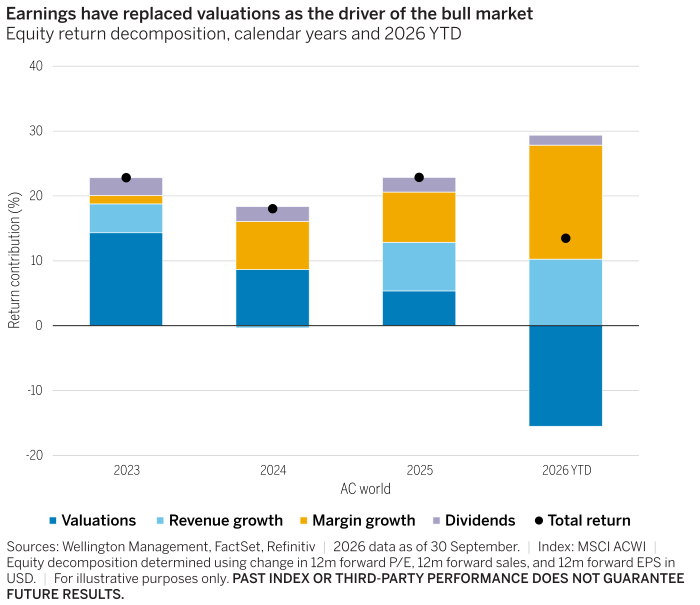
One concern is that while earnings growth has broadened, market breadth has deteriorated. Market concentration in AI-related stocks, which are exposed to a potentially cyclical capital-spending boom, is driving a reluctance to assume current earnings expectations will be fully realized. Together with higher rates, this has contributed to a contraction of approximately 15% in global equity valuation multiples this year (Figure 1).

Figure 1

Equity return decomposition

Higher yields are not inherently bearish for equities. Those driven by stronger growth can generally be absorbed, while those driven by oil prices, inflation, or a higher term premium are more problematic, particularly if the increase is rapid. So far, rate volatility has been reflected more in churn beneath the surface of the equity market than at the index level.

Over the next few weeks and months, we will look for some combination of strong third-quarter earnings, stabilizing oil prices and long-term yields, easing geopolitical risk, and limited further monetary policy tightening. Alternatively, a meaningful equity correction without deterioration in earnings could present a more attractive entry point.

Consistent with our broader equity stance, we have reduced our view on emerging market (EM) equities from overweight to moderately overweight, funded by a smaller underweight view on UK equities. Higher oil prices and US yields leave some EM equities with less scope for policy support, while earnings growth remains increasingly concentrated in Asian AI beneficiaries rather than reflecting a broad EM recovery. China and India have lagged the broader EM rally year to date, while Latin America has become more dependent on commodity prices and political outcomes in Brazil. On the other hand, the UK could benefit from more resilient energy-driven earnings and continued M&A activity supported by cheap valuations.

We are neutral on Japan. The market has seen broad-based earnings strength, with upgrades across banks, industrials, semiconductors, and AI-linked segments. A stronger yen could create winners and losers rather than broad weakness. However, significant macroeconomic and policy uncertainty keep us on the sidelines.

US equity valuations have contracted substantially, reflecting some skepticism about earnings strength and the headwind from sharply higher real rates. Continued earnings strength and stabilizing bond yields could make us more bullish.

Commodities overview

We have moved our view on oil from overweight to neutral. Oil markets face a near‑term deficit of about 5 million barrels per day, even as flows through the Strait of Hormuz have increased. Physical energy flows have been more resilient than expected, although diesel and refined-product supplies have been more disrupted.

We also expect the market to shift to a surplus over the medium term, while many countries have already drawn down inventories substantially. With geopolitics rather than fundamentals driving the market, the binary nature of the risks limits our conviction. Rates of carry on offer due to a sharply downward-facing futures curve (i.e., the contract price for delivery of oil in the future is lower than the current spot price) are very attractive in our view, but we are reluctant to lean toward long positions at current oil prices.

We maintain our neutral view on gold. We think the precious metal can play an important role in long-term portfolio construction, particularly as a potential diversifier during periods of dollar debasement. Over the shorter term, however, high real rates and further central bank tightening could present a less favorable backdrop. Turning to flows, ETF demand for gold has recovered from its lows, while central bank buying remains positive but uneven.

The views expressed are those of the authors at the time of writing. Other teams may hold different views and make different investment decisions. The value of your investment may become worth more or less than at the time of original investment. While any third-party data used is considered reliable, its accuracy is not guaranteed. For professional, institutional or accredited investors only.

Experts

Get our latest market insights straight to your inbox.

Read more from our experts