Asia ex-Japan, Institutional

Changechevron_right

Chart in Focus: Do strong earnings require a resilient economy?

3 min read
2027-08-31
Archived info
Archived pieces remain available on the site. Please consider the publish date while reading these older pieces.
1212188348
Alex King, CFA, Investment Strategy Analyst
1212188348
Joshua Riefler, Product Reporting Lead
1212188348

Earnings expectations have continued to move higher as companies globally deliver results ahead of forecasts. This resilience is notable given the Iran-related energy shock and ongoing macro uncertainty. The key question for investors is whether earnings can continue to meet rising expectations if economic growth begins to slow.

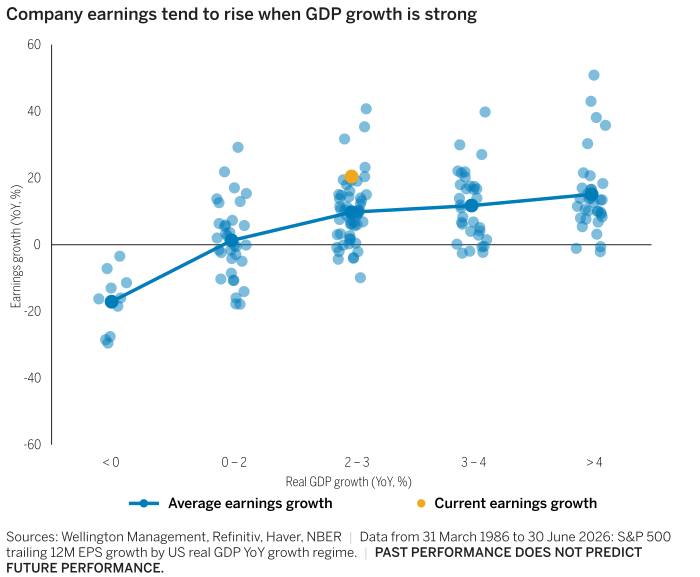
Figure 1 provides useful historical context. Earnings have generally been more durable when GDP growth is positive, and strongest when growth is robust. By contrast, weaker or negative growth has typically created a more challenging backdrop for earnings. This matters because earnings estimates have historically tracked realized earnings reasonably well in expansions, but have tended to lag during recessions, when fundamentals can deteriorate quickly. In our view, elevated earnings expectations are more credible when supported by resilient macro growth, but become harder to sustain if the economy slows meaningfully.

Figure 1
Line chart illustrating the performance of US high yield vs. US long Treasuries as a proxy for the global landscape. Chart highlights that during periods of tight spreads, the relative returns between these two asset classes have diminished.

For now, the backdrop remains supportive. Growth has been more resilient than expected, and earnings delivery has remained strong. Risks from geopolitics, energy prices, and policy uncertainty still warrant close attention, but today’s higher earnings forecasts may remain achievable if the economy avoids a sharper slowdown.

Investment implications

  • Earnings remain central to the durability of the bull market. Current earnings growth and the scale of estimate beats do not appear unusual relative to history. What matters more is the macro backdrop supporting that delivery. If growth remains positive, companies may be better positioned to meet elevated expectations.
  • The earnings cycle is global, but regional drivers differ. US earnings remain closely linked to technology, although upward revisions are broadening across sectors. Europe has shown resilience, but remains more exposed to energy shocks. In Asia, Taiwan and Korea may benefit from their role in the AI supply chain. This underscores the importance of looking beyond headline regional growth to identify where earnings momentum is being generated.
  • AI may be strengthening the link between markets and the economy. Technology has long represented a larger share of equity markets than of the broader economy. That relationship may be evolving as AI-related investment contributes to business spending, productivity, and growth. Over time, this could make equity-market leadership more closely tied to macro outcomes.

What we’re watching

  • Duration of the Iran conflict. A prolonged conflict could keep energy prices elevated and place renewed pressure on global growth resilience.
  • AI’s broader macro impact. AI-related capital spending is already supporting US growth. We are watching whether productivity gains begin to show up more clearly beyond technology-linked companies and sectors.
  • Impact of new equity issuance. Share buybacks have helped support US earnings per share by reducing share count. Elevated IPO activity in 2026 could soften that support if new issuance begins to offset the effect of buybacks.

The views expressed are those of the authors at the time of writing. Other teams may hold different views and make different investment decisions. The value of your investment may become worth more or less than at the time of original investment. While any third-party data used is considered reliable, its accuracy is not guaranteed. For professional, institutional or accredited investors only.


Experts

Get our latest market insights straight to your inbox.

Read more from our experts