


- Equity Portfolio Manager

The views expressed are those of the author at the time of writing. Other teams may hold different views and make different investment decisions. The value of your investment may become worth more or less than at the time of original investment. While any third-party data used is considered reliable, its accuracy is not guaranteed. For professional, institutional, or accredited investors only.
In our first article in a three-part series on shareholder activism in Japan, we reviewed the history and evolution of activism in Japan. Against this backdrop, in our second piece, we now introduce the Japan equity investment team’s approach to engagement and value realization, as illustrated by recent case studies.
From shareholder activism to shareholder value: Our approach
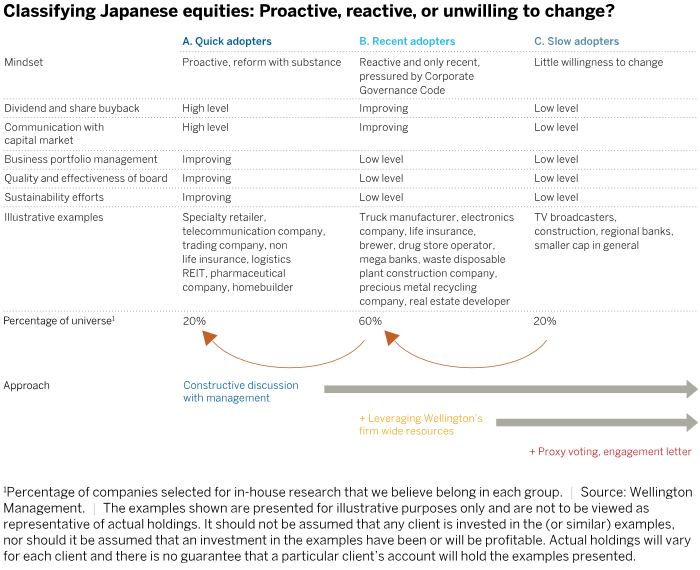
Figure 1 is a conceptual diagram showing how we classify Japanese companies into one of three groups (Group A: Quick adopters, Group B: Recent adopters, and Group C: Slow adopters) according to the degree to which they have adapted to reform.
Our engagement efforts cover a comprehensive range of areas that contribute to increasing corporate value, such as shareholder returns, communication with capital markets, and business portfolio management. Where companies have significant areas for improvement (Groups B and C), we often conduct collaborative engagements by leveraging companywide investment resources. In recent years, we have also worked to escalate engagements with some Group C companies, through proxy voting and engagement letters. Our experience over the years has shown that a significant improvement on engagement metrics tends to lead to a revaluation and reassessment of corporate value.
Figure 1:
Recent case studies
- An electronics company (Group B) was in the process of reviewing its excess cash. Its price-to-book (P/B) ratio was consistently below 1. Under its new medium-term management plan, the company aimed to achieve a P/B ratio of more than 1 and a return on equity of 8% by strengthening shareholder returns and business portfolio management. This would result in a significant improvement in market valuation, particularly given the Tokyo Stock Exchange’s (TSE’s) request that the company raise its P/B ratio above 1. We regularly engaged with management, touching on how the company was progressing in increasing its P/B ratio, and feel that we were successful in encouraging and driving change.
- A life insurance company (Group C) was concerned about its low share price and electric vehicle (EV) multiples. We felt there were many improvement measures that the company had not yet implemented, such as recognition of surplus capital, shareholder returns, and discipline surrounding mergers and acquisitions (M&A). We leveraged global resources, including our global industry analysts (GIAs) and ESG analysts, to conduct fundamental analysis and pursue an engagement with the company. We articulated our recommendations by means of an engagement letter, referring to examples of improvements made by leading industry peers. The company has gradually been making changes, such as increasing shareholder returns, and its reputation in the market has improved significantly.
- This specialty retailer is known as a pioneer in ESG in Japan (Group A). Working alongside our ESG analyst, we have regularly engaged with the company. Most recently, in response to its stagnant share price, the company announced plans to increase shareholder returns, including a new large-scale share repurchase program, sending a strong message to capital markets that the company wishes to increase its corporate value.
Engagement success in Japan — a fine balance between global and regional
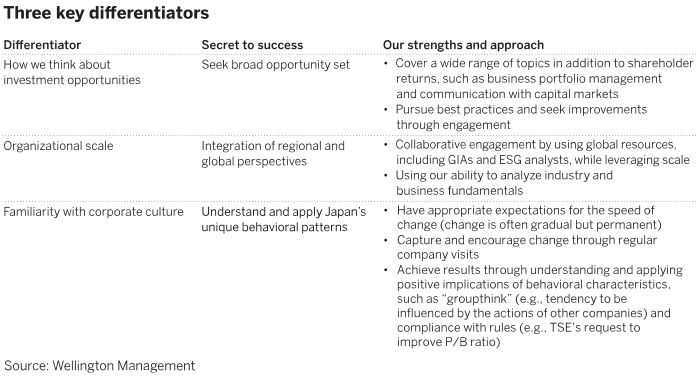
We believe that our engagement success is underpinned by our balance of global scale with regional perspectives and expertise. Below, we outline three key elements that we believe differentiate us, creating a strong foundation for success. (Figure 2).
Figure 2
Looking ahead
We believe the rise of shareholder activism in Japan will continue to drive significant opportunities for investors to enhance corporate value through engagement. Ongoing policy support is expected to continue, anchoring the Japanese stock market’s position as a sustainable investment theme.