Emerging market debt: A strategic opportunity for insurers

9 min read
2027-08-31
Archived info
Archived pieces remain available on the site. Please consider the publish date while reading these older pieces.
568700443
Schuyler Reece, CFA, Fixed Income Portfolio Manager
568700443
Chris Holleman, CFA, Business Development Manager, Financial Reserves Management
568700443

Key points

  • The large EMD universe of sovereign, quasi-sovereign, and corporate issuers may provide opportunities to diversify concentrated developed-market credit exposure.
  • EMD may support duration matching and yield enhancement through exposures tailored to insurers’ distinct liability profiles.
  • Improving fiscal discipline, credible monetary policy, and a potentially weaker US dollar provide a constructive backdrop, although geopolitical, currency, and other risks require careful allocation decisions.
  • Insurers may benefit from treating EMD as a strategic allocation and partnering with specialized managers who understand balance-sheet objectives, regulatory constraints, and risk-management needs.

For insurers, emerging market debt (EMD) can offer access to a broad and differentiated opportunity set, supported by improving fundamentals across many emerging economies and a growing emphasis on policy credibility. Capturing that potential requires specialized research, disciplined portfolio construction, and close attention to country, issuer, currency, and liquidity risks. In this article, we examine the breadth of the EMD universe, consider how insurers are using the asset class, and share our outlook on the risks and opportunities ahead.

Defining the opportunity set

Emerging market debt is a diverse asset class spanning five major regions — Africa, Asia, Eastern Europe, the Middle East, and Latin America — roughly 80 countries, and more than 1,500 corporate and quasi-sovereign issuers. The opportunity set ranges from some of the world’s largest economies, such as China, to smaller markets, such as Jamaica, and from wealthy Gulf states to frontier markets across Africa and Central Asia.

EMD issuers generally fall into three broad categories. The first is sovereign debt, issued by countries that borrow in either their own local currency or hard currency, such as US dollars or euros. The second is quasi-sovereign debt, issued by entities with partial or full government ownership, often aligning them with broader government economic objectives. The third is corporate debt, issued by publicly listed or privately owned companies across the emerging world.

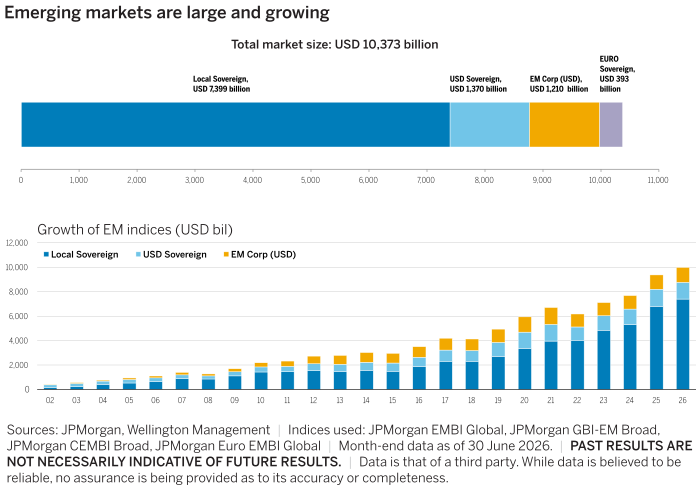
Figure 1 illustrates the growth and scale of the EMD market, which today includes about $10 trillion of index-eligible debt, along with an estimated $2 trillion – $3 trillion of broadly investable debt outside the major indices. This depth and breadth make EMD a viable asset class for insurers and other large institutional investors.

Figure 1

Emerging markets are large and growing

How insurance companies are using EMD

EMD offers insurers a potential solution for several key investment objectives, including aligning duration with liability targets (whether extending duration to meet long-dated liabilities or emphasizing the shorter end of the curve), diversifying credit exposures, and enhancing yield.

Life insurers, for example, have looked to EMD to diversify their balance-sheet assets on the long end of the curve. The breadth of the EMD opportunity set can be a potential benefit in portfolios that are highly concentrated in US long corporates. We’ve also seen insurers use EMD to improve diversification when addressing other long-dated liabilities, including those related to long-term care insurance and company pensions. On the other hand, property and casualty insurers have tended to focus on the medium area or shorter end of the curve, leaning more heavily on EM corporates that better match their liability profile.

In terms of yield enhancement, insurers may benefit from diversifying their sources of yield across exposures with distinct fundamental drivers. Currently we see significant differences in the drivers shaping the outlook for emerging market and developed market credit. In developed markets, for example, we’ve seen a rapid accumulation of debt in the technology sector, which can create market concentration issues. Meanwhile, fundamental quality across the emerging world appears broadly stable, if not improving, thanks to impressive levels of fiscal consolidation since the COVID pandemic and credible central bank decision making. Investing alongside structurally improving credits can, in our view, be a powerful tailwind, particularly at a time when we see global credit risk premia compressed nearly everywhere we look.

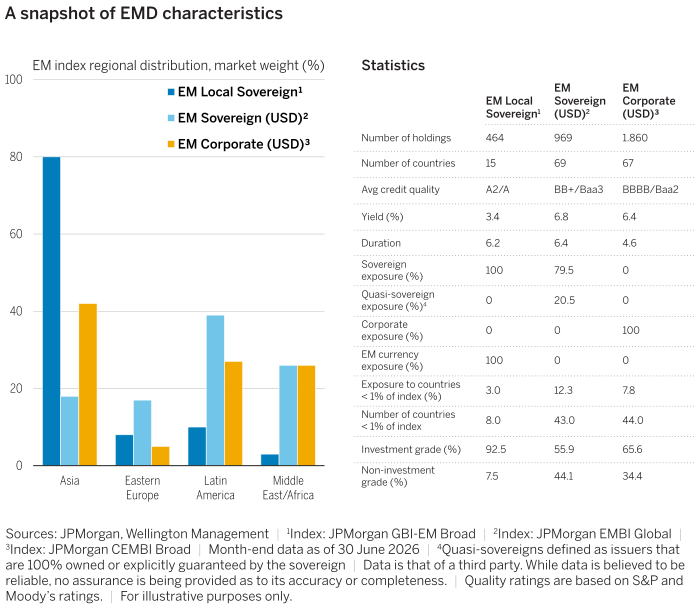
Figure 2 offers some perspective on market yields and other market characteristics. As of the end of the second quarter of 2026, yields on hard-currency sovereigns were nearly 7%, while EMD corporates were a bit lower with a commensurate lower duration profile. We’d also emphasize that there are opportunities in EMD across the quality spectrum, and to that point, we see that significant percentages of the market are investment grade, including about 56% of the hard-currency sovereign market and more than 65% of the corporate market.

Figure 2

A snapshot of EMD

For insurers who want to pursue higher yields and other potential benefits through EMD, we would argue that the asset class warrants consideration as a structural exposure. Historically, insurers have offered their core investment-grade managers some flexibility to include emerging markets, but it tends to be a small portion of the opportunity set. While EMD can be volatile, we think the return potential may deserve a more meaningful, long-term role in portfolios.

The outlook: Opportunity and risk across the EMD universe

We saw strong market results for EMD in 2025, supported by a favorable environment for credit risk taking, including healthy levels of nominal growth, accommodative central bank policy, and low volatility. Early in 2026, those conditions remained in place. Then came the war in Iran, which of course challenged our outlook in some respects, including raising the likelihood of interest rate hikes, which gave us pause about some local rate markets where our optimism was anchored to interest rate cuts.

That said, we're still in an environment in which emerging markets may thrive. Broadly speaking, they’ve been resilient and able to absorb the effects of the energy price shock given the improvements in their fiscal positions mentioned earlier and the credible reactions we’ve seen from local central banks in recent months. Importantly, we also see evidence that capital is in motion as investors look to diversify away from US dollar exposure and toward global assets, including emerging markets.

We’d also emphasize that the impact of the US-Iran war has been quite varied across emerging markets. Countries we consider among the strongest credits in the opportunity set, such as the UAE and Saudi Arabia, have benefited from low levels of debt and strong buffers against the shock. Countries with more limited access to export markets for their hydrocarbon exports, such as Bahrain and Iraq, have suffered more.

For its part, Latin America has been more insulated, given its geographic distance from the conflict, and many economies in the region are positioned to benefit from the current commodity price backdrop. Asia and Europe, on the other hand, have been relatively worse off from a commodity price standpoint. Asia, in particular, imports almost all its energy from the Middle East. Europe is also an energy importer but is broadly a wealthier region able to absorb higher prices. Although energy prices originally retreated following initial ceasefire talks between the US and Iran in June, anticipated flare-ups, increases in oil production, and flows through the Strait of Hormuz bear monitoring.

In select markets with positive fundamentals, conflict-driven volatility created attractive entry points. After the US and Iran began to deescalate hostilities, credit markets rallied strongly, and the near-term window may have narrowed. Even so, our outlook for EMD remains optimistic. We continue to see value across the quality spectrum, despite historically compressed spreads relative to developed markets. Within that environment, we believe investors can still find idiosyncratic sources of return, including in EMD corporates, where episodes of volatility can create differentiated investment opportunities.

Finally, the US dollar is another important consideration for the EMD outlook. In the fourth quarter of 2025, we saw what we believe may be a meaningful shift after more than a decade of persistent dollar strength. Several factors appear to be driving this change, including concerns about US institutional quality, elevated US fiscal deficits, and a broader investor push to diversify global asset exposures. In our view, this may signal a structural bear market for the dollar, creating both a fundamental and technical tailwind for EMD.


EMD allocations and asset manager partnerships

In our experience, successful EMD allocations require more than access to the asset class — they also depend on strong partnerships between insurers and their asset managers. Several elements can help make those partnerships more effective:

A deep understanding of each insurer’s business — Insurers are regulated businesses with sensitivities to turnover, downgrades, defaults, and a variety of other factors. Asset managers therefore need a deep understanding of their objectives and the potential impact of investment decisions on balance sheets and income statements.

A disciplined approach to risk management — Insurers’ balance-sheet objectives and regulatory constraints make diversified, risk-controlled portfolio construction essential. Asset managers need to be highly attuned to risks such as market volatility, the potential for illiquidity, and ratings transitions.

Proactive communication and timely portfolio insight — Given the nature of insurers’ business and investment needs, asset managers should provide timely, actionable portfolio perspectives. The war in Iran was a case in point, prompting important questions in the early days of the conflict: How might different markets be affected? What were the primary risk exposures in their portfolio? What could help mitigate those risks? And as conditions evolved, where were new buying opportunities emerging?

Final thoughts

As insurers seek ways to diversify credit exposure, enhance yield, and support long-dated liabilities, EMD deserves a close look. The asset class is broad, varied, and increasingly relevant for balance-sheet investors — but realizing its potential depends on thoughtful implementation. In our view, insurers are best positioned to benefit when EMD is approached as a structural allocation, guided by specialized managers who can combine global research depth with a clear understanding of insurance-specific objectives and constraints.

The views expressed are those of the authors at the time of writing. Other teams may hold different views and make different investment decisions. The value of your investment may become worth more or less than at the time of original investment. While any third-party data used is considered reliable, its accuracy is not guaranteed. For professional, institutional or accredited investors only.

Expert

Read more from our experts