Austria (Österreich), Institutional

Changechevron_right
menu
search

Are hedge funds the missing ingredient?

Nanette Abuhoff Jacobson, Multi-Asset Strategist
Adam Berger, CFA, Multi-Asset Strategist
16 min read
2026-12-31
Archived info
Archived pieces remain available on the site. Please consider the publish date while reading these older pieces.
Baking preparation background

The views expressed are those of the authors at the time of writing. Other teams may hold different views and make different investment decisions. The value of your investment may become worth more or less than at the time of original investment. While any third-party data used is considered reliable, its accuracy is not guaranteed. For professional, institutional, or accredited investors only.

Key points

  • Given our inflation outlook, fixed income may play a less potent diversification role in portfolios. Multi-strategy hedge funds could serve as a more all-weather complement to a typical 60/40 portfolio.
  • A mix of factors, including policy uncertainty and rising government debt, are driving volatility higher. Asset allocators may be able make their portfolios more resilient by replacing some equity exposure with equity long/short hedge funds.
  • Amid high equity valuations and extreme market concentration, hedge funds could help meet investment goals by providing a return source that’s not dependent on market beta.
  • The implementation and results of these ideas will ultimately depend on manager selection, which we think should focus on the role a fund can play and the manager’s skill level and approach to risk.

Leave just one key ingredient out of a favorite recipe and the outcome is likely to be unsatisfying. We think it’s an apt analogy for investment portfolios in the current economic and market environment, which is raising three important questions among asset allocators we talk to:

  1. If fixed income isn’t a consistently effective portfolio diversifier going forward, what are the alternatives?
  2. In a world of greater uncertainty, how can a portfolio protect against higher volatility?
  3. Given steep equity valuations, what other investments could offer compelling returns?

In all three cases, we think the answer may include adding hedge funds into the asset allocation mix. In this article, we’ll look at how multi-strategy hedge funds may enhance diversification and how equity long/short hedge funds may dampen volatility without sacrificing return. We’ll also consider hedge funds as potential “insurance” on US equity exposure that is both expensive and concentrated in a handful of mega-cap technology stocks.

A recipe for stronger diversification

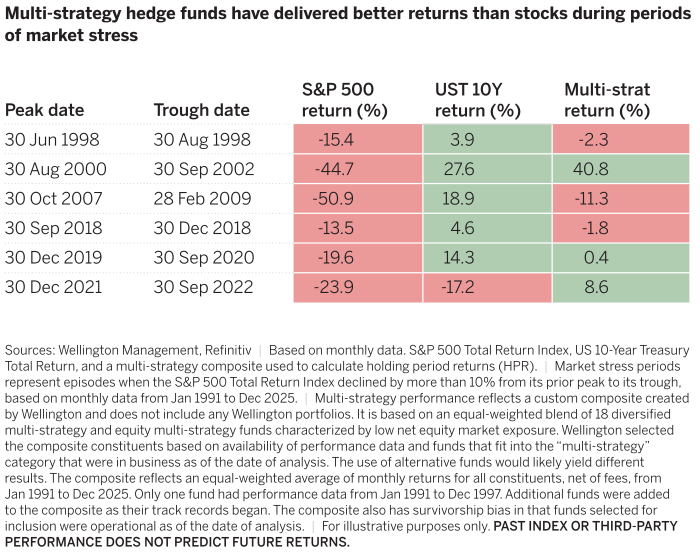
For the better part of the past 20 years, allocators have generally been able to count on the negative correlation between stocks and bonds — when stocks have struggled, bonds have helped cushion the blow. We saw this on display during the global financial crisis (GFC): From November 2007 through February 2009 (peak to trough), US stocks lost 51% but 10-year US government bonds gained 19%. And during the dot-com bust period between September 2000 and September 2002, stocks fell 45% while bonds rose 28%.1 (Of course, it should be noted that the risk in a 60/40 portfolio is dominated by equity risk, so even if the bond market helps to offset an equity market downturn, a 60/40 portfolio may still produce negative returns.)

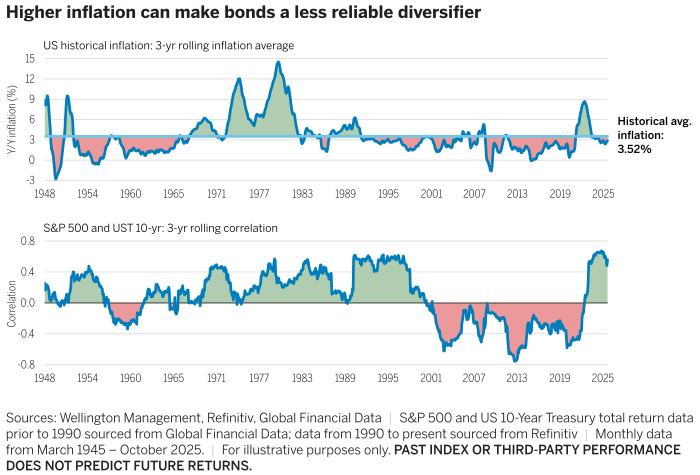
Beginning in 2022, however, this relationship became less reliable. That year, stocks and bonds sold off by -24% and -17%2, respectively. And since then, the correlation has stayed in positive territory on a three-year rolling basis (Figure 1). What changed? Inflation returned, spiking to about 9% in 2022 and remaining elevated relative to the post-GFC period since. Historically, higher inflation has been a key driver of positive stock/bond correlations (Figure 1), as it tends to push interest rates up and bond prices down, while simultaneously eroding equity valuations and challenging margins.

Figure 1

Could ex-US equities begin to outperform US equities?

Looking ahead, we think inflation will be a part of the investment narrative for the next 5 – 10 years for four reasons:

  1. Deglobalization/trade tensions — Tariffs are likely to be a key policy tool to protect domestic industries.
  2. Tight labor markets — Aging populations and low birth rates in the developed world, as well as immigration restrictions in some countries, will constrain the labor force and push wages higher.
  3. Underinvestment in commodities — After many years of underinvestment in commodity production, demand for commodities like copper may far outstrip supply.
  4. Fiscal spending — Governments are facing rising deficits but lack the will to cut spending.

A counterargument to this sticky inflation view is that AI-induced productivity improvements across a swath of industries could drive stronger growth without higher inflation. There is also considerable debate about the impact of AI on the supply of labor. However, we think increased deficit spending is inevitable and will drive inflation pressures. 

Given this economic outlook, fixed income may play a less potent diversification role in portfolios. To prepare, we think allocators should broaden their investment toolkit to include additional sources of return that may be uncorrelated to traditional assets. In particular, multi-strategy hedge funds may serve as a more “all-weather” complement to a typical 60/40 portfolio.

Moving capital from fixed income to multi-strategy hedge funds
Multi-strategy funds generally maintain exposure across hedge fund strategies, such as macro, long/short equity, and long/short credit strategies, in pursuit of a more stable risk and return profile. They may include a wide array of independent, specialized risk takers; invest in distinct asset classes; and combine systematic and fundamental investment processes. By combining strategies and tightly managing their aggregate risk, multi-strategy funds create the potential to provide considerable portfolio-level diversification.

In Figure 2, we look at periods of market stress over the past 35 years in which stocks experienced a peak to trough decline of more than 10%. For most of this period, bonds were a great diversifier — but in 2022, when they fell alongside equities, multi-strategy funds rode to the rescue. While multi-strategy hedge funds didn’t deliver a positive return in every sell-off over the last three-plus decades, they outperformed stocks in each case and helped cushion the blow in the post-TMT bubble (2000 – 2002). More important, on a prospective basis, if future sell-offs are driven more by inflation concerns (as in 2022), then multi-strategy hedge funds may be a key portfolio diversifier.

Figure 2

Could ex-US equities begin to outperform US equities?

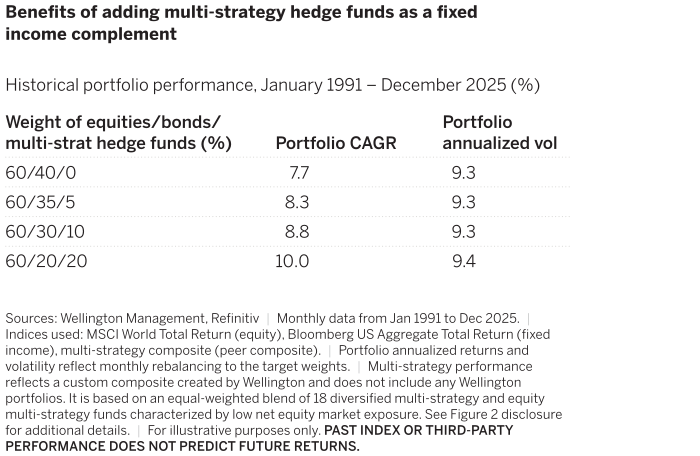
So how might multi-strategy funds be incorporated into a traditional portfolio? To illustrate one possible approach, Figure 3 starts with a 60/40 portfolio and shows the effect of replacing fixed income in five percentage point increments with a composite of equal-weighted multi-strategy hedge funds. The portfolio returns rose meaningfully with the addition of hedge funds (7.9% to 10.0%), while portfolio volatility rose only marginally (9.3% to 9.5%).

Figure 3

Could ex-US equities begin to outperform US equities?

The right blend for rising volatility

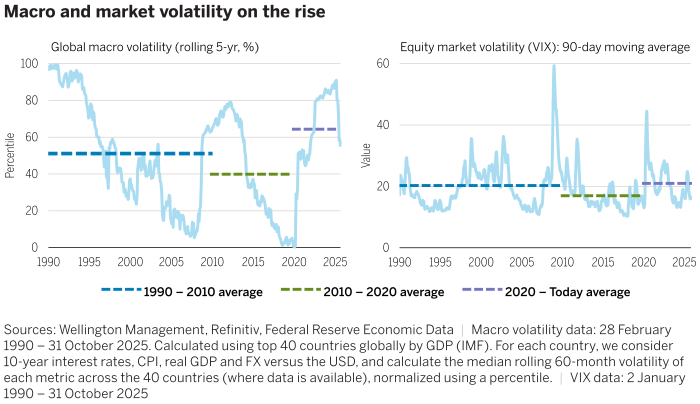
In the decade following the GFC, macro and market volatility were relatively subdued (Figure 4). Because inflation was not a concern, central banks could respond to any economic decline by easing monetary policy. Aside from a brief recession during the pandemic, we saw slow but mostly positive growth. With interest rates low, companies could borrow cheaply, helping to boost earnings and fund share repurchases. Earnings growth generally exceeded economic growth, and innovation fueled strong returns to technology companies.

The left chart in Figure 4 shows that since 2020, global macro volatility has risen substantially. As for market volatility as represented by the VIX (right chart), it was rarely higher than 20 and was often below 15 during the 2010 – 2020 period, but since 2020 it has rarely been below 15 and frequently been well above 20.

Figure 4

Could ex-US equities begin to outperform US equities?

As with the shift in correlations, inflation is a key culprit, forcing central banks into a difficult balancing act as they try to manage rising prices while also supporting economic growth. This is resulting in more policy uncertainty across regions and, as our Global Macro Strategist team has argued, it is likely to drive greater cyclicality and dispersion in economic outcomes going forward.

Also contributing to the volatility are the unprecedented surge in government debt burdens and concerns about institutional credibility since the pandemic. So far, investors have generally given markets a pass because of their belief in governments’ policy flexibility, but that complacency could be setting the stage for unwelcome surprises that create downside for some asset returns.

Meanwhile, geopolitical tensions are running high in many parts of the world and contributing to volatility. In fact, in a survey of institutional asset owners earlier this year, we found that geopolitics topped the list of worries. And from a market standpoint, high equity and credit valuations can amplify the impact of volatility-inducing events.

In short, there are likely to be more boom/bust and bull/bear cycles going forward. One way asset owners may be able to make their portfolios more resilient is by replacing some of their equity exposure with equity long/short hedge funds.

Moving capital from equity to long/short equity hedge funds
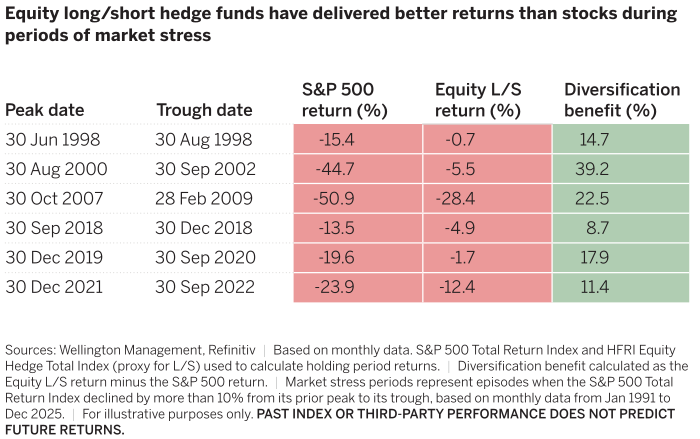
By design, equity long/short hedge funds have much less equity market exposure (“beta”) than long-only equities. The HFRI Equity Hedge Index of long/short hedge funds, for example, has a long-term equity beta of 0.46 — meaning that for every US$100 invested, only about US$46 on average is exposed to directional risk from the stock market.3 In addition, long/short hedge funds tend to have dynamic exposure to the stock market, meaning they can bring their “net” long exposure down to help protect capital during sell-offs. With these potential advantages, we would expect equity long/short hedge funds to meaningfully outperform long-only equities in a deep sell-off (though they would likely be down, perhaps significantly, in the event of a sudden and rapid market collapse). Figure 5 looks at several periods of extreme volatility and shows that while returns were negative for long/short equity hedge funds, they were substantially better than long-only equity returns, helping to smooth the path for equity investors who pivoted to them.

Figure 5

Could ex-US equities begin to outperform US equities?

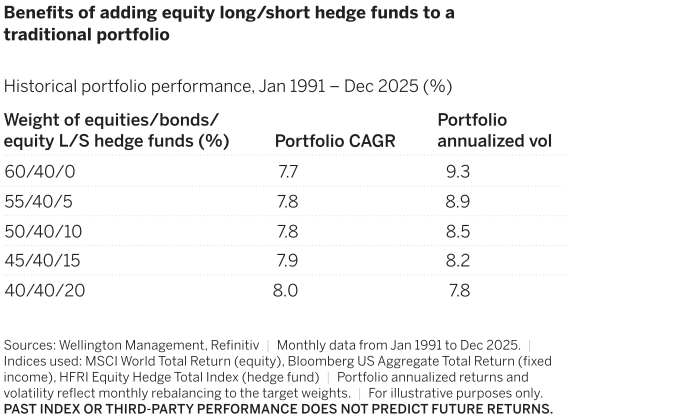
To illustrate the potential portfolio-level impact of adding exposure to equity long/short hedge funds, we again start with a traditional 60/40 portfolio in Figure 6. Replacing long-only equities in five percentage point increments with allocations to equity long/short hedge funds (proxied by the HFRI Equity Hedge Index) results in modestly higher portfolio returns and meaningfully lower volatility.

Figure 6

Could ex-US equities begin to outperform US equities?

New sources of return in case valuations are too spicy

Strong market gains, especially in US mega-cap technology stocks, have left allocators to contemplate the potential downside of high valuations and extreme levels of index concentration. As of 30 October 2025, for example, the trailing PE ratio of the S&P 500 was at nearly the 96th percentile for the past 20 years. The only sustained period with a higher result was the post-pandemic stretch from August 2020 to July 2021.

We think hedge funds can help by providing a return source that does not depend on market beta. And in fact, Wellington’s 10-year capital market assumption (CMA) for hedge funds (5.0%) is well above our CMA for large-cap US stocks (3.4%), with valuations expected to be a particularly strong headwind for the latter (see Important Disclosures at the end of the paper).

That said, we recognize that some allocators are skeptical about hedge funds, having experienced cases of unexceptional performance from 2010 to 2020. But we think we’ve entered an environment that may be more fertile for hedge funds, including higher levels of macro volatility and interest rates, as discussed earlier. Our research suggests these are among the factors that have driven stronger periods of hedge fund performance, as discussed in our paper, “Goldilocks” and the three drivers of hedge fund outperformance.”

Additionally, we’d note that there have been broad industry improvements in hedge fund governance, including fees that are better aligned with alpha generation.

Season to taste: What should allocators do now?

Allocators are grappling with how to reposition portfolios for a new set of challenges: higher stock/bond correlations, higher volatility coming from a variety of sources, and concentrated US equity exposure at high valuations. We think one step in the right direction is to replace some fixed income exposure with multi-strategy hedge funds and some equity exposure with long/short equity hedge funds.

The implementation and results of these ideas will ultimately depend on manager selection and performance. While there have been periods in which hedge fund results have not lived up to expectations, we’ve found that top managers have been able to generate strong returns over time. Of course, the hedge fund universe is large and diverse, so we think the search for top managers and suitable funds should focus on several factors:

  1. What role can the fund play in the portfolio? For example, what does a fund’s historical return pattern indicate about its potential to improve diversification or enhance return?
  2. What is the manager’s skill level? A manager should be able to demonstrate that returns were generated from skill rather than favorable market conditions or factor tailwinds.
  3. How does the manager think about risk? To fully understand the risks being taken by a manager, we believe a variety of quantitative and qualitative tools and metrics should be used, including multiple risk models and stress tests. Managers should also be able to communicate a clear and comprehensive approach to risk management and to demonstrate its effectiveness, including in extreme market environments.

We would welcome the opportunity to discuss manager research best practices, as well as our views on the outlook for hedge fund performance and the right mix of strategies for today’s evolving economic and market environment.

1Equity returns are represented by the S&P 500 Total Return Index. Bond returns are represented by the total return of the US 10-year Treasury. | 22022 performance reflects the S&P 500’s peak-to-trough drawdown period (1 January – 30 September). | 3Source: HFRI. Data for the full history of the HFRI Equity Hedge Index, from 29 December 1989 to 30 September 2025.

IMPORTANT DISCLOSURES: CAPITAL MARKET ASSUMPTIONS
Intermediate capital market assumptions reflect a period of approximately 10 years. If we developed expectations for different time periods, results shown would differ, perhaps significantly. Additionally, assumed annualized performance and results shown do not represent assumed performance for shorter periods (such as the one-year period) within the 10-year period, nor do they reflect our views of what we think may happen in other time periods besides the 10-year period. Annualized returns represent our cumulative 10-year performance expectations annualized. Assumed returns shown do not reflect the potential for fluctuations and periods of negative performance.

This analysis is provided for illustrative purposes only. This material is not intended to constitute investment advice or an offer to sell, or the solicitation of an offer to purchase shares, strategies or other securities. References to future returns are not promises or even estimates of actual returns a client may achieve. This material relies on assumptions that are based on historical performance and our expectations of the future. These return assumptions are forward-looking, hypothetical, and are not representative of any actual portfolio, or the results that an actual portfolio may achieve. Note that asset-class assumptions are market or beta only (i.e., they ignore the impact of active management, transaction costs, management fees, etc.), with the exception of hedge fund assumptions. Hedge fund CMAs consist of a long-term exposure to beta based on analysis of HFRI indices, plus an assumed net alpha. For expected returns, we use a derived composite approach (blend of asset classes) based on a general estimate of beta exposure of the indices in question over time. We also assume one percentage point of net alpha.

The expectations of future outcomes are based on subjective inputs (i.e., strategist/analyst judgment) and are subject to change without notice. As such, this analysis is subject to numerous limitations and biases and the use of alternative assumptions would yield different results. Expected return estimates are subject to uncertainty and error. Future occurrences and results will differ, perhaps significantly, from those reflected in the assumptions. ACTUAL RESULTS MAY DIFFER SIGNIFICANTLY AND AN INVESTMENT CAN LOSE VALUE. Indices are unmanaged and used for illustrative purposes only. Investments cannot be made directly into an index.

This illustration does not consider transaction costs, management fees or other expenses. It also does not consider liquidity (unless otherwise stated), or the impact associated with actual trading. These elements, among others, associated with actual investing would impact the assumed returns and risks, and results would likely be lower (returns) and higher (risk).

em-evolution-new-paths-in-equity-portfolio-construction-fig8

Experts

Related insights

Showing of Insights Posts
Article
8 min
Archived info
Archived pieces remain available on the site. Please consider the publish date while reading these older pieces.

Finding durable value amid shifting currents

Continue reading
event
8 min
Article
2026-11-26
Archived info
Archived pieces remain available on the site. Please consider the publish date while reading these older pieces.
Article
18 min
Archived info
Archived pieces remain available on the site. Please consider the publish date while reading these older pieces.

Monthly Market Review — October 2025

Continue reading
event
18 min
Article
2026-11-20
Archived info
Archived pieces remain available on the site. Please consider the publish date while reading these older pieces.
Article
8 min
Archived info
Archived pieces remain available on the site. Please consider the publish date while reading these older pieces.

Investing in 2026: prepare for inflationary growth

Continue reading
event
8 min
Article
2026-11-15
Archived info
Archived pieces remain available on the site. Please consider the publish date while reading these older pieces.
Article
11 min
Archived info
Archived pieces remain available on the site. Please consider the publish date while reading these older pieces.

Can markets keep climbing the wall of worry?

Continue reading
event
11 min
Article
2026-11-30
Archived info
Archived pieces remain available on the site. Please consider the publish date while reading these older pieces.
Article
4 min
Archived info
Archived pieces remain available on the site. Please consider the publish date while reading these older pieces.

Time to diversify your diversifiers with hedge funds?

Continue reading
event
4 min
Article
2026-10-14
Archived info
Archived pieces remain available on the site. Please consider the publish date while reading these older pieces.
Video
4 min
Archived info
Archived pieces remain available on the site. Please consider the publish date while reading these older pieces.

Rapid Fire Questions with Alex Chambers

Continue reading
event
4 min
Video
2026-10-31
Archived info
Archived pieces remain available on the site. Please consider the publish date while reading these older pieces.
Article
6 min
Archived info
Archived pieces remain available on the site. Please consider the publish date while reading these older pieces.

Europe: Fertile ground for long/short alpha opportunities

Continue reading
event
6 min
Article
2026-06-01
Archived info
Archived pieces remain available on the site. Please consider the publish date while reading these older pieces.

Read next