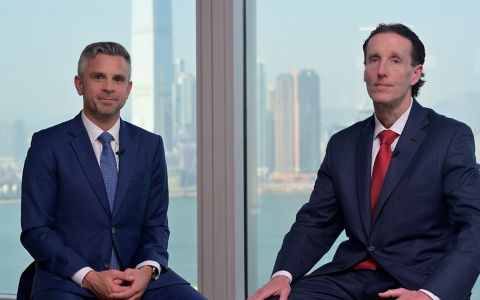
Transcript:
Introduction
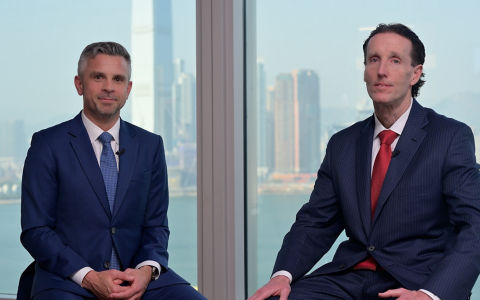
Andrew Sharp-Paul: I'm Andrew Sharp-Paul, APAC Solutions Director here at Wellington Management. And as we continue our series thinking about ways that investors should think about focus, flexibility and resilience within their portfolios, I'm delighted today to welcome Campe Goodman, portfolio manager and lead of our multi-sector credit team. Welcome Campe and thank you for taking the time.
Campe Goodman: Thanks, Andrew. Nice to be with you.
Managing left-tail risk in a flexible fixed income portfolio
Andrew Sharp-Paul: So as we think about those three areas —focus, flexibility and resilience—within portfolios, today we specifically want to think about flexibility. Flexibility within fixed income markets. So, Campe, your strategies that you manage tend to be more rotational in nature, which, in my mind, leaves more of a total return type of mindset. So balancing not only the upside potential, but also the downside risks. So, how do you think about the left-tail and managing against those left-tail risks in your strategy?
Campe Goodman: So, Andrew, what I like about managing in the credit markets, in general, is that there are so many different opportunities. And so a lot of what I’m trying to do in the portfolios that I manage is to really look very broadly across these fixed income markets, particularly the credit markets, and look for those opportunities that I think really have the best relative value. And over time, that has meant going into very different areas, whether it’s more in emerging markets, sovereigns or corporates, into high yield, or looking in more unusual areas—structured finance, convertible bonds. You know, all these different parts of the markets. So, part of what I’m always trying to do is really be very diversified. And by doing that, I think that’s going to provide some inherent protection—better upside, downside.
At the same time, I also think that it is important to balance duration against credit risks. A lot of times, when credit is doing well, that’s when rates may be stable or rising a little bit. But importantly, when credit is not doing as well, often that’s the case that rates are coming down. And so that’s when bonds generally are doing well, and you really want to have that duration. So, having duration as an offset to credit risk is another way that we dampen volatility and try to reduce that left-tail downside risk over time.
Balancing duration and credit exposure
Andrew Sharp-Paul: I was actually going to ask you about the duration and credit roles in a portfolio. So, if you think about those two levers, how flexible are you in your approach and kind of moving in and out of those two kind of key risks?
Campe Goodman: So, I think what’s important for allocators to understand is that, structurally, we do have some duration, and some credit risks as well. So, you can count on us having those things.
But what we have done is, tactically over time, to manage both of those levers. So, during environments when spreads are tighter, we will typically have less credit risk, depending on what our view is on where rates may be going over the next six, twelve, eighteen months. We will lean into that and have more or less duration. So, there’s sort of a sense of a structural allocation to those big betas in the portfolio, but also flexibility to move around them in order to try to add value.
Rethinking tracking error in a multi-sector credit portfolio
Andrew Sharp-Paul: You mentioned allocators. So, one of the key things I think about when I think about a multi-asset portfolio is, obviously, the tracking risk that you’re inherently bringing into a strategy, or bringing into an overarching portfolio, when you allocate to something that’s naturally quite dynamic. How do you see allocators using your flexible approaches, and how do you think they should think about that kind of tracking error challenge?
Campe Goodman: I understand that allocators sometimes feel like, hey, this can be a challenge. How do I know how this is going to perform? But we’ve really tried to build this approach so that allocators have some sense that we will always have credit risk and duration, so they can count on those things. So we have a lot of tracking error versus something like an aggregate type of benchmark.
But if you think about this as potentially—we hope—your best allocation to the credit markets over a long period of time, that’s really what we want to be for investors. I like that because I think that the credit markets, particularly some of these higher-yielding credit markets, have had terrific risk–reward over time. They’ve had almost all of the returns of equities, with about half the volatility. To me, that is a fantastic trade-off.
Andrew Sharp-Paul: Yeah. I mean, high yield itself, just as a standalone sector, has done tremendously well in many recent years. And yet, that Sharpe ratio you’re getting from that single allocation is quite attractive.
Campe Goodman: 100%. High yield has done really well. And we hope that we can even enhance that by bringing in these other sectors, like EMs (emerging markets), structured finance, these other parts of the market, and putting them together. That’s our goal—to generate something for allocators where we can potentially produce an even better risk–reward trade-off than any of those sectors as a standalone.
Navigating public and private fixed income
Andrew Sharp-Paul: One other key trend or theme, I suppose, in client conversations these days is the convergence of public and private. So, how do you think about public and private fixed income interacting with one another? And how do you think about the relative trade-offs between those two?
Campe Goodman: Look, I like both. I guess, as somebody who has been primarily in the public markets for most of my career, I would love to say that I think private markets are terrible, but I don’t actually think they’re terrible. I definitely think they have a place in client portfolios, and what we are trying to do is to be the best allocation to the public markets.
I think it’s really important for allocators to remember liquidity is quite important. And often, the time that you need it is now, when you’re getting demand, say, for private credit or things like that, and you can’t take your money out of private credit. So I think that public credit is a very attractive area. When clients want their money, they can get it.
And the other thing is that we are invested at all times. So we are measured on total return, not on IRR. So I am proud that, you know, if you give us your money, then, fortunately, we will take it on any day and try to deliver great returns. We don’t have that luxury of just demanding the money, you know, at the most attractive point in the cycle. But to me, that’s a real benefit for clients.
Andrew Sharp-Paul: So it feels like for me, on that point, 2022 was a bit of a shock across the board for many allocators. You know, as you had public markets selling off and their private assets were a little slower to adjust, that liquidity point really became critical.
Campe Goodman: Yeah, it did. And I think that every few years we get these cases where investors remember, oh, this is why I have liquid assets. And so, you know, I think it’s important, really, for allocators and investors to remember, like, hey, you’ve got to keep some core liquidity. You don’t want to have all your assets tied up, particularly in environments where you want to be able to take advantage—when you get those real dislocations in markets, you’ve got to have liquid capital in order to do that.
Often we are keeping some portion of the assets in higher-quality assets so that, when things get dislocated, we very quickly can take advantage and move, you know, within days, even hours, into attractive assets.
Andrew Sharp-Paul: I think that also talks to the kind of third theme of the series, is that point on resilience. So having that kind of dry powder, if you will, to be able to move and be nimble, to try to take advantage of opportunities or also to de-risk, if necessary, also inherently builds that resilience into your portfolio as well.
Campe Goodman: I think it really is the case that, like, I am fortunate at Wellington to have so many different investors whose ideas I can take advantage of. And just to take one example, in April of 2025, when we had significant dislocations in the market, I did have my traders and analysts in Hong Kong and Singapore reaching me in the middle of the night in Boston, saying, hey, you know, there are bonds that are down 5 or 10 points. You should be buying this right now. And we could get them the capital immediately in order to do that. I had other analysts in London saying, like, hey, this is a really good time to invest right now. And again, we could do that so quickly because we have liquidity. We have flexibility. And again, fortunately, we had talented investors who are watching these markets.
The biggest career lesson learnt
Andrew Sharp-Paul: One final question for me—you’ve been doing this for quite a long time. What’s the biggest lesson you’ve learned? What’s the one lesson you would pass on to young Campe if you could?
Campe Goodman: So, when I think about some of the big lessons that I’ve learned, a lot of them have come around some of the most volatile, market moving periods that we’ve seen. And really, the lessons that I’ve learned time and time again are twofold around these major sell offs in the market.
One is to really re underwrite your investment ideas and to stick with those that you have a lot of conviction in because, typically, those will come back. And fortunately, that’s often what we’ve done—we’ve leaned in on those investment ideas.
At the same time, in order to do that, the second big lesson has been about risk management. We’ve wanted to stay diversified, keep our sizes reasonable, and we’re always thinking about being diversified. Do we have the right sizing and portfolios? Risk management is really what allows you to then play offense during those periods when you get those dislocations in the market. So those two go together, and you see them time and time again during these stress periods.
Andrew Sharp-Paul: Yeah. So again, we were focused on flexibility here, but we have touched on resilience. And that final point you just made—the risk management—speaks to that first point we’ve been making to clients, is that focus. As we move into a more volatile regime, as we move into a kind of a new geopolitical landscape, that focus on risk and how you deploy risk—making sure it’s very deliberate and well underwritten, to your point—is going to be key.
Campe Goodman: Yeah. I mean, I really think actually resilience and flexibility go together very well. If you have a portfolio that can withstand market shocks, then you’re going to be able to take advantage of those dislocations. And that’s really what we’ve tried to do. My team and I, we have been good risk takers. We lean in when you get these opportunities in the market. And that’s what we really are committed to doing for clients.
Andrew Sharp-Paul: Well, thank you so much Campe. Really appreciate you taking the time to speak with us. I really enjoyed the conversation.
Campe Goodman: Me too. Thanks a lot, Andrew.
Conclusion
Andrew Sharp-Paul: And thank you all for tuning in to the latest of our series on Focus, flexibility and resilience. I think Campe summed it up really nicely at the end there —the interplay and the importance of both flexibility and resilience within a portfolio. But at Wellington, underpinned by broad expertise within asset classes and across asset classes, I look forward to continuing the conversation with you. Thank you.