Skip to main content
- Funds
- My Account

The value of your investment may become worth more or less than at the time of original investment. While any third-party data used is considered reliable, its accuracy is not guaranteed.
For professional, institutional, or accredited investors only.
Wellington is dedicated to working in partnership with clients who ask us to implement climate objectives into new and existing mandates we manage on their behalf. Client objectives are additional to investment-led climate integration, which is outlined in our Climate integration philosophy.
Our clients have a variety of climate goals, including mitigating issuer-level risks, aligning their portfolios with long-term climate objectives, and allocating assets to the low-carbon, climate-resilient economy. We offer clients the following approaches to support their goals:
Many asset owners have established long-term climate goals such as achieving net zero portfolio emissions and encouraging tangible real-world emissions reductions. These clients often request that we implement an engagement strategy in mandates we manage on their behalf to support these goals.
Our investment teams retain responsibility for determining which portfolio companies to engage with, and on which topics, as this ensures consistency with each team’s assessment of potentially financially material climate considerations and their approach to engagement.
While we believe engagement is a useful tool for encouraging companies to demonstrate strategic preparation for the transition to a lower-carbon economy, engagement alone cannot guarantee achievement of a client’s portfolio-level goals. If a client requires achievement of a time-bound milestone, we may recommend supplementing engagement with implementation of a decarbonization glidepath in addition to reporting to monitor portfolio alignment progress.
For asset-owner clients who have requested a decarbonization glidepath, we offer a bottom-up glidepath based on the transition alignment of portfolio holdings or a top-down glidepath based on the portfolio’s overall emissions footprint.
Ultimately, the client’s objective and investment team’s philosophy and process determine the glidepath and target milestones. These decisions are further shaped by a mandate’s region, style, time horizon, concentration, and turnover rate.
Bottom-up glidepath: Increasing exposure to aligned issuers
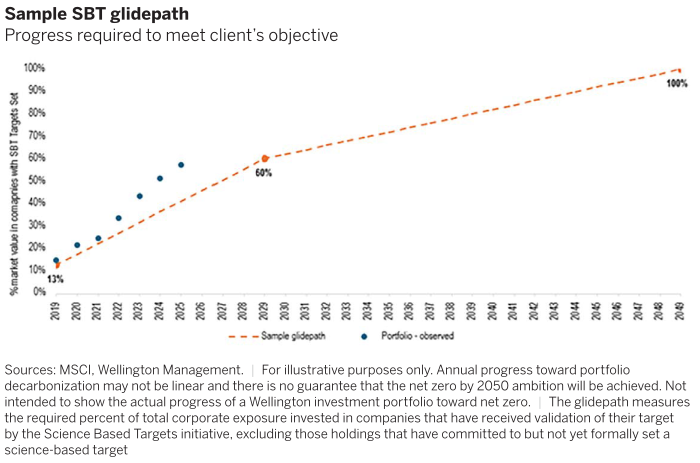
Example client objective: Increase the proportion of the portfolio invested in net-zero-aligned companies by 2050.
This approach, which aims to increase exposure to companies that have set science-based emissions-reduction targets, is philosophically aligned with the Science Based Targets initiative’s (SBTi’s) Guidance for Financial Institutions’ Portfolio Coverage approach. We currently use SBTi-validated targets as our standard metric to measure portfolio exposure. Our approach to evaluating targets, including the use of our proprietary transition alignment assessment, may evolve in response to improvements in data availability and evolution in client expectations.
Figure 1 outlines the key components of the example glidepath:
Top-down glidepath: Reducing a portfolio’s emissions footprint
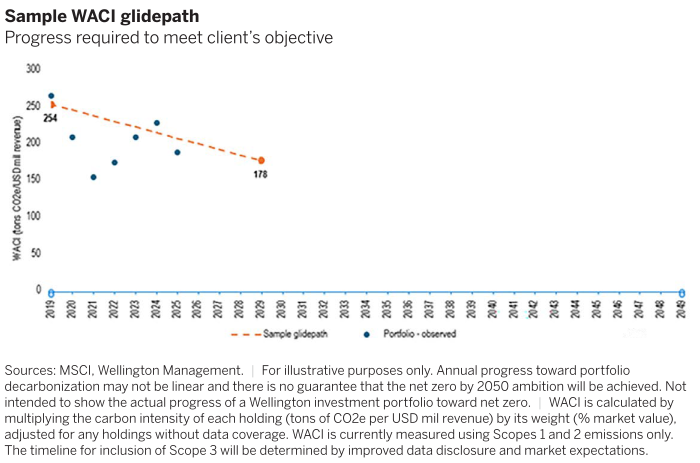
Example client objective: By 2030, reduce portfolio emissions by 30% relative to 2019 benchmark baseline.
Our investment teams use weighted average carbon intensity (WACI) to track progress toward interim 2030 targets. We find WACI to be consistent with our research focus of comparing issuers’ operational efficiency, including energy and materials use. We may also adopt a financed-emissions intensity metric of tons of CO2/US$ million invested (using enterprise value, including cash) on a case-by-case basis. We report on both metrics for clients.
Figure 2 outlines the key components of the example glidepath:
Please read more about the lessons we have learned from implementing decarbonization guidelines.
Some clients seek to limit portfolio exposure to transition-related risks and view carbon as a proxy for these risks. For these clients, we recommend a low-carbon guideline for an existing strategy that is designed to deliver competitive returns with a lower emissions intensity than the strategy’s benchmark. Unless a client requests additional exclusions, investment teams seek to maintain diverse sector and geographical exposure.
We incorporate scenario analysis into our recommendation of a benchmark-relative threshold (% below benchmark) that seeks to preserve a client’s performance expectations. This is especially useful for concentrated, high-conviction investment strategies. For example, some teams take industry-level active bets that may contribute to long-term outperformance. We test how these active bets could be constrained by a benchmark-relative threshold. For clients who implement low-carbon guidelines, we suggest revisiting this analysis periodically as the benchmark evolves.
Strategies investing in equities, investment-grade bonds, or high-yield bonds can feasibly adopt client-directed glidepaths or low-carbon guidelines and provide reporting accordingly. Emissions and alignment data for these asset classes is most reliable, and our investment teams have tested implementation approaches in practice. We expect to expand applicability to other asset classes as better data and methodologies emerge.
Some clients seek to capture the investment opportunity of providing capital to companies whose products and services are enabling a lower-carbon and resilient economy. We manage nonconcessionary climate-solutions strategies that invest in public and private equity markets. These strategies, which invest across climate mitigation and adaptation solutions, emphasize material revenue exposure from products and services that enhance energy efficiency, facilitate the energy transition, and improve resiliency to physical risks of climate change.
While decarbonization glidepath progress is not expected to be linear, we aim to monitor and report on our progress year over year. We include carbon metrics and engagement tracking as relevant to clients’ goals and proactively communicate challenges along the way.
Our Climate Research Team has developed proprietary dashboards that facilitate company- and portfolio-level monitoring. Please refer to our annual Climate Report [Section 2, Climate research, strategy, and risk management] for more detail on the tools available to our investment teams, including the Net Zero Portfolio View.
Wherever possible, we integrate client-directed guidelines into our monitoring system to facilitate automated review on a pre- and/or post-trade basis.
We have designed our standard mandate-level climate report to be consistent with the key metrics and data visualizations available to our investment teams via our internal dashboards. We summarize engagement activity by both the number and portfolio-level market value of engagements that included discussion of a climate topic. Finally, our standard report also includes current and historical performance of carbon footprint metrics and exposure to companies with SBTs.
Please let your relationship management team know if you would like to explore potential implementation options to meet your organization’s climate goals.
Most recent update: February 2026