Ireland, Intermediary

Changechevron_right
menu
search
Skip to main content

Top of Mind: Next-generation diversifiers for a changing market landscape

11 min read
2028-05-31
Archived info
Archived pieces remain available on the site. Please consider the publish date while reading these older pieces.
topofmind-hero-banner
Adam Berger, CFA, Multi-Asset Strategist
topofmind-hero-banner

Key points

  • Given shifting economic and market conditions, the traditional rules of diversification won’t always apply, and investors should consider a broader set of strategies to protect their portfolios.
  • Increasingly, hedge funds are being used as a portfolio diversifier — particularly those that aim for a market-neutral profile, such as multi-strategy funds.
  • It may be time to consider inflation-hedging strategies, including dynamic and diversified approaches that evolve with the economic landscape.
  • Even if fixed income is not as effective at offsetting equity risk at times, the asset class can continue to play critical roles, including serving as a source of income and potential protection against classic deflationary recessions.

This edition of Top of Mind lays out the case for a set of “next-generation diversifiers” — asset classes that may help protect portfolios against equity downside and other risks investors are likely to face in coming years. I share views from several Wellington experts, as well as my own, about the roles hedge funds, real assets, and fixed income can play in building more resilient portfolios. I also highlight several risk-management, asset allocation, and niche investment ideas.

Why is a next generation of diversifiers necessary?

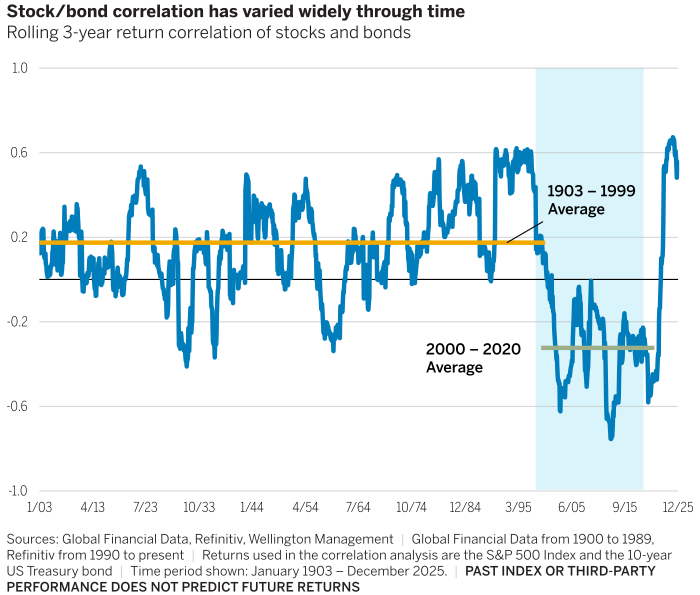
Figure 1 shows the rolling three-year correlation between US stocks and bonds over more than 120 years. On average, the correlation was positive for much of the period, so stocks and bonds were more likely to move in the same direction. But for most investors today, the shaded period in the chart is a more relatable experience: From 2000 to 2020, the average correlation was negative, creating an expectation that a mix of stocks and bonds will provide adequate diversification (i.e., when stocks struggle, bonds can help cushion the blow).

Recently, though, the stock/bond correlation has turned positive and called that expectation into question — most notably in 2022, when stocks and bonds both experienced double-digit declines. A key contributor to this shift is rising inflation, which can be detrimental to both asset classes.

Figure 1

Stock/bond correlation has varied widely through time

Higher inflation is one facet of the more volatile world we’ve entered, particularly compared with the decade that followed the global financial crisis — a period of relative calm when a simple stock/bond portfolio was capable of consistently delivering reasonably good returns and controlling volatility. Today, a range of factors are contributing to a less stable and more uncertain environment, from deglobalization to geopolitical turmoil.

Investors seem attuned to this shift and what it portends for portfolios. In a recent poll, we asked institutional asset owners if they were considering increasing their allocations to diversifiers to help protect against future volatility. More than 40% of the 205 respondents said “yes,” while only 10% said “no” and the balance were undecided.

Profiling three next-gen diversifiers

Against this market backdrop, I want to offer a few insights on the diversification role I think hedge funds, real assets, and fixed income can play going forward.

1. Hedge funds
Historically, investors have often focused on hedge funds as a source of total return. But increasingly, hedge funds are being used as a portfolio diversifier — and especially funds that are market-neutral, meaning their returns are not tied to market factors, such as the direction of equities or interest rates. Instead, they are driven by manager skill and the idiosyncratic performance of different strategies and securities.

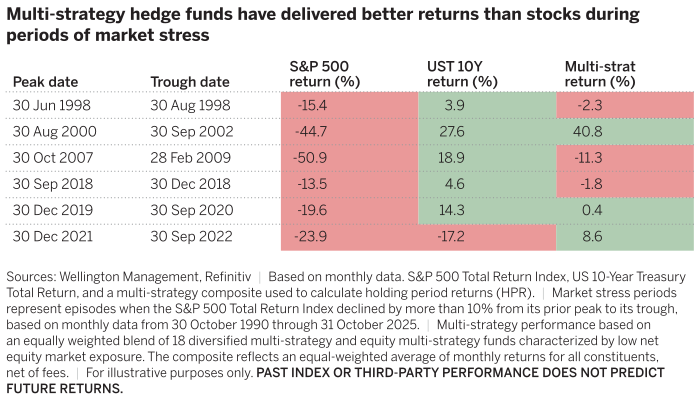
As one example, multi-strategy hedge funds often aim for a market-neutral profile by combining exposure to a diverse mix of hedge fund strategies, such as macro, long/short equity, and long/short credit strategies. To illustrate the potential benefit of this approach, we looked at six periods of market stress over the past 35 years in which stocks experienced a peak-to-trough decline of more than 10%. As Figure 2 shows, bonds were an effective diversifier in most of these periods. But in 2022, when bonds fell alongside equities, multi-strategy funds rode to the rescue. While they didn’t deliver a positive return in every sell-off over the last three-plus decades, they outperformed stocks in each case and really helped cushion the blow in the post-TMT bubble (2000 – 2002). More importantly, if future sell-offs are driven more by inflation concerns (as in 2022), multi-strategy hedge funds may serve as a key portfolio diversifier.

Figure 2

Multi-strategy hedge funds have delivered better returns than stocks during periods of market stress

That said, I know that some allocators are skeptical about hedge funds, having experienced cases of unexceptional performance from 2010 to 2020. But I think we’ve entered an environment that may be more fertile for hedge funds, including higher levels of volatility, as discussed earlier. Our research suggests this is among the factors that have driven stronger periods of hedge fund performance in the past.

For a deeper dive on how hedge funds may enhance diversification, read our recent paper, Are hedge funds the missing ingredient?

2. Real assets
As noted earlier, inflation has risen in recent years, following a long period in which it remained relatively low and stable. While central banks have made some progress tamping down inflation, they may be in for a long fight, with a variety of factors, including rising government deficits and commodities scarcity, contributing to upward pressure on prices.

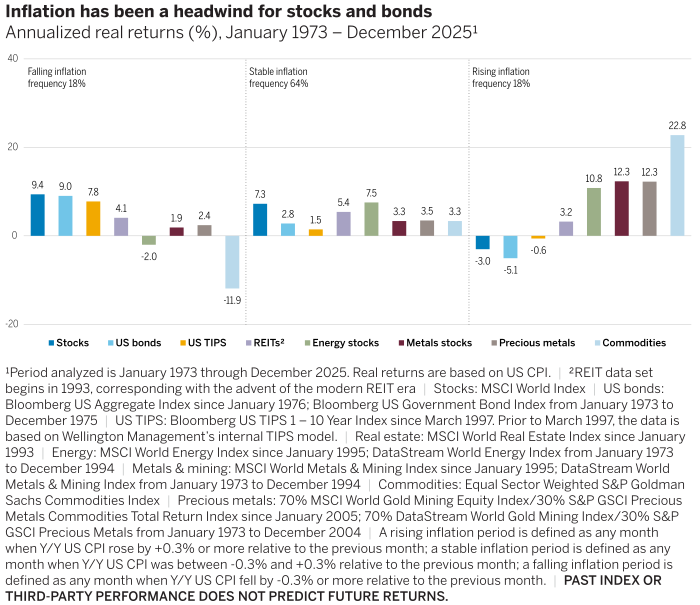
The right side of Figure 3, from my colleague Nick Petrucelli, who manages real asset portfolios, highlights the challenge stocks and bonds have historically faced when inflation has been rising — negative real returns. On the other hand, commodities-related assets have provided strong performance amid rising inflation, and other real assets, such as REITs and TIPS, have provided a degree of stability across different inflation regimes.

Figure 3

Inflation has been a headwind for stocks and bonds

So, how should investors who want to address inflation risk think about a structural allocation to real assets? I’ll summarize three of Nick’s recommendations:

Define the objective — Be clear about the objectives for the real-asset exposure. The primary objective is generally to outperform in times of high and rising inflation, which can provide valuable diversification to other parts of a stock/bond portfolio. Since inflation-hedging exposure is likely to be a relatively small part of an overall asset allocation, we believe a high beta (sensitivity) to inflation is necessary to provide a sufficient hedge. In addition to the primary objective, the exposure also needs to be capable of providing a competitive long-term total return. Otherwise, maintaining the exposure across market environments becomes much more challenging.

Ensure the opportunity set is well diversified — Recently, we’ve seen evidence that performance can vary greatly across different parts of the inflation-hedging opportunity set, which argues for working with a broad, diverse opportunity set. Last year, gold and other metals were in a major bull market. Fast forward to the first quarter of 2026 and we’ve seen drawdowns in some metals but strong gains in energy and agriculture.

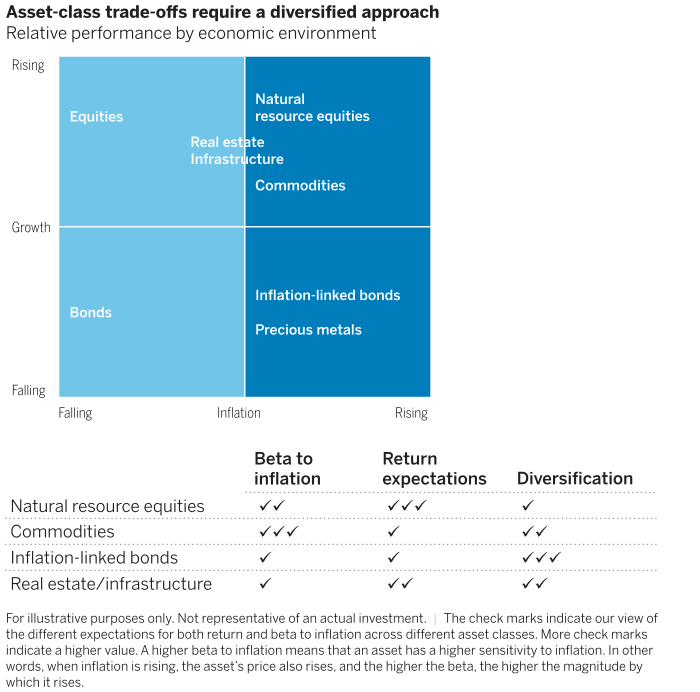
Balance the trade-offs across asset classes — With the objective and opportunity set defined, portfolio construction should account for the trade-offs between different asset classes and sectors. Figure 4 shows the market environments, defined by inflation on the horizontal axis and economic growth on the vertical axis, in which various asset classes have historically tended to perform well. This framework is useful for visualizing the role each asset can play, balancing assets that may perform better in demand/pull inflation in the top right versus more stagflationary outcomes in the bottom right. Each of these asset classes varies in terms of the beta to inflation, long-term total return, and potential diversification it can offer within a portfolio. No single investment can reliably provide all three, so investors should consider a dynamic and diversified approach that evolves with the economic landscape. Having said that, investors who aren’t comfortable with a broad allocation to real assets may at least want to consider a stand-alone allocation to commodities.

Figure 4

Asset-class trade-offs require a diversified approach

One last point related to real-asset diversification: While some investors focus their real asset portfolio in private assets, it’s important not to underestimate the value of liquidity at times. Illiquidity may offer benefits such as lower reported volatility, but the inability to access capital on demand can create challenges — for example, when investors seek to rebalance. With this in mind, holding at least a portion of a real assets allocation in liquid assets may be essential to reap the potential diversification benefits.

3. Fixed income
While I’ve already noted that there may be times when fixed income is not as effective at offsetting equity risk, the asset class can continue to play several critical roles in portfolios, including:

Protection against classic (deflationary) recessions — Recent economic challenges have largely been related to supply shocks, including the pandemic, the war in Ukraine, and the war in Iran. Fixed income may not always provide a diversification benefit in these inflationary environments. But as our fixed income experts have noted, it’s likely to be a more effective diversifier in classic demand-driven recessions and deflationary environments.

A source of income — There's still a need for steady income, and fixed income will typically be a core holding in that respect. This is especially important given demographics, with developed country populations aging and seeking income. It helps, of course, that yields today are more attractive than they were a decade ago.

A volatility dampener in an equity sell-off — Fixed income is still inherently less volatile than equities, which can make it a volatility dampener for an overall portfolio, even when stocks and bonds may be moving in the same direction.

All of that said, if we’ve truly moved away from a deflationary world, driven by deglobalization, loose labor markets, and other factors, investors may need to think about fixed income allocations differently from the traditional core or core-plus approach within a 60/40 portfolio. Fixed income can still provide diversification, but I think it may call for more dynamic approaches — for example, with the ability to navigate different parts of the curve and to toggle the credit switch on or off as conditions change. Dynamic approaches may include total return strategies, multisector strategies that seek to add value through sector selection/rotation, opportunistic strategies that focus on out-of-favor sectors due for a recovery, and fixed income hedge funds.

Bonus diversification ideas

Beyond these three diversification opportunities, I think investors should also consider a few big-picture steps and some niche ideas:

Regular rebalancing and broader risk management — A disciplined rebalancing policy ensures that a portfolio doesn't just start diversified but stays that way over time, while a broader risk-management process, including stress testing, is needed to reinforce diversification and mitigate looming risks.

Tail-risk hedging strategies — One approach here is maintaining a dynamic portfolio composition. Instead of constantly buying and rolling out-of-the money puts, for example, the focus would be on actively determining where it is possible to buy the most protection at the lowest cost. We've also seen some interest in dynamic timing — an approach where the investor may not have a tail-risk hedge on at every moment but instead tries to calibrate exposure to points at which risks are elevated. It’s important to weigh the cost of hedging strategies, however.

Tactical asset allocation — An effective tactical strategy may help an investor get out of the way of an equity downturn and/or lean into diversifiers, including defensive assets. Investors may opt for an internal “do it yourself” approach or look to an external manager.

Niche strategies — Portable alpha may be another opportunity to diversify alpha sources in a portfolio, similar to the thinking behind a multi-strategy hedge fund, as noted earlier. And for investors looking to diversify within their privates allocations, I would consider late-stage growth, commercial real estate debt, and CLO equity.

Final thoughts on implementation

I’ll wrap up with a checklist of next steps:

  1. Know where you stand
    Start by evaluating your current portfolio. What diversifiers are you leaning on and how have they behaved in different periods? While you don’t want to anchor too much to one time period, the performance of those diversifiers in 2022 may provide a good indication.
  2. Understand your vulnerabilities
    Do some risk assessments and stress tests to gauge how your portfolio might fare in various market environments.
  3. Consider portfolio changes
    Think about overlooked diversification opportunities in your portfolio. In our poll mentioned earlier, the top five diversifiers on investors’ lists were real assets, hedge funds, privates, tactical asset allocation, and commodities (stand-alone).

The views expressed are those of the author at the time of writing. Other teams may hold different views and make different investment decisions. The value of your investment may become worth more or less than at the time of original investment. While any third-party data used is considered reliable, its accuracy is not guaranteed. For professional, institutional or accredited investors only.

Expert

Get our latest market insights straight to your inbox.

Read more from our experts