




- Global Investment Strategist
Ireland, Intermediary
ChangeThe views expressed are those of the authors at the time of writing. Other teams may hold different views and make different investment decisions. The value of your investment may become worth more or less than at the time of original investment. While any third-party data used is considered reliable, its accuracy is not guaranteed. For professional, institutional, or accredited investors only.
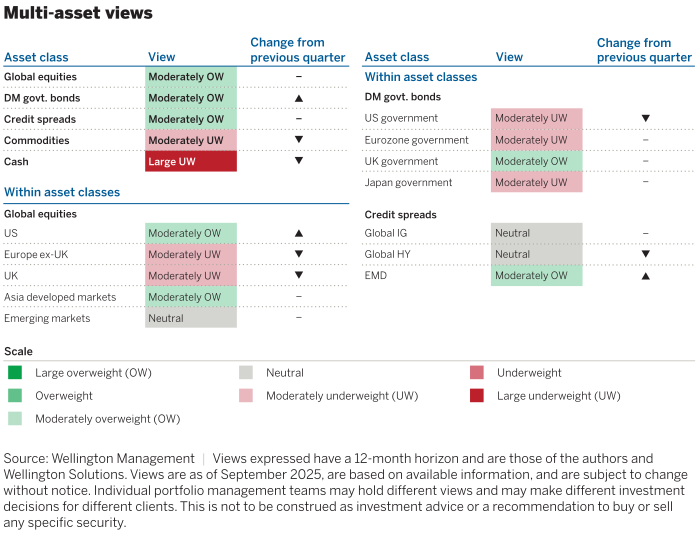
Global equities marched almost 7% higher in the third quarter, as more barriers to market optimism fell by the wayside. Despite open questions about US fiscal health (including a government shutdown as of this writing) and central bank independence, the US dominated the global picture as softer labor market data led the Fed to pivot back to easing after a year’s hiatus and AI spurred eye-popping revenues and earnings. In addition, ample liquidity in the financial system continued to support animal spirits.
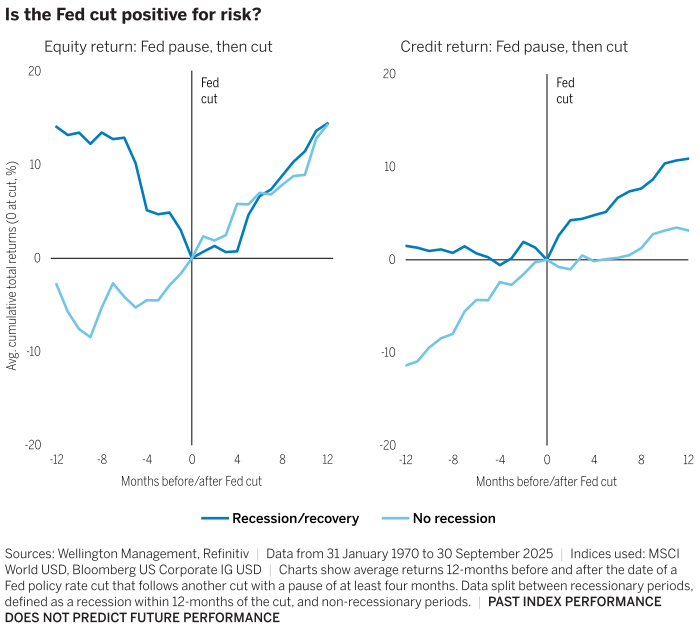
So, will this exuberance end in tears? Maybe, but we think the fundamentals can remain supportive for the next 12 months and we maintain our overweight view on global equities relative to bonds. The key to our optimism is that we continue to see good earnings drive higher returns in the US, particularly among the mega-cap names. In addition, we see historical evidence that even after long pauses in central bank interest-rate cuts, the market has responded well to the resumption of cuts. Figure 1 shows that even in recessions, global equities and US investment-grade bonds delivered positive returns after cuts resumed.
That said, we think allocators should consider diversifying exposure from growth-dominated US equities to more value-oriented non-US equities. We continue to favor Japan, with its improving earnings outlook and shareholder-friendly policies, while we have a moderately underweight view on Europe. Optimism about German fiscal support is understandable, but we are not seeing it come through in broad earnings revisions or market breadth, and France and the UK are facing budget tensions. Within EM, we see a stronger case for taking risk in debt than equities. EM equity outperformance versus DMs has been driven by multiples, not earnings, and China, the largest index weight, has benefited from positive sentiment around AI and retail flows while the economic fundamentals have deteriorated.
In fixed income, we continue to see opportunities to take advantage of regional differences in monetary policy and market pricing. Our highest-conviction view is to be long UK rates. Term premia are compensating for fiscal concerns in our view, and we expect a weaker economy to spur further rate cuts by the Bank of England. This contrasts with Europe and the US, where rate cuts may fall short of market expectations. In credit, we lowered our view on high yield to neutral when spreads approached their all-time tights, and we raised our view on EM debt to moderately overweight. Around half of EM debt is investment grade and spreads are not as compressed. We are monitoring credit closely after pockets of weakness surfaced in consumer finance in the US, particularly among lower-income cohorts, though these appear to be isolated cases rather than signs of broader economic or credit risk.
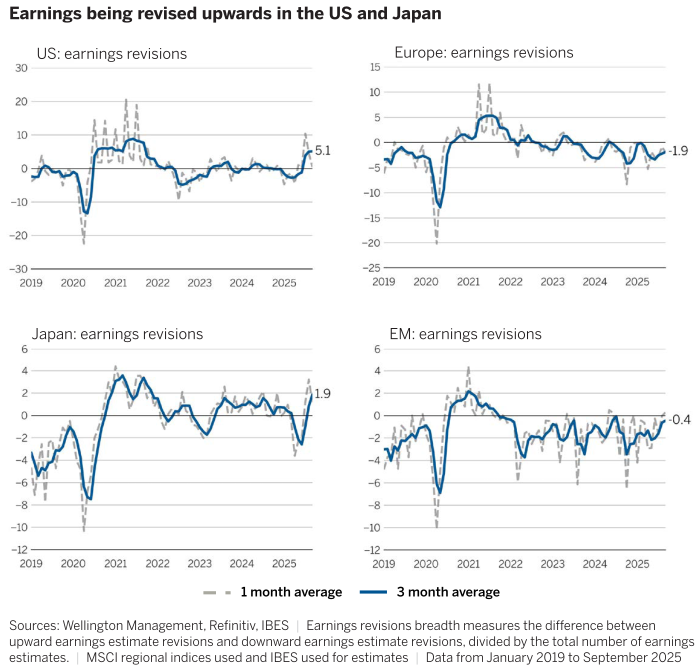
We continue to hold a moderately overweight view on global equities. While the post-April rally has been strong and US equities are expensive, the global earnings picture is solid — though admittedly driven by US mega caps — and the policy backdrop is supportive, as central banks are easing globally, apart from Japan (Figure 2). While questions remain regarding US tariffs (e.g., a Supreme Court ruling on their legality), much of the uncertainty is behind us and companies have mitigated some of the impact by passing on roughly half the cost to consumers or down the supply chain.
We continue to view AI positively, with the massive investments being made providing a near-term boost to the economy and potentially driving even more meaningful long-term productivity gains. Despite the investments required, the largest tech companies have been able to generate strong cash flows and maintain high margins.
Why aren’t we more positive given these drivers? Valuations have risen, particularly in non-US markets with weaker earnings growth, and uncertainty remains high on several policy fronts in the US and elsewhere, including around issues of fiscal sustainability, monetary policy independence, and regulatory and industrial policies.
We have moved our view on the US from moderately underweight to moderately overweight. While gains have been limited to a relatively narrow group of mega caps and large AI names, we see some signs of a broadening EPS recovery as Fed cuts support small caps and value segments. In addition, lower corporate taxes, higher levels of investment, productivity gains, and deregulation seem likely to help some of the laggards. We would see any market broadening as a positive. While the market is richly valued, that is in line with a high return on equity, and earnings are still being delivered. On the earnings side, the US is clearly ahead of other regions, with a sharp recovery in both the number and breadth of revisions across companies.
We maintain our moderately overweight view on Japanese equities. Corporate governance reforms and restructuring continue to provide a tailwind, and buybacks are at record highs (and still rising). That, combined with a relatively high dividend yield, translates to a high cash return to shareholders. This has pulled in foreign investors, who flipped from net sellers to net buyers in the middle of the second quarter. However, positioning is still not stretched. At the macro level, ongoing reflation is a positive for Japanese equities. Despite strong nominal GDP, monetary conditions remain loose even with a potential rate hike later in the year. Valuations have turned less supportive as the market has undergone a re-rating the past few months.
We have lowered our view on Europe ex-UK and the UK from neutral to moderately underweight, mainly because of weak earnings prospects. The lack of earnings growth indicates that recent gains in Europe ex-UK have been valuation-driven, which means the region is no longer cheap or unloved. EPS for 2025 and 2026 have not recovered, and both Europe ex-UK and the UK are lagging on company revisions and breadth. Optimism around German fiscal support is justified and there should be an impact in terms of stock-level winners and losers, particularly among German small/mid-caps, defense, and infrastructure, but we think the broad market impact is likely to be limited. We also see a growing divide between Europe’s periphery, which shows stronger macro fundamentals, and the core, which suffers from challenges in key industries (such as autos) and the impact of a strong euro on exporting industries. For its part, the UK suffers from an absence of tech exposure and from its domestic economic and policy reliance. While earnings showed signs of a recovery over the last few months, they are now weakening again.
We maintain our neutral view on EM, particularly after a powerful rally driven by valuation expansion. Lower US rates, a weaker US dollar, and stronger risk appetites all support EM. However, much of the move has been sentiment-driven, with earnings not improving. Even in China, neither macroeconomic nor earnings fundamentals are improving, although optimism on AI and tech innovation seems partly justified.
Sector-wise, a variety of factors — whether earnings-, technical-, or valuation-driven — are shaping our preferences, rather than any strong overarching theme. We have an overweight view on communications, staples, and utilities, and an underweight view on materials, health care, and industrials. We have a neutral view on technology and financials.
During the third quarter, fiscal concerns weighed on global developed markets and 10-year yields rose. The exception was the US, where labor market weakness replaced inflation as the dominant theme and the Fed pivoted toward rate cuts. We find overall duration a more attractive opportunity relative to cash for two reasons: 1) the combination of real yield and “roll down the curve” return is providing the potential for positive excess returns across developed rates markets, and 2) we think yields are pricing in too much negativity on the fiscal side, especially in the UK.
As we noted last quarter, central banks are generally moving toward rate cuts, but the magnitude, timing, and market expectations vary substantially, and so we see opportunities to take advantage of these regional differences within our long duration view. Our highest-conviction regional view is to be long duration in the UK, which has been the poster child for poor fiscal management since 2022, when Prime Minister Truss signed off on tax cuts combined with big borrowing, and markets revolted. Today, the term premium is higher than during the “Truss moment.” With the UK facing a fiscal shortfall and new rules requiring a balanced budget by 2029 – 2030, all eyes will be on the budget announcement in late November. The consensus is that Chancellor Rachel Reeves will present a combination of tax hikes and spending cuts equivalent to £30 billion or 0.35% of GDP a year, but we think the fiscal hole will be substantially smaller and spread out over several years through 2028.
Against our bullish UK view, we are bearish on the US, Europe, and Japan. We think the market’s gotten ahead of itself on Fed rate cuts in the US when inflation is still sticky and recession risks are low. There’s not much more cutting for the European Central Bank to do, having already delivered 150 bps of rate cuts over the past year, and we see some upside growth potential from German fiscal expansion. We maintain our short duration view on Japan, where monetary policy is accommodative, inflation risks are to the upside, and fiscal policy is likely to loosen following the election.
Tight spreads keep getting tighter, so upside is limited. We are seeing isolated cases of credit stress in consumer finance emanating from weaker income cohorts like subprime and 24 – 30-year-olds struggling with higher unemployment and the resumption of student loan repayments. Still, we see no clear catalyst for broader spread widening, and the overall backdrop appears positive for risk assets, with liability-driven allocators looking for attractive all-in yields in the 4% – 6% range. Given rich valuations, however, we believe the time has come to move up in quality within credit, from high yield to EM sovereign debt.
The macro backdrop for EM is positive — Fed easing, a weaker US dollar, and loose financial conditions. EM debt’s composition is about 50% investment grade and 50% high yield, a more defensive allocation relative to equities than high yield. In addition, US high-yield bonds are callable, giving this market a negatively convex profile relative to the bullet structure of EM debt and investment-grade corporate bonds. Finally, EM debt offers a potential spread pickup relative to both global corporate investment-grade bonds and high yield. In a more stressed US economic environment, EMD spreads would also tend to benefit from their longer duration relative to other spread markets.
We have a moderately underweight view on commodities driven by our view on oil, where we have a small underweight view given the rise in oil prices. With OPEC barrels returning, the demand/supply balance points to a potentially sizable over-supply. We think this makes for an attractive entry point for shorting crude, with the primary risk being the substantial negative carry drag.
We have taken off our long-standing overweight view on gold. While the geopolitical environment and the investor/central bank urge to diversify remain favorable for gold, recent momentum has taken the gold price beyond our targets and the technical set-up looks somewhat fragile after the strong push higher.
Consider maintaining a slight pro-risk stance — While we may be past peak policy uncertainty, there are important questions to be answered in areas like fiscal sustainability and central bank independence. That said, we think the equity backdrop is supportive, including loose central bank policy and strong earnings momentum. AI optimism is not a theme we’re ready to bet against.
Within equities, emphasize earnings growth over valuations — Within global equities, we favor Japan and the US over the UK and Europe ex-UK. We see stronger macro conditions in the US and Japan and think superior earnings/margin prospects will support higher valuations in both markets.
Look for divergent policies to generate regional duration opportunities — We have a small overweight view on duration, but our higher-conviction views are on regional duration opportunities. While fiscal dynamics are worsening in most developed markets, yields in Europe, the US, and Japan price in less risk and smaller inflation premia than the UK. In our view, Fed rate-cut expectations have gone too far.
Consider moving up in quality in spreads — We have lowered our view on global high yield to neutral, given very tight spreads. Instead, we see a case for a small credit overweight in hard-currency EM spreads, which have a lower beta to equities than high yield and may offer some pickup in carry relative to both DM high-yield and investment-grade bonds.
Experts
























Monthly Market Review — September 2026
Continue readingBy