In our view, small-cap equities offer a compelling opportunity set. Broader dispersion, greater inefficiency, and less analyst coverage than large caps all contribute to a richer alpha environment. Yet the allocator's challenge has always been implementation. Many have gravitated toward quantitative approaches as a natural starting point for a small-cap satellite allocation over the last few years. We acknowledge the well-established advantages of quantitative allocations. Quant offers systematic breadth, diversified exposure across hundreds of names, and disciplined portfolio construction with controlled tracking error.
At the same time, allocators who have sought to complement or replace quant with fundamental active management in small caps have often encountered a difficult investment experience. Concentrated, high-conviction fundamental small-cap strategies can deliver significant alpha when thesis conviction plays out, but they can also produce painful drawdowns, elevated tracking risk, and volatile return profiles that make them difficult to hold through a full cycle. For many allocators, the lived experience has been one of large swings in performance rather than the steady compounding they need from a satellite building block.
This creates a genuine tension. Fundamental research can uncover differentiated, idiosyncratic insights in small caps, arguably more so than in large caps where coverage is deeper and information advantages are harder to sustain. But the delivery mechanism matters enormously. The question is not whether fundamental alpha exists in small caps, but whether it can be harvested inside a disciplined enough framework to sit comfortably alongside quant as a complementary allocation.
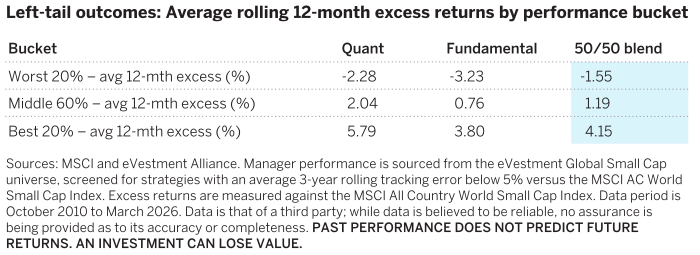
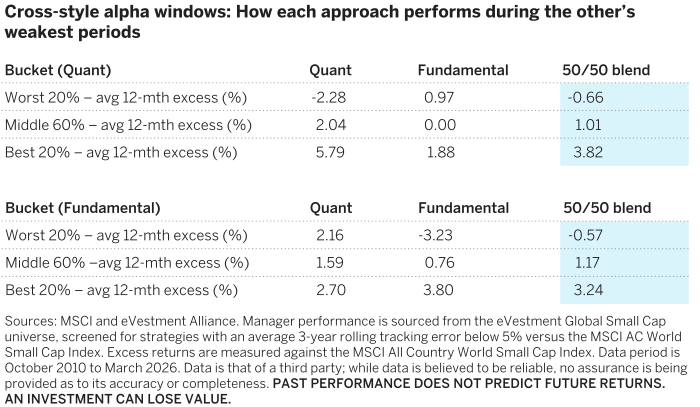
We believe it can. Our research illustrates how blending a disciplined fundamental approach with quantitative strategies within a small-cap satellite allocation can create genuine diversification, not just averaging, and can materially improve the investment experience, particularly in the left tail.
What does "disciplined fundamental" mean in small caps?
Not all fundamental small-cap strategies are created equal. The distinction that matters most for portfolio construction purposes is between high-conviction concentrated approaches and disciplined fundamental strategies that operate within a defined risk budget.
A disciplined fundamental small-cap strategy shares several characteristics with quantitative approaches, including benchmark awareness, controlled tracking error, and broad diversification. However, it generates its alpha from a fundamentally different source: bottom-up, stock-specific research and conviction rather than systematic signal harvesting. The defining features include:
- Broad diversification — which reduces single-stock risk and the volatility associated with concentrated portfolios.
- Controlled tracking error — typically in the range of 2% to 6% p.a., keeping the strategy within a range that allocators can model and hold through the cycle.
- Idiosyncratic risk as the primary alpha driver — where stock selection, not factor tilts or style bets, is the intentional source of active risk.
- Benchmark aware portfolio construction — with sector and regional weights managed to stay close to the benchmark, minimizing unintended macro or factor exposures.
The advantage this brings is not more active risk. It is different active risk: explainable, bottom-up decisions grounded in deep industry expertise that can behave differently from systematic alpha when that style is under stress.
The case for blending: Evidence from global small caps
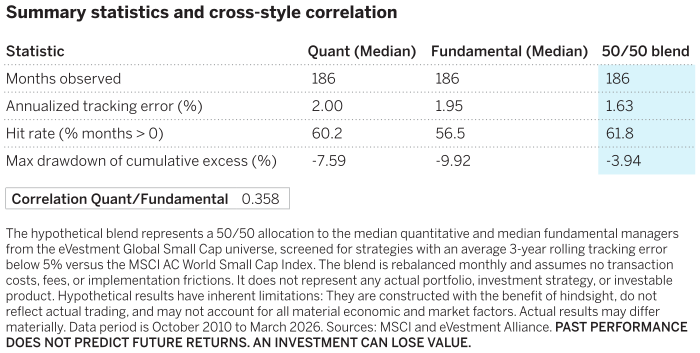
Figure 1 illustrates what happens when you combine both quant and fundamental into a single allocation with 50% invested in each.
Cross-style correlation: 0.358
The blend's tracking error of 1.63% is lower than either stand-alone approach (quant at 2.00%, fundamental at 1.95%), a direct result of the low 0.358 correlation between the two excess return streams. This is genuine diversification, not dilution. The hit rate improves to 61.8%, and critically, the maximum drawdown of cumulative excess returns falls to just -3.94%, which is less than half of fundamental's -9.92% and meaningfully better than quant's -7.59%.