Macro overview
Our central case remains trend US growth, supported by AI-related investment, household wealth, and steady aggregate income growth. The expansion is uneven, however, with housing, autos, and other rate-sensitive sectors under pressure. Wealth is supporting consumption but also creates vulnerability: An equity market drawdown could weaken spending and credit conditions at the same time. On balance, we think growth remains strong enough to support credit over the near term.
Inflation remains the key uncertainty: Will energy and other supply pressures spread to wages, broader prices, and expectations? Wage growth warrants attention, particularly if it outpaces productivity and raises unit labor costs, signaling more persistent inflation. If energy prices stabilize, base effects could help ease inflation in early 2027, although further energy increases, tariffs, or El Niño-related food pressures could delay improvement.
Against this backdrop, we expect a shallow Federal Reserve (Fed) tightening cycle, potentially less than markets are pricing, rather than a full demand-driven hiking cycle. The precise number of hikes is uncertain, and broader wage and inflation pressures could challenge this view and expose front-end and intermediate maturities to further repricing. We see a path to lower yields over the next six to 12 months, but expect a smaller, more volatile rally than we did last quarter. Catalysts could include easing energy pressures, contained inflation spillovers, or weaker growth. At the same time, fiscal deficits, US Treasury supply, and competition for global savings could keep long-end yields elevated.
Outside the US, European growth remains steady but vulnerable to higher energy and borrowing costs. The European Central Bank could deliver one to two further hikes — potentially fewer than markets expect if wages and inflation expectations remain contained. The UK faces a more difficult trade-off between inflation and growth, and we view one hike followed by a pause as a reasonable base case. Fiscal credibility remains an important driver of long-dated sovereign bonds, particularly gilts and French government debt.
Beyond the near-term cycle, AI continues to reshape growth, credit supply, and issuer risk. AI-related investment supports growth today, but broad productivity gains and investment returns remain uncertain. We think financing needs are creating opportunities across corporates, infrastructure, private credit, and securitized markets, while increasing supply and concentration risk. For insurers, we believe this argues for assessing aggregate exposure across hyperscalers, data centers, power, and related businesses, as well as disruption risk in software and other holdings.
For insurers with ongoing cash flows and long-term liabilities, elevated yields may create attractive reinvestment opportunities. However, tight spreads may leave less room for compression to drive returns, and attractive absolute yields do not necessarily imply attractive credit valuations. We therefore think portfolios should emphasize durable income while carefully managing the market-value, capital, and liquidity consequences of further rate increases.
Fixed income overview
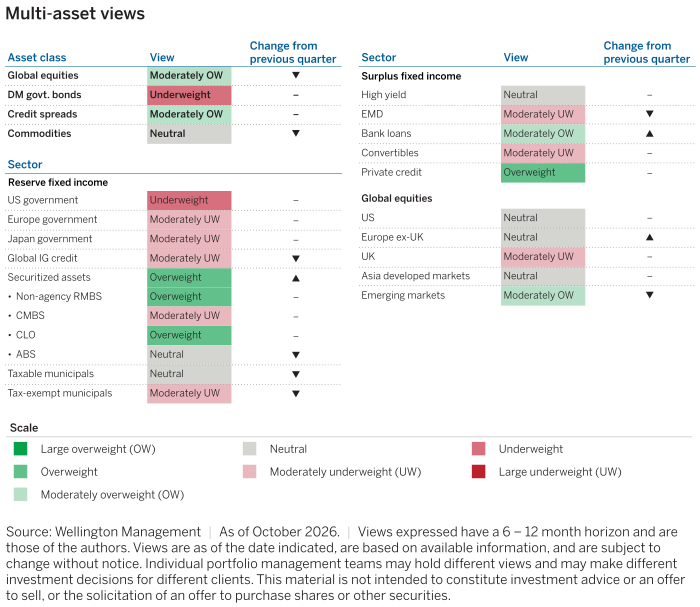
We believe insurers should consider maintaining a moderate risk posture and a modest duration overweight. Resilient but uneven growth may support credit in the near term, particularly higher-quality securitized assets. We expect returns to be driven primarily by income, structural protections, and security selection rather than further spread tightening.
While income remains attractive in our view, compensation for risk varies across sectors, industries, and the quality spectrum. We think this argues for selectivity rather than simply owning broad market risk. We also believe public and private opportunities should be assessed using a common underwriting discipline that considers compensation, protections, liquidity, and client objectives. A rating or sector label should not be viewed as a substitute for rigorous underwriting.
A few sector-specific thoughts to share:
- Corporates — We favor short and intermediate investment-grade credit over long credit, where heavy supply and spread duration exposure limit the appeal. We continue to prefer financials and utilities and maintain an underweight view on industrials, particularly at the long end. Issuer and quality dispersion can reveal opportunities obscured by broad index valuations. We think selectivity is warranted in AI-related issuance, with a distinction between tactical relative-value opportunities and assets suitable for long-term ownership.
- Securitized credit — We maintain a constructive view on CLOs, with a preference for AAA over AA tranches given limited incremental compensation, while recognizing that floating-rate coupons do not eliminate spread or liquidity risk. We remain constructive on non-agency RMBS carry, emphasizing collateral, coupon, vintage, and extension sensitivity. We think recent underperformance has improved relative value in agency MBS, where we favor selective additions based on coupon and structure. We have moved to a neutral view on ABS as relative value has compressed and continue to favor select prime collateral. We remain cautious on CMBS given valuations and refinancing gaps.
- Taxable municipals — We continue to favor a selective approach to intermediate taxable municipals. Long taxable municipals appear less attractive given rich valuations, except where liability needs justify ownership.
- Investment-grade private credit — We favor club deals, shorter tenors, infrastructure finance, and structured transactions where sourcing and protections potentially provide a demonstrable advantage. We continue to think the focus should be on adequate compensation for illiquidity and disciplined management of construction, permitting, and refinancing exposure, particularly in data center and asset-based financing.
- High yield and bank loans — Bank loans represent the clearest positive change in our sector preferences this year. We think attractive carry, improving technicals, and progress addressing near-term maturities support a larger allocation where guidelines permit. We advocate discipline around software disruption, debt-service capacity, and refinancing quality. In high yield, we prefer issuer-specific exposure rather than broadly increasing risk, as attractive yields coexist with tight spreads.
- Global credit — We favor reducing broad emerging markets investment-grade and high-yield exposure on valuation grounds, as supportive fundamentals do not fully offset limited compensation for volatility and event risk. In euro credit, we remain cautious on technicals as sovereign alternatives and new issue supply compete for demand. We are neutral on short euro credit and less constructive on intermediate maturities.
We believe portfolio construction requires added discipline in this environment. Duration has become a less reliable hedge for credit risk, while mortgage extension and floating-rate allocations can alter curve exposure in ways that insurance portfolios typically cannot hedge. Given the limited use of derivatives in many insurance mandates, we think the management of curve exposure should focus on sector and security selection.
We remain mindful of downside risks. Broadening inflation pressures could push the Fed to tighten more than expected, while an equity market drawdown could weigh on consumption and credit simultaneously. We are monitoring energy and food prices, wage growth, unit labor costs, and inflation expectations; AI monetization, capital spending, and financing supply; Treasury issuance and foreign demand; and conditions in mortgages, commercial property, and leveraged credit.
Overall, we believe insurance portfolios should remain focused on dependable income through select securitized sectors, short and intermediate investment-grade credit, and, where eligible, a larger allocation to bank loans. A modest duration overweight and a continued emphasis on quality and liquidity may help provide resilience across a range of outcomes, while preserving the flexibility to add risk should valuations become more compelling.