Over the past several years at Wellington, we have partnered with asset-owner clients to help them implement their decarbonization goals in actively managed equity and corporate credit strategies. For most clients, the primary challenge when implementing these goals is balancing their decarbonization ambitions with their financial return objectives. To meet this challenge, defining robust guidelines is, in our view, essential to setting mandates up for success — both in achieving investors’ climate transition goals and in meeting their financial objectives.
For those clients who have requested implementation of a decarbonization glidepath in the portfolios we manage on their behalf, we collaborate with them to strike the right balance for their organization, and to formulate tailored guidelines using sensible metrics and high-integrity implementation. Here, we share some of the notable lessons learned.
Key points
For asset owners seeking to implement decarbonization goals successfully within their investment strategies, we recommend a tailored, five-step approach:
- Tailor the decarbonization target to the investment mandate
- Lean into what active managers do best: fundamental research and engagement
- Use forward-looking and nuanced metrics
- Assess the scope(s) of the ask
- raft clear guidelines with minimal room for mis(interpretation)
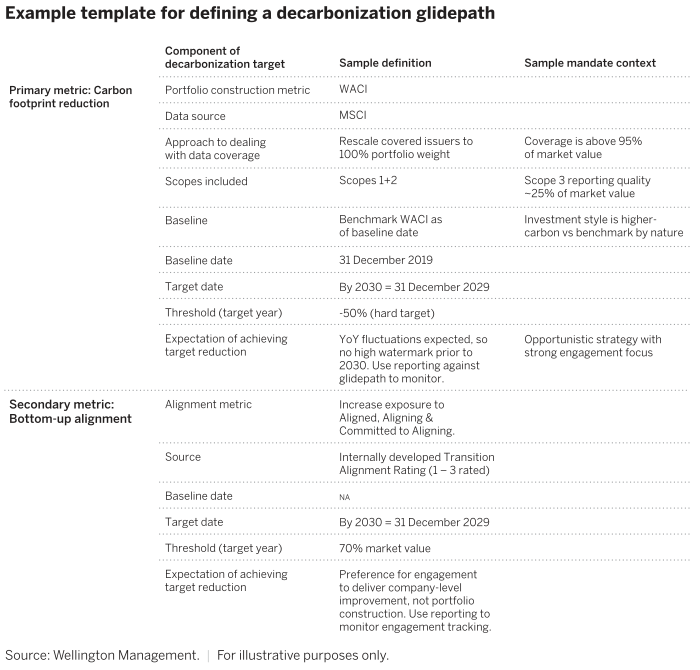
To help asset owners implement these key lessons learned, we provide a sample template at the end of the paper which sets out the details we find most useful for defining a decarbonization glidepath.
1. Tailor the decarbonization target to the investment mandate
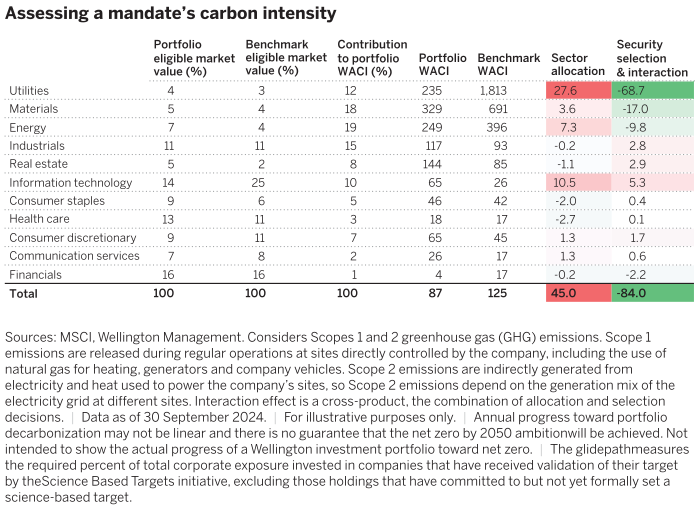
While it may seem obvious, different investment universes and styles have different starting points in terms of transition metrics. With this in mind, we start by assessing the data coverage of the opportunity set, which is highest across equities and corporate credit. We then look at benchmark-relative or absolute contribution to understand the carbon intensity of the mandate. We have selected weighted average carbon intensity (WACI) as the portfolio metric our investment teams will monitor and target for the interim 2030 decarbonization goal. We find WACI less sensitive than other portfolio metrics — such as financed emissions — to changes in market movements and capital structures.. For benchmark-relative mandates, we use two-factor attribution to assess how much of a portfolio’s carbon footprint comes from sector allocation and how much comes from security selection. The example in Figure 1 compares a global, value-orientated equity portfolio with its global, core benchmark: